
In March 1989, while working at CERN, Tim Berners-Lee proposed a way to connect information held across the organisation’s computer systems. The World Wide Web grew from that proposal: a system of linked documents built to run over the Internet. Berners-Lee designed and built its first browser and server, then helped establish shared standards intended to let the web develop beyond any one institution. His work began in a British education and engineering career; its consequences have reached far beyond Britain.
A British education and an early career in computing
Timothy John Berners-Lee was born in London on 8 June 1955. His parents, Mary Lee Berners-Lee and Conway Berners-Lee, were mathematicians and computer scientists who had both worked on the Ferranti Mark 1, the first commercially built computer. He attended Sheen Mount Primary School and Emanuel School. As a child, he learnt about electronics by tinkering with a model railway, an early practical interest that accompanied his later academic study.
At The Queen’s College, Oxford, Berners-Lee studied physics and graduated with a first in 1976. While there, he made a computer from an old television set bought from a repair shop. After university he worked as an engineer at Plessey in Poole. In 1978, he joined D. G. Nash in Ferndown, where he helped create typesetting software for printers. These jobs gave him experience in communications and computing before his career turned towards the challenge of linking information.
From CERN project to the first web
Berners-Lee first worked as an independent contractor at CERN, the European Organization for Nuclear Research, from June to December 1980. There he proposed a hypertext project to help researchers share and update information, and built a prototype called ENQUIRE. After leaving CERN, he worked at John Poole’s Image Computer Systems in Bournemouth for three years, running its technical side and working on a real-time remote procedure call. This gave him further experience in computer networking.
He returned to CERN as a fellow in 1984. In March 1989, he wrote “Information Management: A Proposal”, setting out how hypertext could be joined to the Internet. His manager, Mike Sendall, described the proposal as “vague, but exciting”. Berners-Lee redistributed it in 1990, and Robert Cailliau joined the effort to develop the idea. The web was not another name for the Internet: it was a system for connecting information through links, using the network as its infrastructure.
Berners-Lee designed and built the first web browser, which also functioned as an editor, and the first web server. The first website, which described the project and explained how to use the web, was published on 20 December 1990 and made available from CERN’s network. On 6 August 1991, he invited the wider online community to collaborate on the WorldWideWeb project. The invitation helped take the web beyond its beginnings as a tool for researchers.
Building shared standards and widening access
In 1994, Berners-Lee founded the World Wide Web Consortium (W3C) at the Massachusetts Institute of Technology. The consortium brought organisations together to develop standards and recommendations for the web. Berners-Lee made the web’s underlying technology available without a patent or royalties. The consortium’s standards were to be based on royalty-free technology, so that anyone could adopt them. That approach helped the web grow as a shared system rather than a product controlled by a single owner.
His subsequent work has addressed access, data and the rules that shape online life. In 2009, he launched the World Wide Web Foundation. In 2010, he and Nigel Shadbolt created data.gov.uk, associated with making government data more openly available. Berners-Lee has advocated net neutrality and taken part in efforts to broaden affordable internet access. In 2012, he and Shadbolt co-founded the Open Data Institute, which Berners-Lee became president of. These projects reflect an interest not only in how information is connected, but also in who can use it and on what terms.
In 2018, he announced Inrupt, an open-source start-up intended to support a commercial ecosystem around Solid. The project aims to give people greater control over their personal data, including where it goes and which applications may access it. In 2019, Berners-Lee and the Web Foundation launched the Contract for the Web, a campaign inviting governments, companies and citizens to commit to principles intended to prevent the web’s misuse. These initiatives show his continued engagement with the consequences of the system he helped create, including questions of privacy, access and public responsibility.
Recognition and continuing work
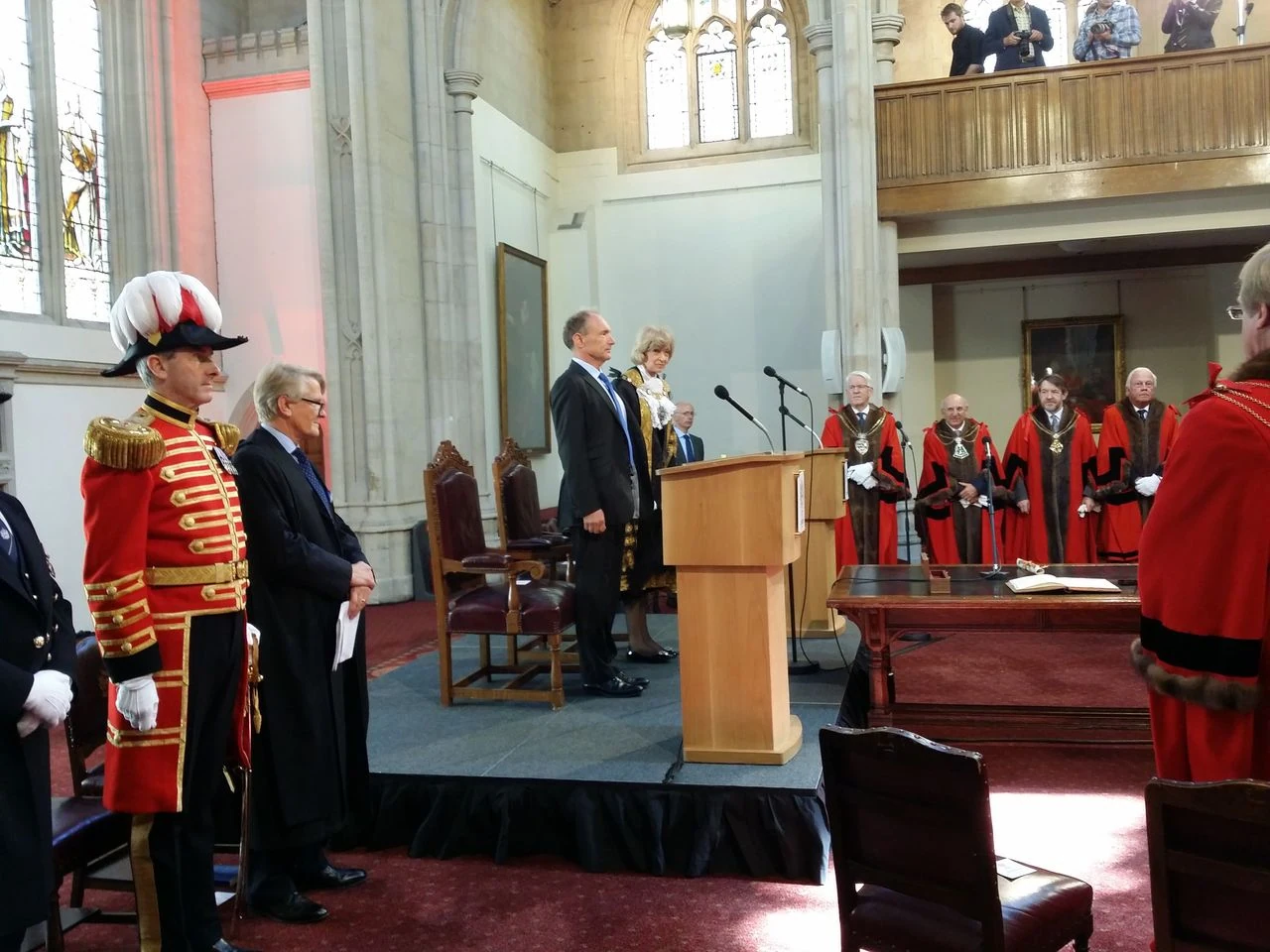
Berners-Lee was knighted by Queen Elizabeth II in the 2004 New Year Honours for services to the global development of the Internet; he was formally invested on 16 July that year. He was elected a Fellow of the Royal Society in 2001 and appointed to the Order of Merit in 2007. The Order is restricted to 24 living members, and appointments are made by the Sovereign. In 2013, he received the inaugural Queen Elizabeth Prize for Engineering. In 2017, he received the 2016 Turing Award for the invention of the web, the first browser and the protocols and algorithms that allowed it to scale.
His academic work has also kept him connected to British institutions. In 2004, he accepted a chair in computer science at the University of Southampton to work on the Semantic Web. In 2016, he joined the University of Oxford as a professorial research fellow and became a fellow of Christ Church. He has also held senior academic roles at the Massachusetts Institute of Technology. Across research, standards work and public initiatives, his career has continued beyond the original invention and into debates about the web’s future.
Why Sir Tim Berners-Lee deserves a place in British Legacy
Berners-Lee’s place in British Legacy rests on a concrete achievement: a computer scientist educated at Oxford and shaped by early engineering and computing work in Poole and Dorset devised and built the foundations of the World Wide Web while working at CERN. His British background is part of the story, not its whole significance. The web gave people and organisations a common way to publish, find and connect information across computer networks. Berners-Lee’s browser, server and proposal helped turn that possibility into a working system; the first website explained how others could use it, and his 1991 invitation opened the project to wider collaboration.
His legacy also includes decisions about how that system should be shared. By making the web’s technology available without patent or royalties, and by founding the W3C to develop common standards, Berners-Lee helped create conditions for broad adoption and interoperability. His later work on open government data, affordable access, the Open Data Institute, Solid and the Contract for the Web has kept attention on who benefits from digital systems and who controls information. These efforts do not resolve every problem associated with the web, but they demonstrate sustained work on access, privacy and public responsibility. For British Legacy, Berners-Lee merits recognition both for an invention whose benefits cross national boundaries and for his continuing attempts to make its infrastructure more open and useful to people beyond its original designers.
Sources
Tim Berners-Lee — Wikipedia revision 1378626549
Adapted in part from Tim Berners-Lee by Wikipedia contributors, under CC BY-SA 4.0. Text has been edited and combined with the existing article; this adapted text is shared under the same licence. Contributor history.
.jpg)