
When “It’s Not Unusual” reached No. 1 in the UK in 1965, Tom Jones became one of the defining voices of the British pop breakthrough of that decade. The singer born Thomas John Woodward in Treforest, south Wales, would move between pop, soul, country and gospel, return to the charts more than once and build a career that crossed music, television and live performance. His knighthood recognised services to music; the breadth of his work explains why he remains a distinct figure in British entertainment.
From Treforest to the first hit
Jones was born on 7 June 1940, the son of Freda Jones and coal miner Thomas Woodward. He attended Wood Road Infants School, Wood Road Junior School and Pontypridd Central Secondary Modern School. Singing began early: he performed at family gatherings and weddings and in his school choir. At 12, he was diagnosed with tuberculosis and spent two years recovering in bed, a period he later described as the worst of his life.
In 1963 he became frontman of Tommy Scott and the Senators, a Welsh beat group that built a local following. The group recorded tracks with producer Joe Meek, but those sessions did not bring a record deal. Manager Gordon Mills later took Jones to London and renamed him Tom Jones, drawing on the popularity of the film Tom Jones. Decca released his first single, “Chills and Fever”, in 1964; it did not chart. The follow-up, “It’s Not Unusual”, became an international hit after Radio Caroline promoted it. It reached No. 1 in the UK and the US top ten in 1965.
That year also brought recordings of film themes, including the title song for What’s New Pussycat? and the theme for the James Bond film Thunderball. Jones was initially unconvinced by “What’s New Pussycat?”, but producer Burt Bacharach persuaded him to sing it. He received the Grammy Award for Best New Artist in 1966. Further British hits included “I’m Coming Home”, “I’ll Never Fall in Love Again” and “Delilah”, each reaching No. 2 in the UK chart.
Between the charts and the stage
As his early popularity eased, Mills reshaped Jones’s image towards that of a crooner, while the singer widened his repertoire. His work drew on pop, R&B, soul, country and gospel, among other styles. In 1967 he performed in Las Vegas for the first time, at the Flamingo. The city became a recurring base for his live work: he played there at least one week each year until 2011. The open shirts and close-fitting trousers of his stage wardrobe became part of the act, as did a forceful voice able to shift between ballads and more rhythmic material.
Television gave Jones another way to reach audiences. This Is Tom Jones, produced by Associated Television, ran from 1969 to 1971 and was broadcast in the UK on ITV and in the United States on ABC. It brought him a Golden Globe nomination in 1970. A second variety show, Tom Jones, was made in Vancouver and ran from 1980 to 1981. He also acted, making his television-film debut in Pleasure Cove in 1979 and later appearing in Mars Attacks! and other productions.
His commercial fortunes shifted over time. “She’s a Lady” was among his 1970s hits, while “Say You’ll Stay Until Tomorrow” reached No. 1 on the US country chart in 1976. He began recording country music in the early 1980s, scoring nine US country top-40 songs between 1980 and 1986. In 1987, “A Boy from Nowhere” reached No. 2 in the UK. A year later, his cover of Prince’s “Kiss”, recorded with Art of Noise, reached No. 5 in the UK; its video won the MTV Video Music Award for Breakthrough Video.
Reinvention and renewed popularity
Jones’s later career was marked by collaborations and changes of musical direction rather than an attempt to reproduce his first successes. The 1999 album Reload paired him with artists including the Cardigans, Natalie Imbruglia, Cerys Matthews, Van Morrison, Portishead, Stereophonics and Robbie Williams. It topped the UK album chart, and “Sex Bomb” became its biggest single, reaching No. 3 in 2000. In 2002 he worked with producer Wyclef Jean on Mr. Jones; in 2004 he recorded a roots rock ’n’ roll album with pianist Jools Holland.
In 2009 Jones reached No. 1 again with “(Barry) Islands in the Stream”, a Comic Relief charity recording with Ruth Jones, Rob Brydon and Robin Gibb. The song drew on the BBC sitcom Gavin & Stacey. It was his first UK chart-topper since “Green, Green Grass of Home” in 1967. He continued to explore older musical traditions on Praise & Blame (2010), Spirit in the Room (2012) and Long Lost Suitcase (2015), albums that included gospel, blues and roots material.
Television introduced Jones to another generation of viewers when he became a coach on BBC talent show The Voice UK in 2012. He returned for several series, including from 2017, and mentored winners in 2012, 2018 and 2022. His continued recording and touring sat alongside this television role: Surrounded by Time, another album of covers produced by Ethan Johns, was released in 2021. His career has also included film and television appearances, a performance at the Queen’s Diamond Jubilee Concert in 2012 and a return to perform in Pontypridd in 2005.
Honours and the work behind the name
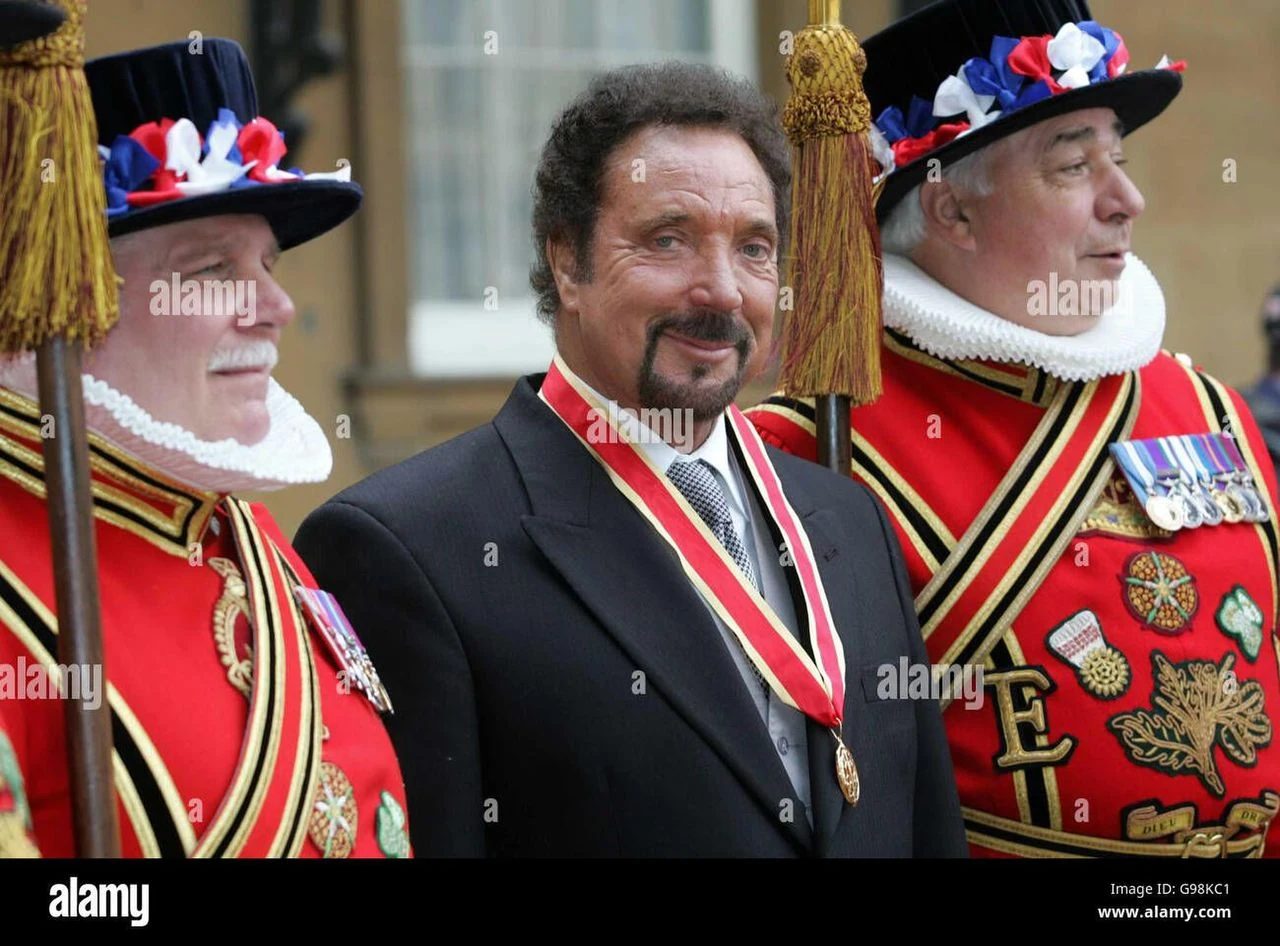
Jones was appointed an Officer of the Order of the British Empire in 1999. Queen Elizabeth II knighted him in 2006 for services to music. His other honours include the Grammy for Best New Artist, a Brit Award for Best British Male in 2000 and the Brit Award for Outstanding Contribution to Music in 2003. These awards mark different aspects of a career that has reached audiences through records, television and live performance, in Britain and abroad.
His public story is not simply a sequence of chart positions. Jones began as the singer in a local Welsh group; a manager’s intervention and a record deal took him from South Wales to national and international audiences. When his early chart success faded, he adjusted his image and repertoire, then found fresh audiences through country recordings, collaborations and later television. His career shows how a popular singer can sustain a public presence by changing direction without losing the recognisable quality of his voice.
Why Sir Tom Jones deserves a place in British Legacy
Tom Jones belongs in British Legacy not because his story needs to stand for every aspect of British music, but because his career offers a particularly clear account of how a Welsh performer became part of the UK’s popular culture and an internationally known artist. “It’s Not Unusual” and “Delilah” established him in the British charts; his performances of songs from films such as Thunderball and What’s New Pussycat? linked his voice to entertainment well beyond the singles market. Later, the chart success of Reload and “Sex Bomb” showed that he could reach new listeners without relying solely on the repertoire that first made his name.
His British legacy is also visible in the routes through which audiences encountered him. His ITV variety show made him a regular presence on television, while his work on The Voice UK brought him back to viewers decades after his first hits. He returned to perform in Pontypridd, the area around his birthplace, and received a knighthood for services to music. The combination of Welsh beginnings, British chart and television history, and a long international performing career makes his place here specific: Jones’s story connects local beginnings to changing forms of popular entertainment, and shows the value of longevity built through reinvention.
Sources
Tom Jones (singer), revision 1376441370
Adapted in part from Tom Jones (singer) by Wikipedia contributors, under CC BY-SA 4.0. Text has been edited and combined with the existing article; this adapted text is shared under the same licence. Contributor history.

.jpg)