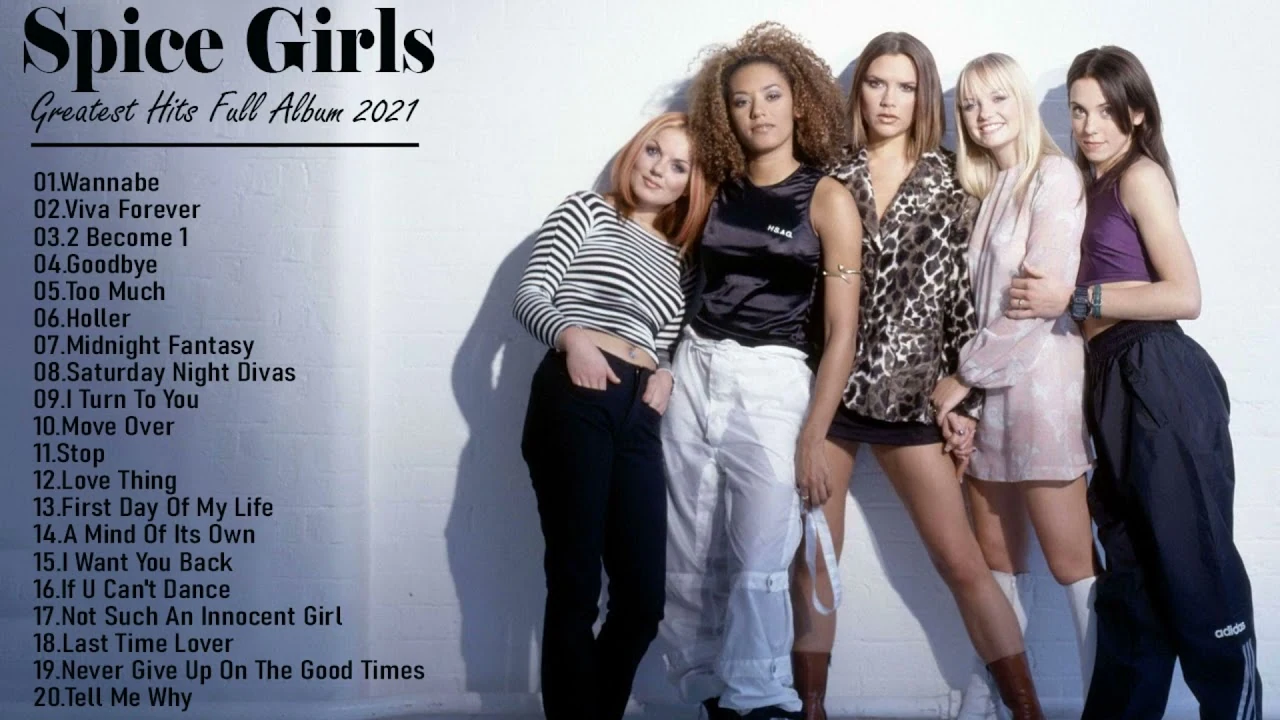
When the Spice Girls released “Wannabe” in July 1996, its chorus turned friendship into a pop hook and introduced five sharply differentiated performers to a worldwide audience. The single reached number one in 37 countries. In Britain, the group’s success arrived amid a music culture often associated with male guitar bands; abroad, their bold, recognisably British image became part of the decade’s pop landscape. The slogan “Girl Power” was not theirs to invent, but they carried it into the mainstream on an exceptional scale.
Five members, one group
The Spice Girls formed in London in 1994 after an advertisement in the music paper The Stage invited women to audition for an all-female singing and dancing group. About 400 attended. The original line-up selected by Heart Management included Victoria Adams, Melanie Brown, Geri Halliwell, Melanie Chisholm and Michelle Stephenson. Emma Bunton joined after Stephenson left the group during its early training. The five rehearsed in a house in Maidenhead and worked on singing, dancing and songwriting before settling on the name Spice Girls; they had first been called Touch, then Spice.
Their beginnings were not simply a story of a group assembled and handed finished songs. The members grew dissatisfied with Heart Management’s direction, and in 1995 they left the company rather than sign the contracts offered to them. They sought out collaborators and continued writing and recording. After a showcase attracted interest, they signed with Virgin Records in July 1995. The group’s first song-writing sessions with Richard Stannard and Matt Rowe produced “Wannabe” and “2 Become 1”; Eliot Kennedy and the production team Absolute also worked with them on material for their debut album.
In the early publicity surrounding the group, a British magazine assigned each woman a nickname based on her appearance or manner: Scary Spice, Sporty Spice, Baby Spice, Ginger Spice and Posh Spice. What began as a magazine conceit became a durable part of their identity. The members’ distinct clothing and stage personas offered fans different points of recognition, while their shared group name and vocal arrangements presented them as a collective rather than a solo singer with backing performers.
‘Wannabe’ and the breakthrough
Released in Britain on 8 July 1996, “Wannabe” climbed to number one and remained there for seven weeks. It became a number-one hit in 37 countries, including the United States, where it spent four weeks at the top of the Billboard Hot 100. The song’s demand for friendship alongside romance gave its central exchange a different emphasis from a conventional love-song pledge. Its video and the group’s lively, individualised performance helped establish the five members as personalities as well as singers.
Their debut album, Spice, followed in November 1996. It sold more than 23 million copies worldwide and became the best-selling album by an all-female group. Its singles included “Say You’ll Be There”, “2 Become 1” and the double A-side “Mama”/“Who Do You Think You Are”. “2 Become 1” became a Christmas number one in Britain; “Mama”/“Who Do You Think You Are” later gave the group a fourth consecutive UK number-one single. The songs ranged from dance-pop to ballads, but their public appeal was tied to the way the members shared the spotlight.
The group co-wrote their songs and divided vocal parts among all five members rather than appointing a permanent lead singer. They also maintained equal shares of their portion of songwriting royalties, regardless of how much any one member had contributed to a particular song. The arrangement made parity part of the group’s working practice as well as its public presentation. Their collaborators describe sessions in which the members brought forward phrases and ideas quickly; the finished music joined those contributions to the work of experienced writers and producers.
Spiceworld: records, spectacle and a famous dress
Their second album, Spiceworld, arrived in November 1997 and sold about 14 million copies worldwide. Its singles “Spice Up Your Life”, “Too Much” and “Viva Forever” all reached number one in Britain. The pace of the group’s success was matched by a schedule of recording, filming and promotion. They were making their first feature film, Spice World, while writing and recording the album; the overlapping work left them exhausted. The film was a commercial success but received poor reviews, and has since become a cult favourite.
At the 1997 Brit Awards, the group performed “Who Do You Think You Are” and won Best British Single for “Wannabe” and Best British Video for “Say You’ll Be There”. Halliwell wore a Union Jack mini-dress that became one of the best-known images associated with the band and with 1990s British pop. Their public identity travelled through more than records: distinctive outfits, nicknames and a highly visible campaign of sponsorships and merchandise made the Spice Girls a major commercial brand. The scale of that marketing drew criticism for overexposure, even as it helped make their names familiar far beyond music audiences.
The group’s cultural position intersected with what the press called “Cool Britannia”, a period when British music and popular culture drew renewed international attention. The Spice Girls did not create that broader moment, but they became one of its most visible musical exports. Their success in the United States was described as part of a new British Invasion, while the Union Jack dress supplied a readily recognisable emblem. Their audience was notably young and female: unlike earlier girl groups commonly marketed towards male record buyers, the Spice Girls spoke directly to girls and women.
Girl Power and what the slogan meant
“Girl Power” had appeared before the group adopted it. The phrase was associated with the American punk band Bikini Kill and had also featured in the work of British pop duo Shampoo. The Spice Girls brought it to an audience of a very different size, using it to express confidence, individuality and solidarity between women. Halliwell was particularly associated with the slogan, though all five members used it. The group’s approach was boisterous and upbeat, and its message could sit comfortably alongside mainstream pop and the members’ distinctive public characters.
The slogan attracted mixed responses. Some commentators saw it as an accessible route into feminist ideas for young fans; others argued that it had been turned into a marketing device. That tension is part of the story rather than a reason to treat the message as either a complete political programme or empty branding. The songs gave friendship and female independence a prominent place in commercial pop. “Wannabe” made the group’s friendship central to a romantic proposition, while the single version of “2 Become 1” changed a lyric from the album version, broadening its reference to love. Their lyrics and image gave young listeners a visible alternative to a pop landscape in which women were often positioned as passive subjects of romance.
Their influence was not confined to their own records. The success of the group helped revive mainstream pop and contributed to the late-1990s boom in girl groups. British acts including All Saints, B*Witched, Atomic Kitten, Girls Aloud and the Sugababes emerged in a market transformed by the commercial possibility of a female group with a young female fanbase. Later singers and groups have also cited the Spice Girls as an influence. The extent and character of that influence varied, but their combination of pop songs, self-definition and a deliberately accessible collective identity proved widely recognisable.
Departure, hiatus and reunions
In May 1998, Halliwell announced that she was leaving the group, citing creative differences and later describing exhaustion and disillusionment. The news became a major international entertainment story. The other four continued the Spiceworld Tour, which drew an estimated 2.1 million people across 97 shows. Their 1998 single “Goodbye”, widely understood as a farewell to Halliwell, became their third consecutive British Christmas number one, matching a record previously set by the Beatles.
The four remaining members released Forever in 2000, a more R&B-influenced album whose lead single, “Holler”/“Let Love Lead the Way”, became their ninth UK number one. The group then entered an indefinite hiatus as its members concentrated on solo work. They reunited as five for the Return of the Spice Girls Tour in 2007–08, and all appeared at the 2012 London Olympics closing ceremony. In 2019, Brown, Bunton, Chisholm and Halliwell toured Britain and Ireland without Beckham; the tour included three sold-out Wembley Stadium shows.
The reunions have made the group’s catalogue available to new audiences while confirming the continuing strength of its original appeal. Later releases and anniversary editions have also returned their early albums and singles to public attention. Yet the Spice Girls’ story is not only one of repeated comebacks: the initial run, from “Wannabe” through the group’s 2000 hiatus, produced a substantial body of successful work and an unusually durable cultural shorthand.
Why the Spice Girls deserve a place in British Legacy
The Spice Girls deserve a place in British Legacy because their success joined British pop songwriting to a distinctive idea of who the audience could be. Their first album sold more than 23 million copies worldwide, “Wannabe” topped charts in 37 countries, and their later singles and tours sustained a scale of achievement rarely matched by a British girl group. They reached that audience as five recognisable individuals who shared vocals and songwriting credit, rather than as a single star supported by anonymous backing singers. That collective arrangement mattered: it gave the group’s emphasis on friendship and solidarity a practical counterpart in how the members presented their work.
Their British legacy also lies in the way they changed the visibility and commercial prospects of female pop. By addressing young women directly, they helped challenge assumptions about whom a girl group could appeal to and helped open space for the wave of British female groups that followed. Their “Girl Power” message was simplified and marketed, and it attracted criticism; nevertheless, its language of confidence and female friendship became part of mainstream culture. The Union Jack dress, the five nicknames and the group’s global success linked their image to a particular moment in British popular culture without making their significance merely nostalgic. Their records, their model of a self-defined female ensemble and the debate around their slogan remain concrete reasons to remember them.
Sources
Spice Girls — Wikipedia, revision 1374200205
Adapted in part from Spice Girls by Wikipedia contributors, under CC BY-SA 4.0. Text has been edited and combined with the existing article; this adapted text is shared under the same licence. Contributor history.