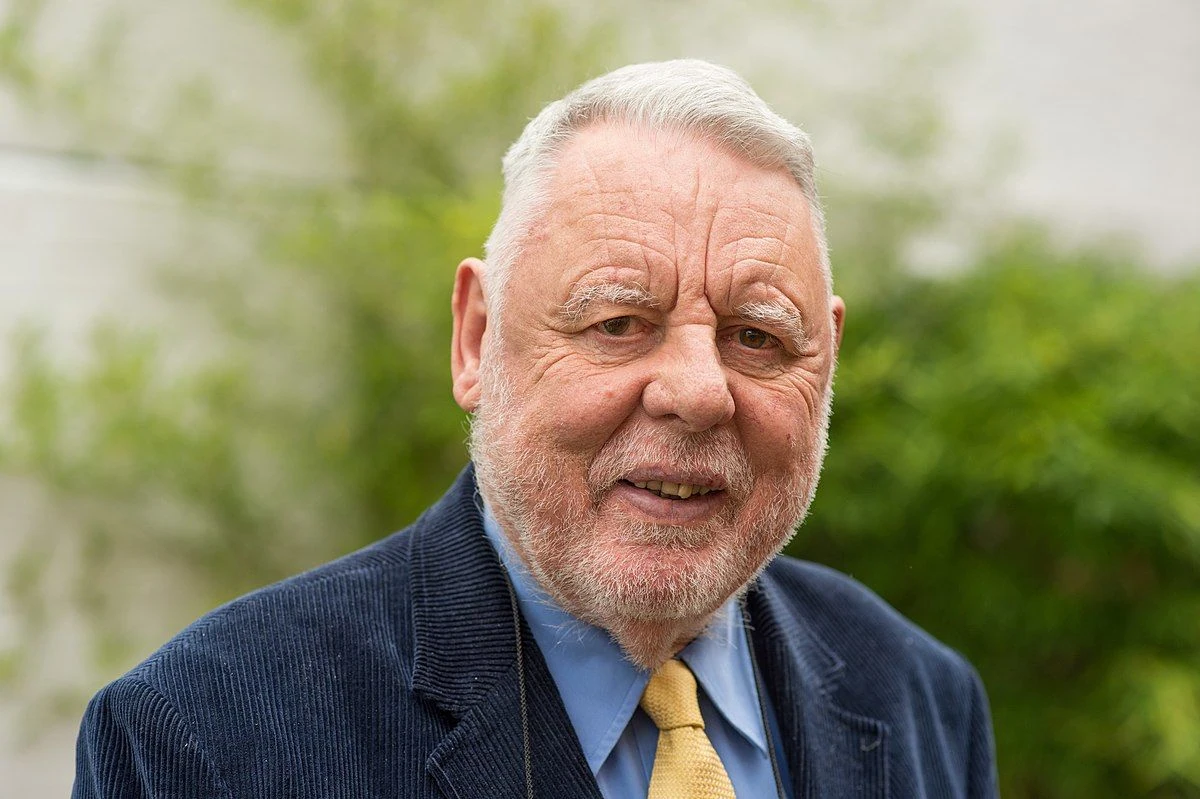
Terry Waite travelled to Beirut in January 1987 to negotiate for the release of hostages held in Lebanon. He was taken captive himself and spent 1,763 days in captivity, including four years in solitary confinement. Released in November 1991, he returned to a life of public work: writing about his experience, supporting charities and helping establish an organisation for hostage families. His story connects the Church of England’s international role with the personal cost of negotiation and a long commitment to humanitarian causes.
From Cheshire to international service
Terence Hardy Waite was born on 31 May 1939 in Bollington, Cheshire. His father was a village policeman in Styal, where Waite was brought up. He attended Stockton Heath County Secondary School, becoming head boy. Although his parents were only nominally religious, he was drawn to Christianity from an early age; he later became both a Quaker and an Anglican.
Waite briefly joined the Grenadier Guards, but an allergy to a dye in the uniform forced him to leave. After considering a monastic life, he trained with the Church Army, an Anglican social-welfare organisation. In 1963 he became education adviser to Oliver Tomkins, the Anglican Bishop of Bristol. The work included helping to implement a programme intended to encourage greater involvement by lay people in the diocese.
In 1969, Waite moved to Uganda as Provincial Training Adviser to Archbishop Erica Sabiti. He travelled widely in East Africa and founded the Southern Sudan Project from his office in Kampala, developing aid and development programmes for the region. He and his wife, Helen, and their four children experienced the Idi Amin coup and narrowly escaped death on several occasions. From 1972, based in Rome, he worked as an international consultant to the Medical Mission Sisters. His work took him across several continents and involved health and education, institutional change and relations between cultures and groups.
An envoy in hostage negotiations
Waite returned to Britain in 1978 and joined the British Council of Churches. In 1980, Archbishop of Canterbury Robert Runcie appointed him Assistant for Anglican Communion Affairs. Based at Lambeth Palace, he handled diplomatic and ecclesiastical exchanges, accompanying Runcie on international visits, including the first visit to China by an Archbishop of Canterbury.
He also became an envoy in hostage negotiations. In Iran in 1980, Waite negotiated the release of several people, including Anglican clergy and church workers. In 1984, he secured the release of four British hostages held in Libya after negotiating with Muammar Gaddafi. From 1985, he was involved in efforts to free hostages in Lebanon, helping secure the releases of Lawrence Jenco and David Jacobsen.
Those efforts became entangled with the Iran-Contra affair. Waite had travelled secretly between Cyprus and Lebanon by American helicopter and appeared with Lieutenant Colonel Oliver North. When the scandal broke in 1986, his position was compromised. He nevertheless believed he needed to demonstrate his continuing trustworthiness and commitment to the hostages still held.
Captivity and return
Waite arrived in Beirut on 12 January 1987 to negotiate with the Islamic Jihad Organization, which was holding hostages including Terry Anderson and Thomas Sutherland. On 20 January, he agreed to meet the captors after being promised safe conduct to visit hostages who were said to be ill. Instead, he was taken hostage. He remained in captivity for 1,763 days, the first four years in solitary confinement, and was released on 18 November 1991.
After his release, Waite became a fellow commoner at Trinity Hall, Cambridge, where he wrote Taken on Trust, his memoir of captivity. Published in 1994, it became a best-seller in Britain and internationally. He continued to write, lecture and undertake humanitarian work. Footfalls in Memory, a further reflection on his captivity, appeared in 1995; Travels with a Primate, a humorous account of journeys with Runcie, followed in 2000. In 2004, Waite returned to Beirut for the first time since his release. He later travelled there again in 2012, seeking reconciliation with his captors and, as he put it, to lay the ghosts of the past to rest.
Charity, public service and recognition
Waite’s work after captivity extended well beyond the subject of hostage-taking. He became president of Emmaus UK shortly after his release and was a co-founder and president of Y Care International, the YMCA’s international development and relief agency. In 2004 he founded Hostage UK, an organisation to support the families of hostages. It later became known as Hostage International. These activities gave his experience a practical public purpose: alongside accounts of captivity, he helped build charitable work focused on people affected by hardship and crisis.
His charitable associations also included the Warrington Male Voice Choir, of which he became patron in 1996 following the Warrington bomb attacks. He appeared with the choir in prison performances in Britain and Ireland connected with rehabilitation programmes. He was also a patron of organisations including Storybook Dads, which helps prisoners record stories for their children, and Habitat for Humanity Great Britain.
His honours included the CBE and, in 2023, appointment as a Knight Commander of the Order of St Michael and St George for services to charity and humanitarian work. He received the Four Freedoms Award for the Freedom of Worship in 1992 and several honorary degrees. His public writing and speaking drew on both his captivity and his wider experience of humanitarian work, without reducing his career to a single episode.
Why Terry Waite deserves a place in British Legacy
Terry Waite’s place in British Legacy rests on a combination of public service, personal risk and sustained charitable work. As Assistant for Anglican Communion Affairs, he represented the Archbishop of Canterbury in international exchanges; as an envoy, he helped secure the release of hostages in Iran, Libya and Lebanon. His capture in Beirut was not a separate, symbolic episode but the consequence of returning to negotiate for people still being held. The 1,763 days he spent in captivity, and his return to public life afterwards, give particular weight to his later work on behalf of hostage families.
That work took several forms. Waite helped establish Hostage UK, later Hostage International, and held leadership roles with Y Care International and Emmaus UK. He also supported causes concerned with prisoners, children and people experiencing homelessness. His books made his experience available to readers, while his charitable activity placed him alongside organisations working on practical needs. The British connection is specific: his public service grew from a role within the Church of England and British church institutions, and continued through charities and organisations based in the UK. His legacy is not simply a story of endurance; it is also the record of a life redirected towards supporting others affected by conflict and hardship.
Sources
Terry Waite — Wikipedia revision 1376309326
Adapted in part from Terry Waite by Wikipedia contributors, under CC BY-SA 4.0. Text has been edited and combined with the existing article; this adapted text is shared under the same licence. Contributor history.