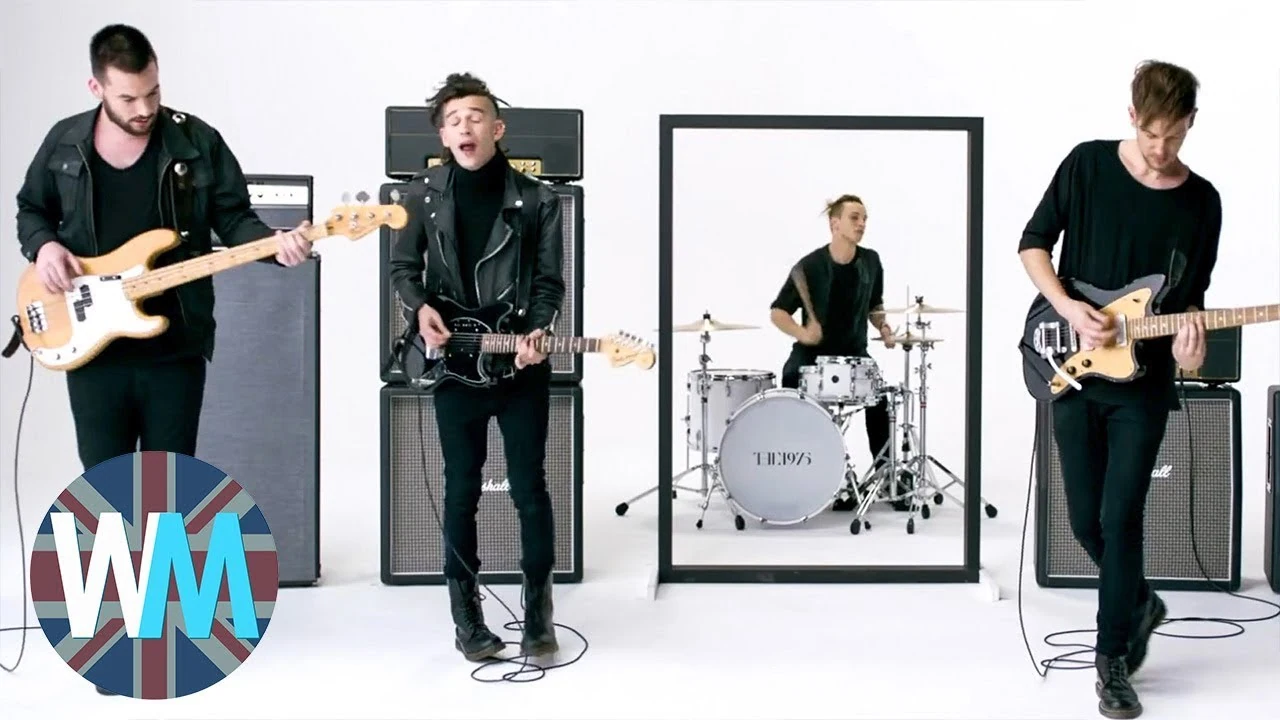
Formed as teenagers at Wilmslow High School in Cheshire, The 1975 grew from a group playing punk and emo covers into one of Britain’s most prominent pop-rock bands. Matty Healy, Adam Hann, Ross MacDonald and George Daniel have kept that original line-up while moving between guitar-led rock, synth-pop, art pop and other styles. Their route from early independent releases to a run of UK number-one albums has brought both major recognition and disagreement about what the band is trying to do.
Four school friends, several names
The band began in 2002, when guitarist Adam Hann recruited Healy to play drums in a group he was forming with bassist Ross MacDonald. Their prospective singer left after one rehearsal, and Healy took over vocals. George Daniel later became the drummer. At first, the friends played punk and emo covers at school and at Healy’s house; they then began writing their own material.
Before settling on The 1975, they performed under names including Me and You Versus Them, Those 1975s, Forever Drawing Six, Talkhouse, the Slowdown and Bigsleep. They were also known as Drive Like I Do. The final name came from a page of scribblings in Healy’s second-hand copy of Jack Kerouac’s On the Road, dated “1 June, The 1975”.
Their early years involved fitting music around other commitments. Hann, MacDonald and Daniel went to university in Manchester, while Healy briefly attended music school. The band played gigs and recorded their own music while working as delivery boys at a local Chinese restaurant. By 2010, manager Jamie Oborne was working with them, but they remained unsigned. Oborne established the independent label Dirty Hit and signed the group.
The 1975 began professionally releasing music in 2012. Four extended plays—Facedown, Sex, Music for Cars and IV—introduced listeners to a band whose sound did not sit neatly within one genre. “The City”, from Facedown, received national UK radio airplay, including on a BBC Introducing show with Huw Stephens. Zane Lowe championed “Sex” on BBC Radio 1, while “Chocolate” reached number 19 in the UK Singles Chart in 2013.
Building an audience, then changing the scale
The group toured extensively before and after the release of its first album. Among its early appearances were supporting Muse at London’s Emirates Stadium, playing with the Neighbourhood in the United States and performing with the Rolling Stones in Hyde Park. In August 2013, it appeared at the Reading and Leeds Festivals. The run of EPs and live shows helped establish a following before the band’s full-length debut arrived.
Co-produced by Mike Crossey, the self-titled The 1975 was released in September 2013 and went straight to number one on the UK Albums Chart. Its singles included “Sex”, “Chocolate” and “Robbers”. The record set out a sound combining melodic pop, rock guitars and atmospheric production, but success did not bring universal approval. Contemporary responses ranged from enthusiasm to sharp criticism, a divide that would remain part of the band’s public story.
The second album, I Like It When You Sleep, for You Are So Beautiful yet So Unaware of It, followed in 2016. “The Sound” and “Somebody Else” were among its singles; the latter examines the difficult feelings surrounding a former partner’s new relationship. “The Sound” pairs an energetic pop arrangement with a pointed response to music critics. “Love Me”, another single from the record, introduced a different strand of the band’s self-aware pop. The album topped the charts in the UK and the United States, was shortlisted for the Mercury Prize and later named NME’s album of the year for 2016. Critics disagreed about its ambition: some welcomed its scope, while others considered parts of it overextended.
Albums about a changing present
A Brief Inquiry into Online Relationships, released in 2018, continued the group’s movement between styles and subjects. The album received widespread critical praise and won British Album of the Year at the 2019 Brit Awards. Its single “Love It If We Made It” uses the line “Modernity has failed us” within a sequence of observations about contemporary life. The song’s language gives the band’s social commentary an urgent, unsettled quality rather than presenting it as a detached statement. In 2019, The 1975 also won the Brit Award for Best British Group.
Their fourth album, Notes on a Conditional Form, arrived in 2020 and became their fourth consecutive UK number-one album. Its opening track features climate activist Greta Thunberg, and proceeds from the song went to Extinction Rebellion. The release came during the COVID-19 pandemic, when many of the band’s planned shows were postponed and ultimately cancelled. The album’s variety continued a career in which shifts in sound and presentation have been as prominent as continuity.
Being Funny in a Foreign Language, their fifth studio album, was released in 2022 and was nominated for British Album of the Year at the 2023 Brit Awards. That year the band appeared on BBC Two’s Later... with Jools Holland and played a sold-out show at Madison Square Garden. In 2023, it also headlined Reading and Leeds Festivals for a tenth-anniversary performance of its debut album. The band’s live recording from Manchester’s AO Arena, Still... At Their Very Best (Live From The AO Arena, Manchester, 17.02.24), was released in 2025.
In June 2025, The 1975 headlined the Pyramid Stage at Glastonbury Festival. The performance offered a major platform for a group whose career had begun in school performances in Cheshire. It also came as their manager said they were working on a sixth studio album, without giving a release date.
Influence, argument and public consequences
The 1975’s eclecticism has helped make them difficult to reduce to a single genre. Their work has been described as pop-rock, art pop, alternative pop, synth-pop, new wave and indie rock. Matty Healy is the band’s primary songwriter, while George Daniel is its primary producer; Healy has described their creative relationship as “symbiotic”. Across their albums, changes in production and style sit alongside recurring interests in relationships, identity and public life.
The group’s influence has been discussed in relation to a strand of indie pop dubbed “Healywave” by NME. The description points to features associated with the band—including bright synths, a distinctive picked-guitar sound and emo-influenced lyrics—and has been applied to acts such as Pale Waves, Fickle Friends and the Aces. It is a critical label, not a claim that those musicians share one formal movement.
The band’s cultural presence has also involved controversy. At Malaysia’s Good Vibes Festival in July 2023, Healy and MacDonald kissed onstage, and Healy criticised the country’s anti-LGBT laws. Malaysian authorities stopped the remainder of the festival, and the band later cancelled shows in Taiwan and Indonesia. The festival organisers sued the band in the High Court, seeking £1.9 million in damages for breach of contract. The episode showed that a performance presented as protest can have consequences for organisers and audiences, as well as provoking sharply different reactions.
Why The 1975 deserves a place in British Legacy
The 1975’s British story begins in a specific place and with a particular group of friends: four teenagers at a Cheshire school who continued making music as their lives changed. Their formation at Wilmslow High School, their connections to Manchester and their early professional releases through the independent label Dirty Hit place the band within the UK’s music culture. Their success was built over time: a sequence of extended plays, national radio attention and extensive touring preceded the 2013 debut album, which reached number one in the UK. Later chart-topping records and British music awards mark the scale of their achievement without suggesting that it rests on one song or moment.
Their place in a record of contemporary British culture also rests on making stylistic change central to their work. Across successive albums, they have moved through pop-rock, synth-pop and art-pop textures, while addressing relationships, technology and public life. The response has included both acclaim and criticism. Their performance in Malaysia, and the consequences that followed for the festival and its organisers, make clear that public interventions can be complicated rather than uncomplicatedly celebrated. A worthwhile legacy account should preserve that complexity: the band’s influence on a strand of indie pop, their records, touring and chart achievements, and the debate their music and actions provoke. Together, those elements make The 1975 a revealing example of how a British band can develop from local beginnings into an internationally visible cultural presence.
Sources
Adapted in part from The 1975 by Wikipedia contributors, under CC BY-SA 4.0. Text has been edited and combined with the existing article; this adapted text is shared under the same licence. Contributor history.