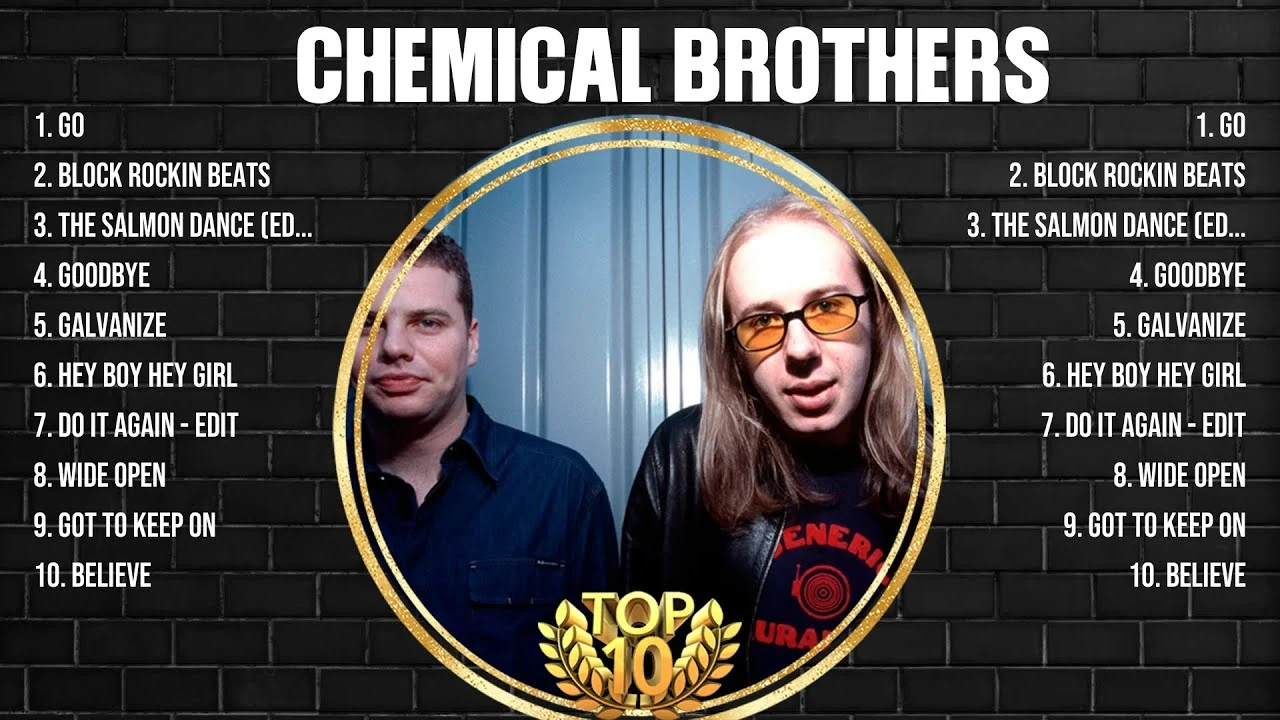
Before they were The Chemical Brothers, Ed Simons and Tom Rowlands were Manchester DJs making their own music because the records they wanted to play were hard to find. Their partnership grew from the city’s club culture into a run of chart-topping albums and singles, and helped bring big beat to a much wider audience. The duo’s work has ranged from pounding dance-floor tracks to more expansive, melodic records, while collaborations and film projects have carried their sound beyond the club.
Manchester beginnings and a new name
Rowlands met Simons at the University of Manchester in 1989. They shared an interest in rave culture and club-going, and began DJing together in 1992. Their early sets drew on hip-hop, techno and house. At first, they performed as the Dust Brothers, borrowing the name of an American production duo. When the original duo objected to its use, the Manchester pair chose a new name, taken from their track “Chemical Beats”.
They began making records when they ran short of instrumental hip-hop tracks suited to their sets. Their first release, “Song to the Siren”, appeared in 1993 on their own Diamond Records label. The following year’s Fourteenth Century Sky EP included “Chemical Beats”, an early statement of the forceful, sample-driven sound that would become closely associated with big beat. Their work as DJs and remixers also helped establish connections with other British acts, including the Manic Street Preachers, the Charlatans and Primal Scream.
The name change and the move from DJing into original production mark the difference between the pair first meeting and the group’s formation. The supplied reference source dates their meeting to 1989 and their start as a duo to 1992, rather than supporting the imported article’s claim that the group formed in 1989.
Exit Planet Dust and the breakthrough
Their first album, Exit Planet Dust, was released in June 1995. It reached number nine on the UK Albums Chart and went on to sell more than a million copies worldwide. The title reflected the change from the Dust Brothers name. Its tracks included “Leave Home”, their first charting single, and “Chemical Beats”, which had appeared on the earlier EP. The album’s mix of hard-edged rhythms and psychedelic textures gave the duo a foundation for a career that would not be confined to one production style.
In 1996, “Setting Sun”, featuring Noel Gallagher, became their first UK number-one single. The collaboration linked the Manchester producers with one of the most prominent voices in British guitar music, while the duo’s own club background remained central to the track’s momentum. It also pointed towards a continuing feature of their work: guest performers could add a distinct voice without displacing the production partnership at its centre.
Their second album, Dig Your Own Hole, followed in 1997 and topped the UK albums chart. Its single “Block Rockin’ Beats” reached number one in Britain and won a Grammy for Best Rock Instrumental Performance. The record confirmed that music built from electronic production and dance-floor rhythms could also make a substantial impact in the wider album market. Rather than treating big beat as a fixed formula, the duo used it as a starting point for busy, layered arrangements and high-impact singles.
Changing the shape of the sound
Surrender, released in 1999, again reached number one in the UK. Its guests included Noel Gallagher, Hope Sandoval and Jonathan Donahue, while Bernard Sumner and Bobby Gillespie contributed vocals to “Out of Control”. The album leaned further towards house than its two predecessors. “Hey Boy Hey Girl”, released ahead of it, became one of the duo’s best-known tracks and reached number three in the UK singles chart. Its direct, insistent hook gave it a life beyond the album and helped make the Chemical Brothers a familiar name well outside specialist dance audiences.
Their next run of albums showed how widely they could move within electronic music. Come with Us (2002), Push the Button (2005) and We Are the Night (2007) each reached number one on the UK Albums Chart. Across them, the duo worked with performers including Richard Ashcroft, Beth Orton, Q-Tip, Kele Okereke and Tim Burgess. “Galvanize”, featuring Q-Tip, became another major single and won a Grammy for Best Dance Recording; Push the Button also received a Grammy for Best Dance/Electronic Album. Their wider catalogue includes “Go”, featuring Q-Tip, from the 2015 album Born in the Echoes.
Their collaborations were not limited to guest vocals on their own records. They remixed music by other artists and took on work for film and games. Rowlands and Simons made the soundtrack for Joe Wright’s film Hanna, released in 2011. These projects brought their production skills into settings where music had to serve a story or scene as well as a dance floor.
Records designed to be seen and heard
Performance has been another important part of the duo’s identity. The visual dimension of their shows has developed alongside the music, and their 2010 album Further made that relationship explicit: each of its eight tracks was accompanied by a film created to match it, made with their long-time visual collaborators Adam Smith and Marcus Lyall. The album and films were presented together in a series of London Roundhouse shows before release.
In 2012, they issued Don’t Think, a concert film documenting their performance at Japan’s Fuji Rock Festival in 2011. The recording was mixed in 7.1 surround sound. That same year, they composed “Theme for Velodrome” for the cycling events at the London Olympics. The commission put their electronic sound into a distinctly British public setting, while the concert film captured how their music and stage visuals worked together in front of a festival crowd.
Their later albums continued the trajectory. Born in the Echoes arrived in 2015, followed by No Geography in 2019. The latter won Grammy Awards for Best Dance/Electronic Album and Best Dance Recording, among other recognition for the album and its music. In 2023, the duo released For That Beautiful Feeling, their tenth studio album. The sequence of releases shows a group continuing to make new work across decades rather than relying solely on the success of its early records.
Why The Chemical Brothers deserve a place in British Legacy
The Chemical Brothers belong in British Legacy because their story connects a particular place and scene with a lasting change in popular music. Rowlands and Simons met at university in Manchester, began DJing together there, and developed a sound from the records and club culture around them. Their early move into original production helped turn big beat from a club-facing style into music that could command the UK singles and album charts. “Setting Sun”, “Block Rockin’ Beats” and “Hey Boy Hey Girl” each show a different route to that reach: collaboration, forceful sample-based production and a direct dance-floor hook.
Their significance is also visible in the breadth of the work that followed. They repeatedly altered their sound, brought in vocalists from different musical worlds and carried electronic production into film, visual performance and the London Olympics. Albums such as Further, conceived with accompanying films, and the concert release Don’t Think treat the live experience as more than a presentation of recorded tracks. Their chart success and Grammy recognition provide evidence of international reach, but the British connection is more specific than acclaim alone: a Manchester partnership turned local club experience into a distinctive contribution to British popular music, then sustained that contribution through records and performance across generations.
The imported account also draws attention to the words threaded through the music. “Back with another one of those block rockin’ beats” and “Here we go!” are concise examples of the duo’s memorable lyrical hooks. Their story—of creativity, persistence and an enduring commitment to making music—offers a legacy that can encourage future generations of performers and producers.
Sources
The Chemical Brothers — revision 1378080202
Adapted in part from The Chemical Brothers by Wikipedia contributors, under CC BY-SA 4.0. Text has been edited and combined with the existing article; this adapted text is shared under the same licence. Contributor history.