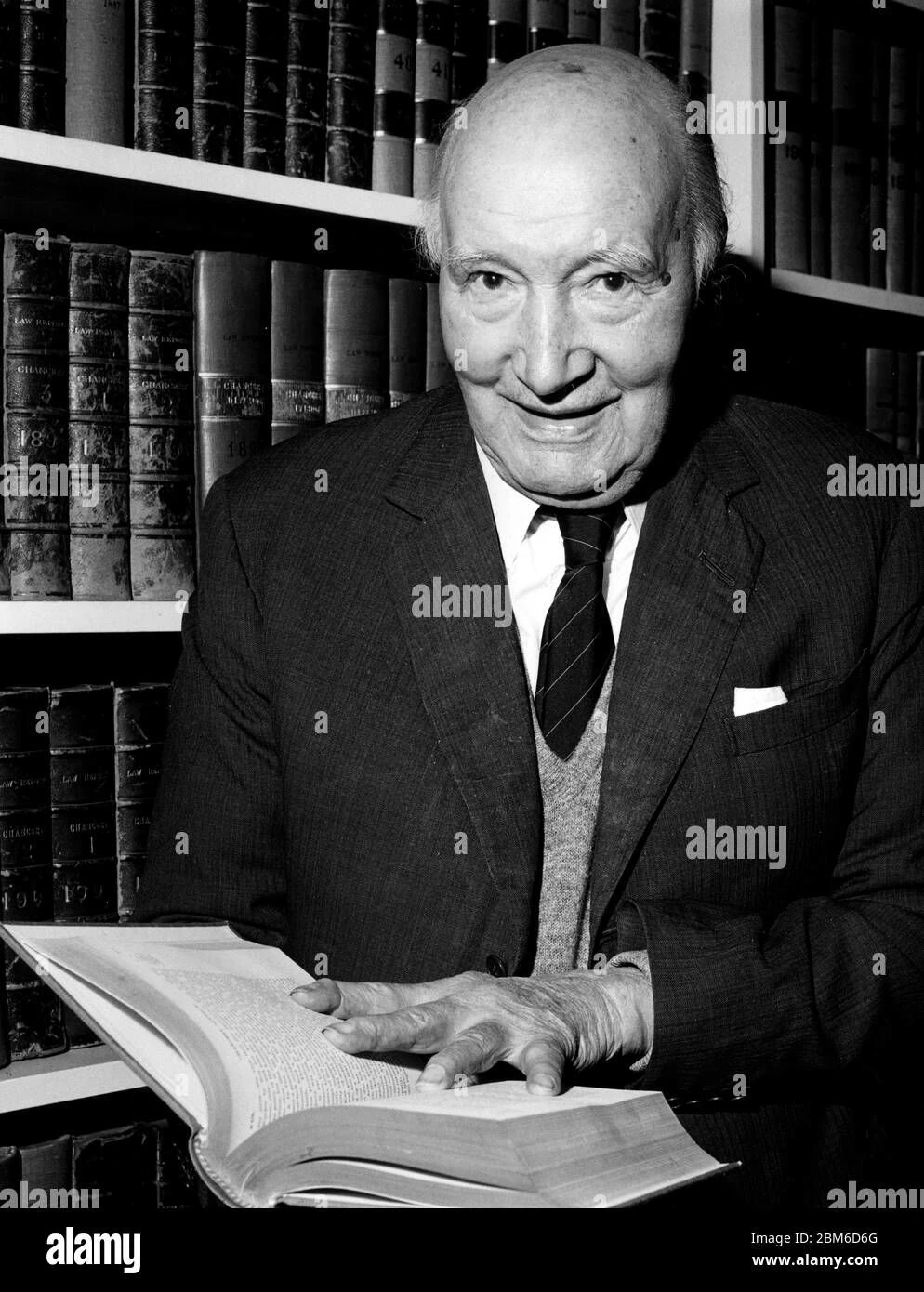
Alfred Thompson Denning became one of the most recognisable judges in England by writing judgments for readers beyond the courtroom. As Master of the Rolls from 1962 to 1982, he used the Court of Appeal to press for changes in areas including contract, family and tort law. Some of his decisions influenced later law; others were overturned or drew sharp criticism. His career combined an insistence that law should be intelligible with a willingness to test its limits.
From Whitchurch to the Bar
Born in Whitchurch, Hampshire, on 23 January 1899, Denning was one of six children of Charles Denning, a draper, and Clara Denning. He won a scholarship to Andover Grammar School and, after studying mathematics at Magdalen College, Oxford, graduated in 1920. He first taught mathematics at Winchester College. Watching proceedings at Winchester Assize Court helped turn his attention to the law.
Denning studied jurisprudence at Oxford and joined Lincoln’s Inn. Called to the Bar in 1923, he began with modest briefs before his practice grew. In 1938 he became King’s Counsel. He served in the First World War with the Royal Engineers, working on bridges in France during the German advance of 1918; illness kept him in hospital during the war’s final days. In the Second World War he volunteered for service but, considered too old for active duty, became a legal adviser to the North East Region.
Before appointment to the bench, Denning’s cases included Gold v Essex County Council (1942), which held a hospital liable for the professional negligence of its staff. He became a High Court judge in 1944, first in the Probate, Divorce and Admiralty Division and then in the King’s Bench Division. His early judicial work included pension appeals. In Starr v Ministry of Pensions (1946), he placed the burden on a tribunal to show that an injury was not due to war service; in James v Minister of Pensions (1947), he allowed a claimant further time to gather evidence. The British Legion and members of the public supported the changes, and the Legion brought him 73 previously rejected cases to hear.
Changing the law, and testing its boundaries
In Central London Property Trust Ltd v High Trees House Ltd (1947), known as the High Trees case, Denning revived the principle of promissory estoppel. The decision became a landmark in English contract law, though its reach and significance have also been debated. In the Court of Appeal, he continued to develop the doctrine. In Combe v Combe (1952), he explained that promissory estoppel could be used as a “shield” rather than a “sword”: it could provide a defence, but not create a claim where none otherwise existed.
Denning was appointed to the Court of Appeal in 1948, became a Law Lord in 1957 and returned to the Court of Appeal as Master of the Rolls in 1962. He preferred that court to the House of Lords, where he had served for five years. As Master of the Rolls, he selected cases and colleagues for particular expertise, and his judgments helped shape debate across the common law. The House of Lords overturned some of his decisions; other judgments stood or were later reflected in legislation. His willingness to innovate brought admiration from those seeking fairer outcomes and concern from those who feared uncertainty in the law.
His work covered more than contract. In Entores Ltd v Miles Far East Corporation (1955), he addressed when acceptance takes effect in near-instantaneous communications. In Hewer v Bryant (1969), he described parental authority over an older child as a “dwindling right”, a formulation later cited in the important case of Gillick. In Spartan Steel and Alloys Ltd v Martin & Co Ltd (1973), he set out limits on recovering pure economic loss after a damaged power cable interrupted a factory’s electricity supply. The judgment was criticised, including for its reliance on public policy.
His public reputation also owed much to his 1963 report on the Profumo affair. Commissioned by Prime Minister Harold Macmillan to investigate the circumstances surrounding John Profumo’s resignation, Denning interviewed 160 people and produced a 70,000-word report. It sold widely, but critics called it a whitewash; Denning defended its emphasis on the public interest and justice to the individual. His judgment in the 1977 Hosenball case, by contrast, did not expand judicial review: he upheld the deportation of journalist Mark Hosenball and argued that the balance between national security and individual liberty in that case was for the Home Secretary, not the courts.
A plain style and a contested record
Denning wanted judgments to be understood by the public. He favoured short sentences and narrative explanation, sometimes naming the people involved rather than relying on labels such as “plaintiff” and “defendant”. His account of the people and events in Beswick v Beswick showed the storytelling approach for which he was known. He also argued for open court proceedings and press access, believing public scrutiny helped keep the legal system accountable.
That accessibility did not make his record uncomplicated. In 1980, during an appeal by the Birmingham Six, he argued against allowing the men to challenge their convictions, describing the prospect of a successful appeal as an “appalling vista”. The men were later acquitted. In retirement, he made further controversial remarks about the Birmingham Six and Guildford Four. He also faced criticism for statements about race and jury service in his 1982 book What Next in the Law; the book was withdrawn and republished without the passages at issue. These episodes complicate the image of a judge speaking for ordinary people and remain part of any considered account of his public legacy.
Denning retired from the bench in 1982, after delivering his final judgment as Master of the Rolls. He continued writing and speaking on law. His books included Freedom Under the Law (1949), The Family Story (1981), What Next in the Law (1982), The Closing Chapter (1983) and Landmarks in the Law (1984). He was appointed to the Order of Merit in 1997. He died on 5 March 1999, aged 100, and was buried in Whitchurch.
Why Tom Denning deserves a place in British Legacy
Denning’s place in British legal history rests on identifiable work, not simply his fame. As a High Court judge, he changed the approach to some war-pension appeals, giving claimants a fairer opportunity to establish their cases. In the Court of Appeal, his decisions helped develop arguments about promises, family rights, negligence and the limits of recovery for economic loss. High Trees remains a central reference point in discussions of promissory estoppel, while cases such as Hewer v Bryant show how his judgments could influence later debate about children’s legal position.
His contribution also lay in how he presented the law. By explaining disputes in direct, memorable prose, he made appellate judgments easier for non-specialists to follow and helped bring public attention to the work of the courts. His report on the Profumo affair made him a nationally familiar figure, though its reception also illustrates the risks when a judge’s public role attracts scrutiny. Denning’s record includes decisions and statements that were contested, and some of his judgments were overturned. British Legacy can recognise both the practical influence of his legal work and the arguments his methods provoked: his career offers a vivid example of how a British judge could shape the common law while leaving the limits of judicial power open to debate.
Sources
Tom Denning, Baron Denning — supplied Wikipedia revision
Adapted in part from Tom Denning, Baron Denning by Wikipedia contributors, under CC BY-SA 4.0. Text has been edited and combined with the existing article; this adapted text is shared under the same licence. Contributor history.