
Tom Jones’s rise began in South Wales, but his voice soon travelled well beyond it. Born Thomas John Woodward in Treforest on 7 June 1940, he first drew international attention in 1965 with “It’s Not Unusual”. A run of hits established him as a leading British vocalist; later decades brought country recordings, television work and a new generation of listeners through The Voice UK. Across those changes, a full-throated baritone and a taste for material from several musical traditions remained central to his public career.
A South Wales beginning
Woodward was the son of Freda Jones and Thomas Woodward, a coal miner. He attended Wood Road Infants School, Wood Road Junior School and Pontypridd Central Secondary Modern School. He began singing at family gatherings, weddings and in the school choir. At 12, he was diagnosed with tuberculosis and spent two years recovering in bed. He later recalled that period as the worst time of his life; listening to music and drawing were among the few things he could do.
As a young man he became the frontman of Tommy Scott and the Senators, a Welsh beat group that built a following in South Wales. In 1964 the group recorded tracks with producer Joe Meek, but attempts to secure a record deal came to little. Decca producer Peter Sullivan later saw them perform and directed Woodward to manager Phil Solomon; that partnership did not last. The group continued to play locally, and manager Gordon Mills eventually took Woodward to London and gave him the stage name Tom Jones, borrowing the name’s association with the popular 1963 film.
The voice finds its audience
Jones’s first single, “Chills and Fever”, appeared in late 1964 without charting. The follow-up, “It’s Not Unusual”, became an international hit after the offshore station Radio Caroline promoted it. In early 1965 it reached number one in the UK and the top ten in the United States. That year also brought “What’s New Pussycat?”, written by Burt Bacharach and Hal David for the film of the same name, and the theme for the James Bond film Thunderball.
Jones was initially sceptical about “What’s New Pussycat?”; Bacharach persuaded him that the song’s unusual character called for his powerful voice. The contrast between that playful number and the direct impact of “It’s Not Unusual” points to an early strength: he could make very different material sound unmistakably his own. He received the Grammy Award for Best New Artist in 1966.
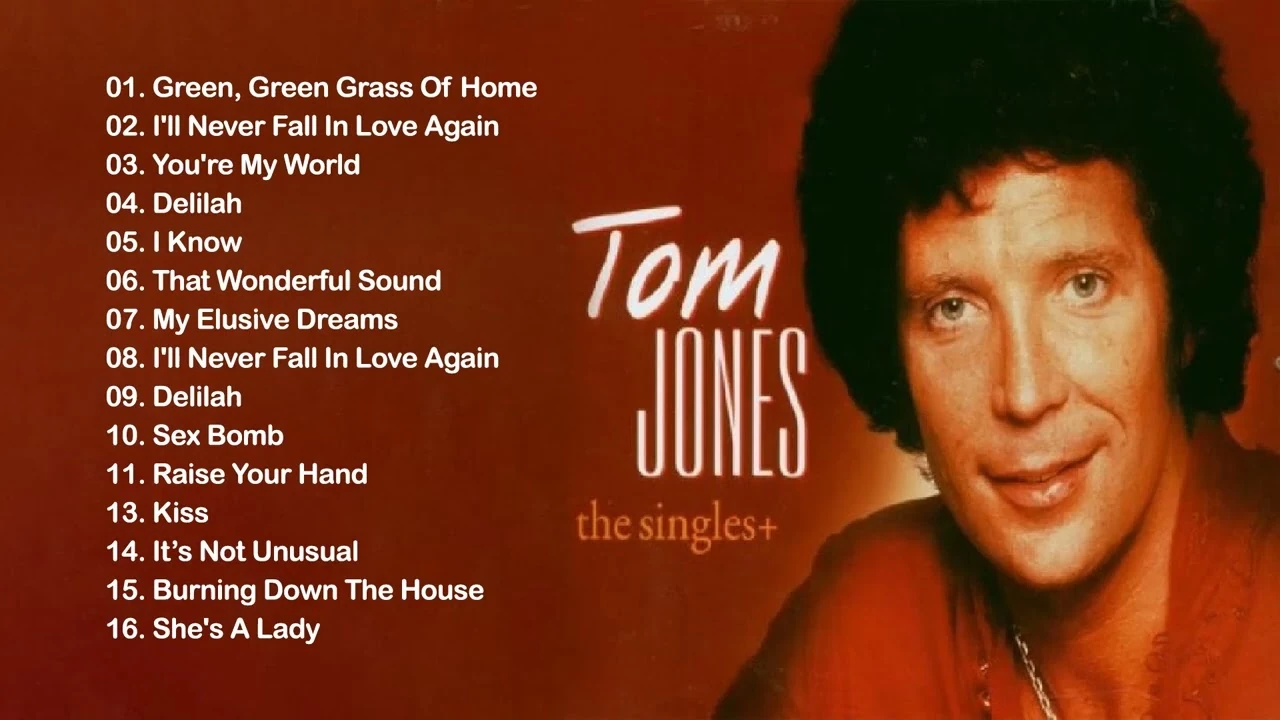
As his popularity shifted in the mid-1960s, Mills recast him as a crooner and Jones broadened his repertoire. “Green, Green Grass of Home” and “Delilah” each reached number two in the UK, alongside “I’m Coming Home” and “I’ll Never Fall in Love Again”. His live persona developed with his appearances in Las Vegas, beginning at the Flamingo in 1967. Open, half-unbuttoned shirts and tight trousers became part of the act; he returned to Las Vegas for at least a week each year until 2011.
Television, country and reinvention
From 1969 to 1971, Jones hosted the television variety programme This Is Tom Jones, shown on ITV in Britain and ABC in the United States. The programme brought his performance style into millions of homes and earned him a Golden Globe nomination in 1970. He later fronted another television variety series, Tom Jones, made in Vancouver and broadcast from 1980 to 1981. His recordings continued, too: “She’s a Lady” was among his 1970s hits, while “Say You’ll Stay Until Tomorrow” topped the US country chart in 1976.
In the early 1980s he recorded country music, placing nine songs in the US country top 40 between 1980 and 1986. A return to the UK singles chart followed in 1987 with “A Boy from Nowhere”, which reached number two. The next year, his cover of Prince’s “Kiss”, made with Art of Noise, reached number five in the UK. Its video won the MTV Video Music Award for Breakthrough Video.
Jones found a new route to contemporary pop in the 1990s. His 1994 album The Lead and How to Swing It included “If I Only Knew”, which reached number 11 in the UK. In 1999, Reload, an album of cover duets with artists including the Cardigans, Natalie Imbruglia, Cerys Matthews, Van Morrison, Portishead, Stereophonics and Robbie Williams, reached number one in the UK. It sold more than four million copies worldwide, and its single “Sex Bomb” reached number three in 2000.
Honours and a continuing public career
Jones’s later work kept moving between styles and formats. He released Mr. Jones, produced by Wyclef Jean, in 2002; the album and its first single, “Tom Jones International”, reached the UK top 40. A roots-rock album with pianist Jools Holland followed in 2004. In 2010, Praise & Blame drew mainly on gospel and blues, with songs associated with Bob Dylan, John Lee Hooker and Billy Joe Shaver. It reached number two on the UK album chart. The next two releases in that musical sequence were Spirit in the Room (2012) and Long Lost Suitcase (2015). Surrounded by Time, released in 2021, was another covers album produced by Ethan Johns.
His television role as a coach on The Voice UK brought Jones to viewers from 2012, with a break in 2016, and he returned in 2017. Contestants he mentored won the programme in 2012, 2018 and 2022. In 2003 he received the BRIT Award for Outstanding Contribution to Music; in 2006 Queen Elizabeth II knighted him for services to music. He was made an Officer of the Order of the British Empire before the knighthood; the supplied Wikipedia text gives conflicting dates for that appointment, so no year is stated here. In September 2026, he said he would not return to The Voice UK after ITV decided to refresh the programme. His career, however, has never rested on a single medium: records, touring and television have each provided a way to reach audiences.
Why Tom Jones deserves a place in British Legacy
Tom Jones belongs in British Legacy because his story connects a specific Welsh beginning with a sustained place in British popular culture. Born in Treforest and raised in the Pontypridd area, he moved from fronting a local beat group to a recording career that reached the top of the UK charts. “It’s Not Unusual” announced him in 1965; songs including “Green, Green Grass of Home”, “Delilah” and “She’s a Lady” extended that early success. His later chart returns with “A Boy from Nowhere”, “Kiss” and the Reload era show a career that repeatedly found new audiences rather than relying only on its first wave of hits.
That longevity has a practical cultural dimension. Jones carried his music from records and concert stages into television, first with This Is Tom Jones and later as a coach on The Voice UK. The show put his experience in direct contact with new performers and viewers; contestants he mentored won three series. His work across pop, soul, country, gospel and dance also made a broad musical range part of his public identity. The BRIT Award for Outstanding Contribution to Music and his knighthood for services to music mark recognition in Britain of a career that also achieved international reach. His legacy is not simply a powerful voice: it is a Welsh artist’s long passage through changing forms of popular entertainment, with songs and performances that remained visible across generations.
Sources
Tom Jones (singer), revision 1376441370
Adapted in part from Tom Jones (singer) by Wikipedia contributors, under CC BY-SA 4.0. Text has been edited and combined with the existing article; this adapted text is shared under the same licence. Contributor history.
.jpg)