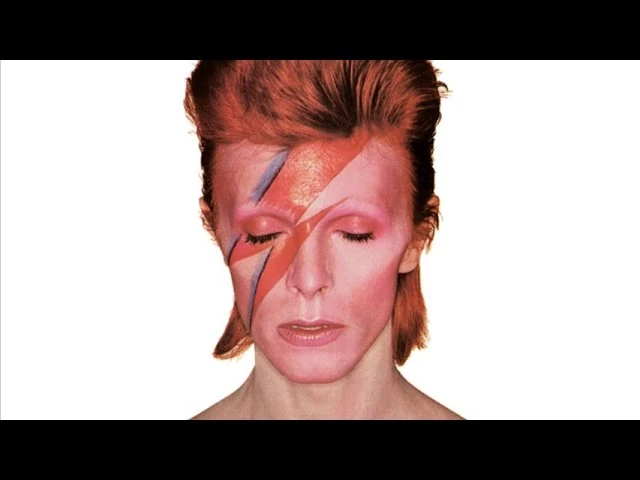
David Bowie’s career began with unsuccessful singles, shifting bands and experiments in performance. Its defining quality was not simply that he changed his sound or appearance, but that he made each change part of the work. Songs, characters, clothes and stagecraft became ways to explore new ideas and invite audiences into them. From the young musician who recorded “Space Oddity” to the performer who made Ziggy Stardust a pop phenomenon, Bowie repeatedly turned unfamiliar artistic territory into popular music.
Born David Robert Jones in London on 8 January 1947, he grew up in south London and built a career that carried ideas from art, theatre, fashion, soul and electronic music into the mainstream. The result was a body of work whose British beginnings remained visible even as its audiences and influence became international.
South London beginnings and years of apprenticeship
Bowie spent his early years in Brixton before moving with his family through Bickley and Bromley Common to Sundridge Park. He attended schools in south London, including Bromley Technical High School, where he studied art, music and design. Music arrived early: his father brought home American records, and Bowie learned saxophone after becoming interested in modern jazz. He also played in skiffle sessions and formed the Konrads, his first band, in 1962, aged 15.
The early years of his music career were a sequence of attempts rather than a smooth ascent. Bowie moved through the King Bees, the Manish Boys and the Lower Third, releasing singles that failed commercially. He worked with different managers and record labels, and for a time considered leaving music to study mime. In the mid-1960s, confusion with Davy Jones of the Monkees prompted him to adopt the name David Bowie.
He was interested in more than the sound of a song. Bowie studied dramatic arts with Lindsay Kemp, whose work included mime and avant-garde theatre, and became involved in the Beckenham Arts Lab, a local arts club that grew out of a Sunday-night folk club. These experiences offered ways to think about performance and identity alongside songwriting. “Space Oddity”, released in 1969, brought his first substantial chart success: it reached the UK top five. The song’s fictional astronaut Major Tom also introduced an interest in character and narrative that would run through much of his later work.
Ziggy Stardust: a character becomes a breakthrough
Bowie’s breakthrough came in 1972 with the album The Rise and Fall of Ziggy Stardust and the Spiders from Mars. Ziggy was not just a name attached to a set of songs. Bowie built the character through music, clothes, make-up, hair and performance, joining theatrical presentation to rock songwriting. Tracks including “Starman” and “Suffragette City” helped make the album a defining work of the glam-rock era.
The character made artifice conspicuous without making the emotions behind it feel false. In Ziggy’s story, audiences encountered songs about fame, escape and uncertainty alongside a performer who made identity look changeable. Bowie’s stage shows brought that idea into public view. The Ziggy Stardust tour began in 1972 and took him from the Toby Jug pub in Tolworth to wider audiences around the UK and, later, the United States. In July 1973, he announced Ziggy’s retirement on stage at the Hammersmith Odeon in London.
He was also writing and producing beyond his own records. “All the Young Dudes”, which Bowie wrote and produced for Mott the Hoople, became a hit for the band. He contributed to Lou Reed’s Transformer and co-produced Iggy Pop’s Raw Power. These projects show a musician whose creative reach included helping other artists make records, not only developing his own public characters.
Changing direction: soul, art rock and Berlin
After Ziggy, Bowie continued to move between styles. Diamond Dogs (1974) combined dystopian ideas with rock and introduced the character Halloween Jack. On Young Americans (1975), he turned towards soul, describing the style as “plastic soul”. “Fame”, made with John Lennon, became his first US number-one single. Station to Station followed in 1976, with a more austere sound and another persona, the Thin White Duke.
The next major change took shape in Berlin. Bowie moved there in 1976 and worked with Brian Eno and producer Tony Visconti on the albums Low (1977), “Heroes” (1977) and Lodger (1979), later grouped as the Berlin Trilogy. The records used electronic sounds, instrumental passages and less conventional song structures. Low moved between short, sharply outlined songs and atmospheric instrumentals; “Heroes” placed a more recognisable rock sound alongside its experiments; Lodger shifted again, towards a mixture of rock, pop and other musical influences.
The Berlin albums were not a retreat from popular music so much as an expansion of what a rock record could contain. Their influence reached musicians working in later pop, post-punk and alternative music. Bowie’s changes in style were not confined to a single period: after the experimental records, Let’s Dance (1983), co-produced with Nile Rodgers, brought him his greatest commercial success. Its title track, “Modern Love” and “China Girl” helped take his music to a vast international audience.
Beyond the studio: image, acting and new media
Bowie treated visual presentation as part of his musical work. Ziggy Stardust, Aladdin Sane, Halloween Jack and the Thin White Duke were distinct characters, each associated with a different sound and public appearance. Clothes, make-up, photography and music videos added meaning to the songs rather than simply decorating them. That approach made Bowie an enduring point of reference for designers and performers interested in the relationship between image and music.
Acting gave him another way to work through performance. His first major film role came in Nicolas Roeg’s The Man Who Fell to Earth (1976), in which he played the alien Thomas Jerome Newton. He later appeared in Merry Christmas, Mr Lawrence, Labyrinth and The Prestige, among other films. His roles were often supporting parts or cameos rather than attempts to establish himself as a conventional leading man. On stage, he played Joseph Merrick in the Broadway production of The Elephant Man and took the title role in a BBC adaptation of Brecht’s Baal.
He also explored how the internet might change the relationship between musicians and audiences. BowieNet, launched in 1998, offered subscribers online access, a Bowie email address and material associated with the musician. His 1996 single “Telling Lies” was among the early singles released for download, and Hours (1999) was made available online. These ventures extended a familiar impulse: rather than treating a new medium as separate from his work, Bowie experimented with ways an audience might use it.
Late work, recognition and remembrance
After Reality (2003) and its accompanying tour, Bowie became less visible as a live performer. He returned with The Next Day in 2013, after a decade without a new studio album. It was followed by Blackstar, released on his 69th birthday, 8 January 2016. Bowie died in New York two days later, aged 69. The album’s release so close to his death gave its music and lyrics a particular resonance, but it also stands as a carefully made final studio work.
His achievements were recognised in Britain and internationally. Bowie received six Grammy Awards and four Brit Awards and was inducted into the Rock and Roll Hall of Fame in 1996. He was also made a Commander of the French Order of Arts and Letters. He declined a CBE in 2000 and a knighthood in 2003. These honours form part of his story, but the more enduring measure of his career is the range of musical and visual possibilities he made familiar to a broad audience.
In London, the Victoria and Albert Museum’s exhibition David Bowie Is opened in 2013 and attracted more than 300,000 visitors during its run at the museum. A travelling version went on to reach audiences in other cities. In 2025, the David Bowie Centre opened at V&A East Storehouse in Stratford, housing his archive and presenting material through rotating exhibitions. These institutions preserve more than the records: they offer ways to encounter the images, objects and creative decisions that formed part of Bowie’s work.
Why David Bowie deserves a place in British Legacy
David Bowie deserves a place in British Legacy because his work changed the scope of British popular music without severing its connection to home. He began in south London, moving through local bands, art and design study, mime and the Beckenham Arts Lab before “Space Oddity” brought him to a national audience. From that base he developed a career able to embrace glam rock, soul, electronic sound, film and new media. The Ziggy Stardust years made theatricality central to a rock performance; the Berlin albums brought unfamiliar textures and forms into the conversation around popular music; and Let’s Dance demonstrated that experiment and mass appeal could coexist.
His contribution also lies in the possibilities he opened for other people. Bowie’s characters made self-presentation visible as a creative choice, while his support for Mott the Hoople, Lou Reed and Iggy Pop shows that his influence extended through collaboration as well as example. His performances on stage and screen, his use of music video and his early internet projects each carried the same willingness to test a form rather than settle into it. The V&A’s exhibition and the David Bowie Centre give British audiences a continuing opportunity to examine that work in its many forms. Remembering Bowie in a British context is therefore not a claim that his influence stopped at the country’s borders. It is recognition that an artist shaped by London helped alter what popular culture could look and sound like, here and around the world.
Sources
David Bowie — Wikipedia, revision 1375618295
Adapted in part from David Bowie by Wikipedia contributors, under CC BY-SA 4.0. Text has been edited and combined with the existing article; this adapted text is shared under the same licence. Contributor history.