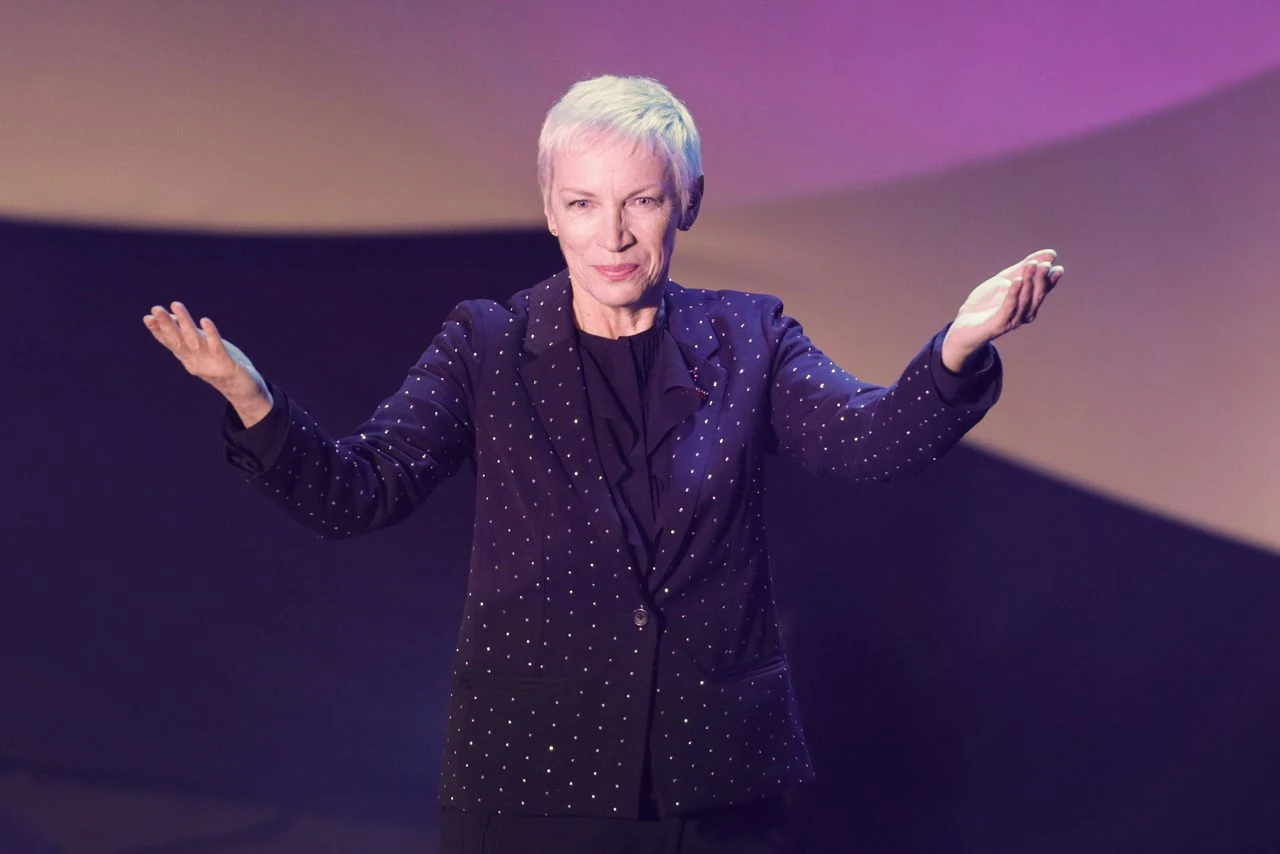
Annie Lennox’s career has moved between two kinds of public voice: the unmistakable lead vocals of Eurythmics and a sustained campaign for people affected by HIV and AIDS. Her music took her from Aberdeen to international audiences; her activism has focused attention on women and children affected by the epidemic and on women’s rights. Neither strand stands apart from the other: Lennox has used the visibility gained as a performer to support causes she regards as urgent.
From Aberdeen to the Royal Academy
Born Ann Lennox in Torry, Aberdeen, on Christmas Day 1954, she grew up in a family that encouraged her artistic interests. At Aberdeen High School for Girls, she studied music, poetry and art, learned the flute and piano, sang in the choir and took part in orchestras, military bands and the Aberdeen Music Festival. She also attended Dalcroze eurhythmics classes, an approach to music education that would later lend its French spelling to the name Eurythmics.
In 1971, Lennox moved to London to study music performance at the Royal Academy of Music. Her studies included flute, piano and harpsichord, but the demands of classical training left her unsure that this was the life she wanted. She did not complete the course. To support herself, she worked part-time, including as a waitress, barmaid and shop assistant, while playing and singing with bands. In 1976 she briefly played flute with Dragon’s Playground; the following year she became lead singer of the Tourists, beginning her musical partnership with Dave Stewart.
The sound and image of Eurythmics
Lennox and Stewart formed Eurythmics in 1980. The duo’s electronic pop gave Lennox room to combine a powerful, soul-inflected voice with a striking visual presence. The 1983 video for “Sweet Dreams (Are Made of This)”, with Lennox’s close-cropped orange hair and tailored suit, became an especially memorable image. Eurythmics went on to record a succession of successful singles, including “Love Is a Stranger”, “Here Comes the Rain Again”, “There Must Be an Angel (Playing with My Heart)” and “Would I Lie to You?”. Their work helped establish a sound and look that made Lennox one of the defining British pop performers of the 1980s.
Her achievements were not confined to the duo. Eurythmics received Brit Awards, including an Outstanding Contribution to Music award in 1999, and Lennox has won eight Brit Awards in all, six times named Best British Female Artist. The pair returned to recording with the album Peace in 1999 and toured afterwards, donating the tour’s profits to Greenpeace and Amnesty International. Their later recognition included induction into the Songwriters Hall of Fame in 2020 and the Rock and Roll Hall of Fame in 2022.
A solo career with its own voice
Lennox began her solo career with Diva in 1992. The album reached number one in the UK and introduced songs including “Why” and “Walking on Broken Glass”, whose period-style video featured Hugh Laurie and John Malkovich. Her second album, Medusa (1995), took a different approach: it consisted of cover versions, including “No More ‘I Love You’s’” and “A Whiter Shade of Pale”. The former reached number two in the UK singles chart and won Lennox a Grammy for Best Female Pop Vocal Performance.
Further albums included Bare (2003), Songs of Mass Destruction (2007), A Christmas Cornucopia (2010) and Nostalgia (2014), a collection of soul, jazz and blues songs. Lennox also earned major recognition for “Into the West”, written with Fran Walsh and Howard Shore for The Lord of the Rings: The Return of the King. The song won the Academy Award for Best Original Song, as well as a Golden Globe and a Grammy, in 2004. She performed “Little Bird” at the closing ceremony of the London 2012 Olympic Games, and in 2015 became the first woman to be made a fellow of the British Academy of Songwriters, Composers and Authors.
Campaigning through music
Lennox’s campaigning has made HIV and AIDS, particularly their effects on women and children in Africa, a sustained focus of her public work. In 2007, she established the SING campaign to raise funds and awareness. Its song “Sing”, recorded with prominent female artists and members of the South African Treatment Action Campaign’s vocal group the Generics, grew from her involvement with the Treatment Action Campaign and the 46664 initiative. The project connected a pop recording with an established campaign for education and healthcare for people affected by HIV.
In 2008, Lennox founded The Circle, a charitable organisation intended to connect people and raise funds for women’s projects around the world. The focus on women’s rights has continued alongside her AIDS campaigning. Her public advocacy has included speaking at the British House of Commons about the importance of children in the UK engaging with their counterparts in Africa, and using public appearances to draw attention to the epidemic. In 2010 she was named a UNESCO Goodwill Ambassador for AIDS. She received the OBE in 2011 for her humanitarian work.
Her advocacy has also included support for Amnesty International and Greenpeace. The Eurythmics Peace tour’s donation to those organisations was one expression of that commitment; Lennox has also spoken publicly on political and humanitarian issues. In 2013, Archbishop Desmond Tutu praised her AIDS activism and support for South Africa’s Treatment Action Campaign. The recognition she has received for campaigning sits alongside, rather than replacing, her musical achievements.
Recognition and continuing influence
Lennox’s honours reflect both sides of her career. Alongside her Brit Awards and Grammy Awards, she received the Billboard Century Award in 2002. In 2004, “Into the West” brought the Academy Award and Golden Globe as well as the Grammy. The OBE recognised her humanitarian work, while the 2015 fellowship from the British Academy of Songwriters, Composers and Authors marked her place in the songwriting profession.
Her connection to music education has also continued. In 2017, the Royal Academy of Music awarded her an honorary doctorate. She became Glasgow Caledonian University’s first female chancellor in 2017; her term ended in 2024, and a university building was named after her. These roles extend her influence beyond recordings and performances, linking a working musician’s career to education and public life in Scotland and the wider UK.
Why Annie Lennox deserves a place in British Legacy
Annie Lennox belongs in British Legacy because her musical achievements are both distinctive and substantial. As the lead singer of Eurythmics, she helped make a British act internationally recognised through songs such as “Sweet Dreams (Are Made of This)” and “There Must Be an Angel (Playing with My Heart)”. Her solo work then established a separate career, from the chart-topping Diva to the Grammy-winning “No More ‘I Love You’s’” and the Academy Award-winning “Into the West”. The awards tell part of the story; her vocal identity, songwriting and visual presence also helped shape how British pop could sound and appear.
Her contribution to public life is equally specific. Through SING, Lennox connected music with efforts to raise awareness and funds for people affected by HIV and AIDS, working in the context of the Treatment Action Campaign and 46664. The Circle extended her work into support for women’s projects around the world. These initiatives show how a performer’s public reach can be directed towards causes that often receive less attention. Her career joins British popular music to practical, international campaigning, while her honours and work in education reflect a continuing connection to cultural life in the UK. That combination, rather than celebrity alone, gives her a lasting place in the country’s musical and humanitarian history.
Sources
Annie Lennox — Wikipedia, revision 1378725568
Adapted in part from Annie Lennox by Wikipedia contributors, under CC BY-SA 4.0. Text has been edited and combined with the existing article; this adapted text is shared under the same licence. Contributor history.