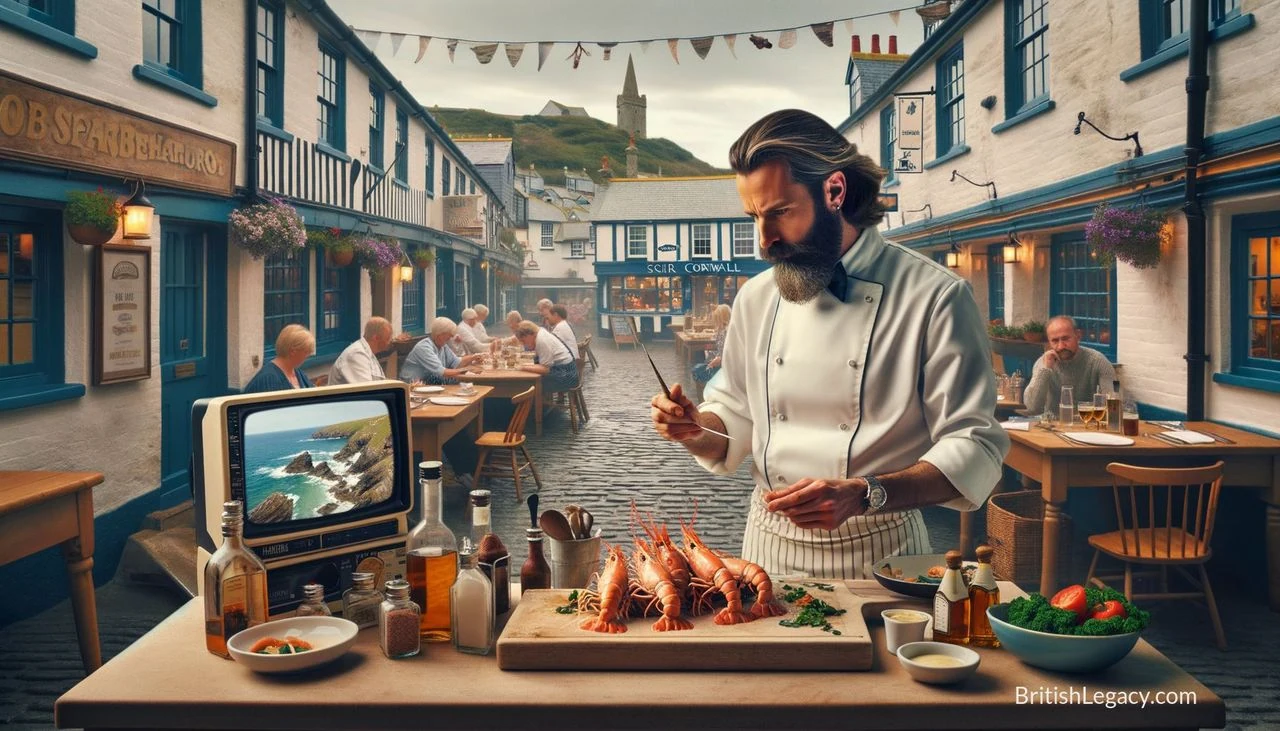
Rick Stein’s public career began not with a celebrated seafood restaurant but with a nightclub beside Padstow harbour. When the club lost its licence, Stein and his business partner still had a restaurant licence elsewhere in the building. Continuing with the restaurant helped them avoid bankruptcy. In 1975, Stein and his first wife, Jill, turned it into The Seafood Restaurant. That practical beginning became the foundation of a business and a television career closely associated with Cornwall and the cooking of fish.
Before the restaurant: Oxfordshire, Australia and Oxford
Christopher Richard Stein was born on 4 January 1947 in Churchill, Oxfordshire, and grew up on a farm. He attended preparatory schools before Uppingham. After school, he began a hotel-management traineeship with British Transport Hotels at the Great Western Royal Hotel in Paddington, where he worked as a chef for six months. He later travelled to Australia, working in an abattoir and a naval dockyard, and also spent time in New Zealand and Mexico.
Stein subsequently applied to New College, Oxford, and graduated with a degree in English in 1971. While a student, he had run a mobile disco in Padstow with a friend, Johnny. After graduating, he returned to the town and converted the disco into a quayside nightclub. The club became known for freeze-dried curries, but frequent fights with local fishermen contributed to its closure by police. The restaurant licence in another part of the building offered a way to keep the business going. Stein, drawing on experience he had gained as a commis chef, ran the kitchen; the restaurant developed into a small harbour-side bistro.
A Cornish restaurant business takes shape
The Seafood Restaurant opened in 1975, with Jill Stein as a partner in the restaurant and hotel business. It became the base for a wider collection of food and hospitality ventures. The business grew to include restaurants, shops and hotels in Padstow, as well as restaurants in other English towns. Its Cornish operations included St Petroc’s Bistro, Stein’s Fish & Chips and the Cornish Arms at St Merryn. Stein also opened restaurants beyond Cornwall, including in Winchester and Barnes, London.
Expansion brought changes as well as openings. Stein and Jill took over the Cornish Arms in 2009, intending to keep it as a traditional Cornish pub. Stein’s Falmouth restaurant closed in October 2020. The Porthleven restaurant, closed from March that year during the COVID-19 pandemic, was confirmed as permanently shut in June. In 2015, the business was reported to include four restaurants, a bistro, a café, a seafood delicatessen, a pâtisserie, a gift shop and a cookery school. These details show the range that had grown around the original harbour-side restaurant.
Stein’s work also extended overseas. In October 2009, he and Sarah Burns opened Rick Stein at Bannisters in Mollymook, New South Wales; a second restaurant followed at Port Stephens in 2018. The Australian restaurants placed his name in a different coastal setting, while continuing his interest in fish and shellfish.
From cookery books to television travelogues
Stein first appeared on television as a guest chef in Keith Floyd’s Floyd on Fish in 1985 and Floyd on Food the following year. He went on to present his own BBC cookery programmes, often shaped as journeys through a region’s food. His series included Taste of the Sea, Seafood Odyssey, Food Heroes, French Odyssey, Mediterranean Escapes, Far Eastern Odyssey, Spain and India. This travelling format brought cooking together with places and local food traditions, making the journey part of the programme rather than merely a backdrop to recipes.
Books accompanied many of the series. His English Seafood Cookery, published in 1988, won the Glenfiddich Cook Book of the Year award in 1989. Other books carried the travel-and-food format into print, among them Rick Stein’s Food Heroes, Rick Stein’s French Odyssey and Rick Stein’s India. His television and publishing work took his career beyond restaurant cooking: audiences could encounter his food writing and programmes at home as well as in Cornwall.
The broadcasts ranged well beyond seafood, taking Stein through France, the Mediterranean, the Far East, Spain and India, among other places. The pairing of a journey with a cookery book gave this work a lasting form: viewers could follow a route on screen and return to the dishes in print. His Jack Russell terrier, Chalky, sometimes accompanied him on screen. Chalky became popular enough for Sharp’s Brewery to name two speciality beers after him.
Honours, business and change
Stein was appointed OBE in the 2003 New Year Honours for services to tourism in Cornwall. He was later appointed CBE in the 2018 New Year Honours for services to the economy. The awards reflect a public career in which hospitality and regional tourism were closely linked: the restaurant group became a prominent part of Padstow’s visitor economy, while television introduced viewers to the town and its food.
That prominence was not without local tension. In 2007, threats were made against Stein’s businesses by Cornish nationalists, and Padstow acquired the nickname “Padstein” in connection with the scale of his impact on the town. The detail complicates any simple account of expansion as unqualified success. A restaurant group can attract visitors and employment while also becoming a conspicuous presence in the place where it operates.
Stein and Jill’s marriage ended in divorce in 2007, but they agreed to continue running the business together. Stein married Sarah Burns in 2011. The Padstow operation therefore continued to be associated with both Stein and Jill, even as their personal lives changed. The breadth of the group—restaurants, shops, hotels and cookery activities—depended on more than the public figure seen presenting programmes.
Why Rick Stein deserves a place in British Legacy
Rick Stein deserves a place in British Legacy because his career connects a specific British coastal town with changes in how British food has been cooked, discussed and presented. The Seafood Restaurant began in Padstow in 1975 after the nightclub that preceded it lost its licence. From that uncertain start, Stein and Jill built a hospitality business whose restaurants and related ventures became closely identified with the town. Stein’s OBE for services to tourism in Cornwall makes that regional connection explicit; his later CBE recognised services to the economy.
His influence also travelled through television and books. Programmes such as Seafood Odyssey, Food Heroes and India invited audiences to consider food in relation to region and culture, while accompanying books carried recipes and journeys beyond the broadcast. His career helped establish a recognisable form of cookery television in which travel and food were presented together. The business’s expansion into other English locations and Australia demonstrates the reach of a career that began in Padstow, while its closures and local tensions remind us that growth has consequences as well as rewards. Stein’s legacy lies in that combination: a substantial body of food writing and broadcasting, a long-running restaurant enterprise, and a lasting association between Cornwall, seafood and the wider public imagination of British food.
Sources
Rick Stein — Wikipedia revision 1378707342 · Rick Stein — Wikipedia
Adapted in part from Rick Stein by Wikipedia contributors, under CC BY-SA 4.0. Text has been edited and combined with the existing article; this adapted text is shared under the same licence. Contributor history.