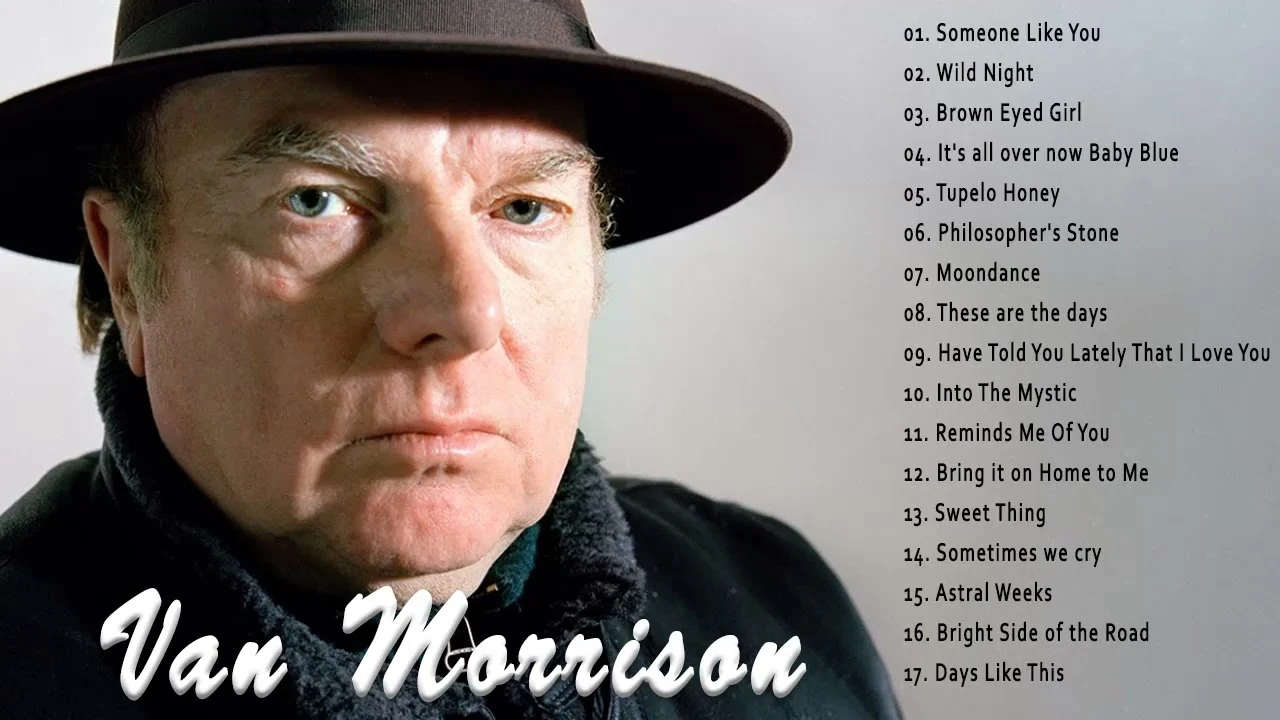
Van Morrison’s music can move from a tightly shaped rhythm-and-blues song to an extended performance in which a repeated phrase seems to open into something new. That range took shape in Belfast, where he grew up listening to his father’s record collection, learned several instruments and played in local bands before becoming the singer of Them. His solo career brought popular songs as well as albums that took greater musical risks. The work remains rooted in Northern Ireland, even as it has travelled far beyond it.
Belfast beginnings and the road to Them
George Ivan Morrison was born in Belfast on 31 August 1945. His mother, Violet, had been a singer and tap dancer; his father, George, was a shipyard electrician with a large record collection. At home, Morrison heard blues, jazz, gospel, folk and country performers, including Ray Charles, Lead Belly, Mahalia Jackson and Hank Williams. His father bought him his first acoustic guitar when he was 11. Morrison later learned saxophone and music reading, and his early musical education came from a broad range of records rather than one genre.
He attended Elmgrove Primary School and Orangefield Boys Secondary School, leaving in 1960 without qualifications. Music was already a practical pursuit. As a boy he formed skiffle groups and played in local bands. At 17, he toured Europe with the International Monarchs, an Irish showband whose engagements included clubs and US Army bases in Scotland, England and Germany. The band recorded a single in Cologne in 1963, Morrison’s first recording.
In 1964, he helped form Them, the Belfast rhythm-and-blues band that established his wider reputation. Its performances at the Maritime Hotel drew attention for their energy and improvisation. Morrison sang and played saxophone and harmonica, and wrote songs including “Gloria”, which he first performed on stage. Released as the B-side of “Baby, Please Don’t Go”, it became a rock standard through recordings by other artists. Them also had chart hits with “Baby, Please Don’t Go”, “Here Comes the Night” and “Mystic Eyes”.
The band toured the United States in 1966, but disputes with its management and the expiry of its members’ work visas contributed to its break-up. Morrison turned towards writing the songs that would later appear on his first major solo album. The transition was not straightforward: a record contract, disputes over control and the challenge of finding work all formed part of his early solo years.
From “Brown Eyed Girl” to Astral Weeks
Morrison began his solo recording career with Bang Records in 1967. “Brown Eyed Girl”, from Blowin’ Your Mind!, became a major American hit. The album itself was released without his consultation, and after producer Bert Berns died, Morrison became involved in a contract dispute with Berns’s widow. Warner Bros. Records bought out the Bang contract, giving him the opportunity to record for a new label.
The result was Astral Weeks (1968), an album that initially attracted limited public attention but later became widely regarded as a classic. Rather than follow the compact structure of a pop single, its songs make room for extended performances, poetic images and shifts in mood. “Madame George” and “Sweet Thing” help establish its distinctive atmosphere. The album’s reputation grew over time; it has appeared on major best-album lists and was voted the top Irish album of all time in a 2009 poll of Irish musicians.
Moondance (1970) took another direction. Its more formally arranged songs and lively rhythm-and-blues sound reached a broader audience, and the album became a commercial success. The title track, “And It Stoned Me” and “Into the Mystic” became among Morrison’s best-known songs. Rather than choosing between the accessible and the exploratory, he continued to move between them. Tupelo Honey brought country-soul textures; Saint Dominic’s Preview returned to longer, more meditative forms; and Veedon Fleece, written after a visit to Ireland, later acquired a strong critical reputation despite little initial attention.
The 1970s also included a notable live period. It’s Too Late to Stop Now, recorded during a 1973 tour with the Caledonia Soul Orchestra, captures Morrison performing with a large backing group. After a period of stage anxiety, he rebuilt his confidence in smaller venues. At the 1976 farewell concert for the Band, he performed “Caravan” from Moondance; the concert was filmed for Martin Scorsese’s The Last Waltz.
A sound shaped by voice, place and improvisation
Morrison’s catalogue draws on soul and early rhythm and blues, alongside jazz, folk, rock, gospel, country and traditional Irish music. His characteristic voice can be rough-edged and forceful, then suddenly quiet or intimate. Phrasing, repetition and changes in musical texture often carry as much weight as a plainly stated narrative. Spiritual searching and memory recur, as does the pull of Belfast: “Cyprus Avenue”, “Orangefield” and “On Hyndford Street” take their names from places associated with his youth.
His songs do not always settle into a fixed form. In performance, Morrison has often rearranged material and relied on spontaneity rather than reproducing a record exactly. The live album It’s Too Late to Stop Now documents one important period of that work on stage. In 2008, he performed Astral Weeks in full at the Hollywood Bowl; the concerts were released as a live album and film. He has said he believes in the jazz practice of not performing a song the same way twice.
Collaboration has provided another route through his musical interests. He recorded traditional Irish songs with the Chieftains for Irish Heartbeat (1988), worked with blues musician John Lee Hooker, and made a country duet album with Linda Gail Lewis. Other collaborators have included Georgie Fame, Cliff Richard, Ray Charles, Eric Clapton and Joey DeFrancesco. The range is not simply a list of styles: it reflects a career in which Morrison repeatedly returned to the music that first formed his ear while testing different arrangements and ensembles.
Several later albums made the connection to his childhood more explicit. Beautiful Vision included “Cleaning Windows”, a reference to one of his first jobs after leaving school. Down the Road (2002) revisited genres he had explored across his career and included a tribute to his father. Morrison has also described the healing power of music as a recurring concern in his work, particularly from Into the Music onwards.
Belfast recognised, a career still in motion
Morrison’s connection to Belfast has remained visible alongside a career spent in several countries. In 2013, the city awarded him its Freedom, one of its highest honours. A year later, the Van Morrison Trail was established in East Belfast in partnership with the Connswater Community Greenway. Its route links places associated with his life and music. The markers are practical expressions of a relationship also present in the songs: a local landscape repeatedly recalled and reworked for listeners elsewhere.
His honours include two Grammy Awards, induction into the Rock and Roll Hall of Fame in 1993 and the Songwriters Hall of Fame in 2003, and the 1994 Brit Award for Outstanding Contribution to Music. He received an OBE in 1996 and was made a Knight Bachelor for services to the music industry and tourism in Northern Ireland. The supplied Wikipedia revision gives conflicting years for the knighthood, so no year is stated here. Morrison has also received honorary degrees from the University of Ulster and Queen’s University Belfast.
His recording career continued through successive decades. Albums such as Avalon Sunset, The Healing Game and Keep It Simple followed different paths through his established interests. After turning 70, he released a run of albums that included jazz standards, blues, country songs and skiffle. Latest Record Project, Volume 1 returned him to the UK top ten in 2021, extending a run of top-ten album success across four consecutive decades. His songs also reached cinema audiences: his work was used extensively in Kenneth Branagh’s film Belfast, and “Down to Joy” received an Academy Award nomination for Best Original Song.
Morrison’s public statements during the COVID-19 pandemic drew criticism. He opposed restrictions affecting live music and released songs protesting against lockdowns. Northern Ireland’s health minister, Robin Swann, criticised his remarks. Swann sued Morrison for defamation, and Morrison later brought legal proceedings against Swann over an opinion piece. Both claims were settled confidentially shortly before their respective court proceedings were due to begin in 2024. This episode is part of the public record of a long career, but it does not explain or define the music itself.
Why Van Morrison deserves a place in British Legacy
Van Morrison’s place in British Legacy rests first on the way his work connects a particular home city with music that has travelled far beyond it. Belfast is not merely a point of origin in his biography: its streets and schools recur in song titles, while the city’s musical life helped form the performer who emerged with Them. His later Freedom of Belfast and the East Belfast trail make that relationship tangible. They recognise a body of work that has repeatedly returned to the places and memories from which it began.
His musical achievement is equally specific. Morrison moved from the direct force of “Gloria” and the hit-making craft of “Brown Eyed Girl” to the open-ended forms of Astral Weeks, then made Moondance a popular statement of his own. Across decades of recording and performance, he has brought rhythm and blues, jazz, soul and Irish traditions into conversation without settling into one formula. That range gives listeners different ways into his catalogue: the familiar song, the band-driven performance and the extended musical passage. His influence has reached performers across genres, while his work has helped bring Northern Irish places and musical traditions to international audiences. Remembering Morrison in British Legacy means recognising both the particular roots of his work in Belfast and the reach it has gained through recording, performance and continuing engagement with musical traditions.
Sources
Van Morrison — Wikipedia, revision 1379250399
Adapted in part from Van Morrison by Wikipedia contributors, under CC BY-SA 4.0. Text has been edited and combined with the existing article; this adapted text is shared under the same licence. Contributor history.