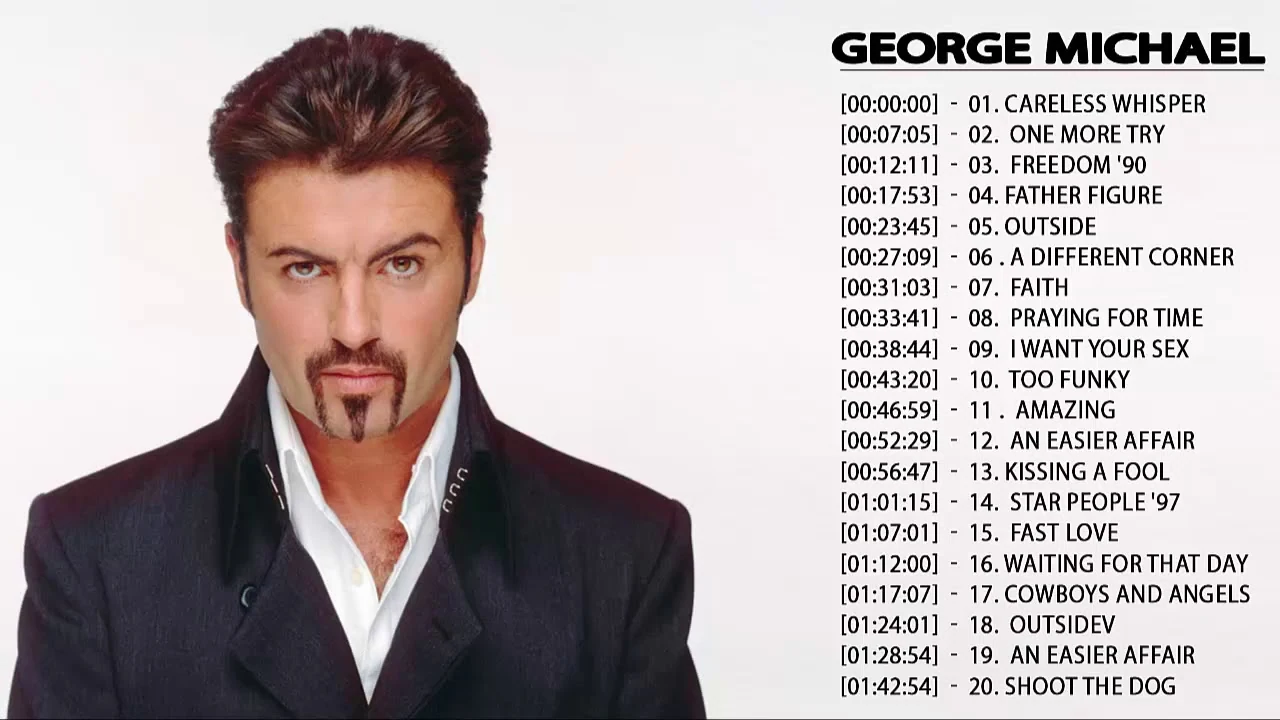
George Michael’s songs could sound effortless: the bright rush of Wham!, the poised confidence of Faith, the self-questioning of ‘Freedom! ’90’ and the annual return of ‘Last Christmas’. Their ease was an achievement, not an accident. Across a career that moved from teenage pop to adult soul and balladry, Michael made records with immediate appeal and a more complicated emotional life beneath it. His writing could be tender, wry, defensive or wounded without losing its command of melody.
Born Georgios Kyriacos Panayiotou in East Finchley on 25 June 1963, Michael grew up in a London family with Greek Cypriot and English roots. With schoolfriend Andrew Ridgeley, he formed Wham!, then built a solo career that brought exceptional commercial success and a public struggle for artistic control. He also supported charitable causes, sometimes through conspicuous performances and sometimes away from the spotlight. His story is not simply one of records and awards: it is about the choices, costs and generosity behind a carefully made public image.
The songwriter inside Wham!
Michael spent much of his childhood in Kingsbury, north-west London, and attended Roe Green Junior School and Kingsbury High School. When he was in his early teens, his family moved to Radlett. At Bushey Meads School in Bushey, he met Ridgeley, who shared his ambition to become a musician. Michael busked on the London Underground, worked as a DJ at a restaurant, clubs and local schools, and formed the short-lived ska band the Executive with Ridgeley and others. These early steps preceded Wham!, which the two friends formed in 1981. Michael adopted his stage name as the duo approached fame.
Wham!’s cheerful image—dance routines, vivid clothes and sunlit videos—made the pair an immediate pop presence. But Michael was more than the voice at the front of it. He was a songwriter with a strong sense of melody and structure, able to give polished pop an unsettled edge. The group’s first album, Fantastic, reached number one in Britain in 1983. Their second, Make It Big, also topped the US chart.
‘Young Guns’, ‘Club Tropicana’, ‘Wake Me Up Before You Go-Go’ and ‘Everything She Wants’ show different sides of Michael’s skill. Their hooks are direct, but their rhythms and phrasing give them character. ‘Everything She Wants’ places adult uncertainty inside a song made for a broad audience. Michael understood that bright production did not require simple feeling: a crowd could sing along while the music left room for something less settled.
‘Careless Whisper’, conceived during the Wham! years and released as a solo single in most territories, made a different kind of contrast. Its polished arrangement and instantly recognisable melody carry regret rather than carefree exuberance. The song topped the charts in nearly 25 countries, including Britain and the United States. It became one of the recordings most readily associated with Michael, even as his work continued to change around it.
Wham!’s reach extended beyond the charts. In April 1985, the duo became the first Western popular music act to tour China, a visit that attracted worldwide media coverage. Their performances brought British pop into an unfamiliar cultural setting at a time when many kinds of music were forbidden there. In Britain, Michael’s career was also connected to two of the decade’s most prominent musical responses to famine. He sang on Band Aid’s ‘Do They Know It’s Christmas?’ and performed with Elton John at Live Aid at Wembley Stadium in July 1985. He donated profits from ‘Last Christmas’ and ‘Everything She Wants’ to charity.
Michael wrote and produced ‘Last Christmas’, released in December 1984. Band Aid’s record held it at number two that year, but the song went on to acquire a lasting place in British festive life. It finally reached number one in the UK singles chart in 2021, then became the Christmas number one in 2023 and repeated the feat in 2024. Its buoyant surface and melancholy story occupy the same song without cancelling one another out, a combination that helps explain its continuing appeal.
Faith and a solo identity
After Wham! ended in 1986, Michael faced the familiar risk of being treated as a former teen idol whose success belonged to an earlier moment. Instead, he used his first solo phase to widen his musical range and take greater control of how he appeared. Before the release of his debut album, he recorded ‘I Knew You Were Waiting (For Me)’, a duet with Aretha Franklin. It topped the British and US singles charts, and the pair won a Grammy for Best R&B Performance by a Duo or Group with Vocal.
‘I Want Your Sex’, the first single from Faith, challenged radio caution and simplistic tabloid readings. It was banned by some stations in Britain and the United States, while others played a toned-down version. Michael said the song was about sex within a monogamous relationship. ‘Faith’ brought rockabilly-inflected swagger to a solo identity drawing on soul as well as pop. Michael was not rejecting popularity; he was demonstrating that it did not have to dictate his terms.
Released in 1987, Faith topped the UK albums chart and spent 12 weeks at number one in the United States. It produced four US number-one singles and sold more than 25 million copies worldwide. The album won the Grammy Award for Album of the Year, and Michael received the BRIT Award for British Male Solo Artist in 1988. Its scale was remarkable, but its significance also lay in the balance between finish and personality. Michael could deliver a forceful chorus and polished production while making room for hesitation, longing and restraint.
He did not need to discard Wham!’s accessibility to make more adult work. He could sing with an R&B softness, write a chorus with immediate commercial force and still allow uncertainty into a song. The result was neither a rejection of pop nor a retreat from its audience. Faith established Michael as a major international solo star while leaving open the question of how much control a star could exercise over the image that helped sell the music.
Authorship, independence and a second act
Listen Without Prejudice Vol. 1, released in 1990, challenged the idea that a pop career should remain organised around the performer’s image. Its title asked listeners to hear the work before judging the person. ‘Praying for Time’ looks outwards at injustice and hypocrisy; ‘Freedom! ’90’ turns inwards, questioning the bargain between celebrity and identity. Michael chose not to appear in most of the project’s videos. For ‘Freedom! ’90’, he used supermodels to lip-sync in his place, turning his absence into part of the song’s argument.
The album topped the UK chart and won the BRIT Award for British Album in 1991. Michael’s refusal to promote it in the manner of Faith was more than a change in presentation: he wanted the music to be taken seriously on its own terms. His dispute with Sony in the early 1990s was costly and personally draining. It brought into public view questions that remain familiar to musicians: how much control should a record company have over an artist’s career and public identity, and does commercial success oblige an artist to remain the version of themselves that first sold records?
During this period Michael also supported AIDS-related causes through the project Red Hot + Dance, to which he contributed songs and royalties. He performed with Queen and Lisa Stansfield at the Freddie Mercury Tribute Concert at Wembley Stadium in 1992. The related Five Live EP included performances from the concert and his own tour; its proceeds benefited the Mercury Phoenix Trust.
When Michael returned with Older in 1996, the album sounded shaped by loss and maturity. ‘Jesus to a Child’ was a tribute to Anselmo Feleppa, who died in 1993; ‘Fastlove’ offered a sleek, more immediate counterpoint. The record did not try to recreate the energy of his earlier pop stardom. It let different emotional registers sit alongside one another and showed that Michael’s career could keep changing after its most commercially successful period. He received the BRIT Award for British Male Solo Artist in 1997, and across his career won six Ivor Novello Awards for songwriting.
Michael continued to release and perform music into the 2000s. Patience, issued in 2004, reached number one in Britain. His 25 Live tour ran from 2006 to 2008, and in 2007 he became the first artist to perform live at the newly renovated Wembley Stadium. He also joined Paul McCartney on stage at the 2005 Live 8 concert in Hyde Park, singing ‘Drive My Car’.
Public exposure and private costs
Michael’s public life was not tidy, and the pressure on him was artistic, sexual and personal. The death of Feleppa and later the death of his mother brought grief into a life already subject to intense press scrutiny. His life also included drug use and legal troubles. In 1998, an arrest in Beverly Hills brought his sexuality into public view on terms he had not chosen. That episode became part of a story often told more through scandal than through the music that had made him famous.
Michael responded in ‘Outside’, meeting the episode with humour. In the years that followed, he became more openly identified as a gay man, an LGBTQ rights campaigner and a fundraiser for HIV/AIDS causes. The significance is not that a public figure’s private life should become spectacle. Rather, his experience shows how little control a performer may have over the terms on which personal identity becomes public—and how a songwriter can answer that exposure by reclaiming some of the narrative through work.
Michael’s performances reflected a continuing commitment to delivery, arrangement and contact with an audience. His 25 Live tour brought him back to the stage on a large scale. In 2011 he developed pneumonia in Vienna, became critically ill and briefly fell into a coma. He recovered and resumed the Symphonica tour. Its final concert, at Earls Court in London in October 2012, was also the last concert of his life.
Michael died at his home in Goring-on-Thames on 25 December 2016, aged 53. The death certificate recorded dilated cardiomyopathy with myocarditis and fatty liver disease as causes. He was buried at Highgate Cemetery in London. His death closed a career, but not the life of the songs, which continued to move between radio, chart history and private memory.
Generosity beyond the spotlight
Michael’s charitable work accompanied his rise to fame. His participation in Band Aid and Live Aid connected pop performance with famine relief. Later support included AIDS-related causes through projects such as Red Hot + Dance and the Elton John AIDS Foundation, of which he was a patron. In 2006, he gave a free concert for NHS nurses at London’s Roundhouse, thanking them for the care given to his late mother. The performance was a specific gesture towards people whose work had touched his family.
After his death, charities described support for Childline, the Terrence Higgins Trust and cancer charities, often given without publicity. Michael’s charitable record included public events as well as private donations. That quieter aspect offers a counterpoint to the highly visible machinery of pop stardom, without smoothing away the difficulties and contradictions of his life.
The George Michael Fund has continued another form of this work. On the 40th anniversary of ‘Last Christmas’, royalties from the song were used to make grants to organisations working with children and young people across the United Kingdom. A recording that had become part of the country’s seasonal popular culture also provided a source of charitable support. Its afterlife is not only a matter of chart returns: its continuing success has been connected to practical assistance for organisations serving young people.
Recognition of Michael’s place in music continued after his death. He was inducted into the Rock and Roll Hall of Fame in 2023, and the Royal Mint issued a collectable coin featuring him in 2024. The Radio Academy named him the most played artist on British radio between 1984 and 2004. These honours and records of airplay mark the scale of his reputation, but they do not explain it on their own. The more revealing measure is the range of work that remains in circulation: Wham!’s exuberant singles, searching solo albums, the intimacy of ‘Careless Whisper’ and the annual return of ‘Last Christmas’.
Why George Michael deserves a place in British Legacy
George Michael deserves a place in British Legacy because he made British pop internationally successful and emotionally specific at once. His career began in a north London school friendship, passed through Wham!’s mass appeal and developed into a solo body of work that could address desire, grief, fame and identity without abandoning melody or a broad audience. ‘Faith’, ‘Freedom! ’90’, ‘Careless Whisper’, ‘Fastlove’ and ‘Last Christmas’ are not interchangeable monuments to celebrity. Each demonstrates a different command of songwriting and performance. Their contrasting emotional tones are part of their staying power: they are immediately recognisable without becoming emotionally simple.
His work also made a distinct contribution to British popular culture. Wham!’s 1985 China tour marked an unusual international moment for a British pop act, while the duo’s records and Michael’s solo writing travelled well beyond their London beginnings. ‘Last Christmas’ became part of the country’s seasonal listening and reached the Christmas number one in consecutive years in 2023 and 2024. These are specific examples of a British songwriter finding both an international audience and a continuing place in everyday life at home.
Michael’s legacy includes the insistence that a successful performer should be allowed to grow beyond the image that first made him famous. His decision to step away from the centre of the Listen Without Prejudice videos and his dispute with Sony gave artistic independence a public, personal dimension. He showed that commercial popularity did not remove the need to negotiate control over one’s work and public identity. That struggle remains relevant to musicians, but it is also part of his own career’s shape: the move from teen-pop phenomenon to an artist determined to be heard on different terms.
His growing openness about being gay, alongside support for HIV/AIDS causes, gave his public life a significance beyond the records. So did charitable work connected to his music: from famine relief and the NHS nurses’ concert to grants for organisations supporting children and young people. These contributions link his fame to specific benefits for others. The songs continue to provide pleasure and companionship, while some of their success has also helped fund practical support. That combination—lasting musical craft, a serious claim to artistic independence and tangible generosity—makes George Michael’s British legacy distinctive and enduring.
Sources
George Michael · George Michael
Adapted in part from George Michael by Wikipedia contributors, under CC BY-SA 4.0. Text has been edited and combined with the existing article; this adapted text is shared under the same licence. Contributor history.