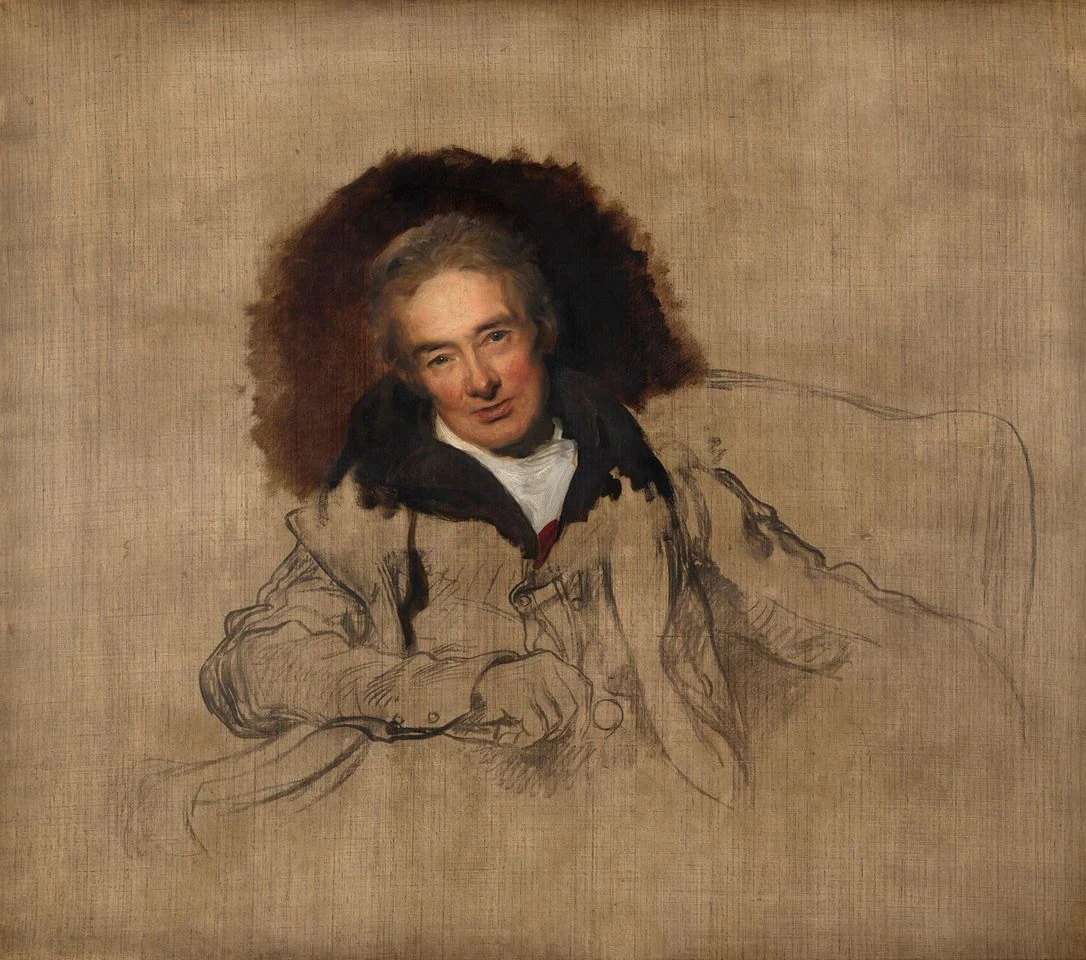
William Wilberforce’s best-known achievement was not the abolition of slavery itself, but the end of Britain’s participation in the transatlantic slave trade. As an MP, he led the parliamentary campaign that secured the Slave Trade Act of 1807, after years of defeat, delay and changing political circumstances. He continued to support the cause of emancipation, but died in 1833 before the Slavery Abolition Act took effect. His life also encompassed evangelical campaigning, philanthropy and a conservative politics that could conflict sharply with the rights of people at home.
Hull, Cambridge and Parliament
Wilberforce was born in Kingston upon Hull on 24 August 1759, the only son of merchant Robert Wilberforce and Elizabeth Bird. His grandfather had made the family’s fortune through maritime trade with Baltic countries and had twice been mayor of Hull. After his father died in 1768, the young Wilberforce spent time with relatives in London and Wimbledon before returning to Yorkshire. He attended Hull Grammar School and Pocklington School, then matriculated at St John’s College, Cambridge, in 1776.
At Cambridge he formed a close friendship with William Pitt, later prime minister. Wilberforce was elected MP for Kingston upon Hull in 1780, while still a student, and later represented Yorkshire and Bramber. He sat as an independent, rather than committing himself to a party, and worked with governments of different political alignments. His public speaking attracted notice, but his parliamentary career was not simply a story of eloquence: he also pursued measures on subjects ranging from election procedures to criminal justice.
In 1785, during a European tour, he underwent an evangelical conversion that reshaped his religious practice and sharpened his commitment to reform. He considered leaving public life, but the evangelical clergyman John Newton encouraged him to remain in politics. His faith became a source of political purpose, though it also informed views that were often conservative and wary of radical change.
The long campaign against the slave trade
Wilberforce did not begin the abolition campaign alone. Quaker activists and other campaigners had already organised against the trade. In 1787, Thomas Clarkson brought Wilberforce evidence gathered from people connected with the trade, while Granville Sharp and other abolitionists helped build the movement. Charles Middleton urged Wilberforce to raise the issue in Parliament. After discussions with campaigners and with Pitt, Wilberforce agreed to lead the parliamentary effort.
In May 1789, he made his first major speech on abolition in the Commons, drawing on evidence about the treatment of enslaved people during the Atlantic crossing. He introduced resolutions condemning the trade. The campaign then met repeated obstacles: hearings were delayed, bills were defeated and political priorities shifted. A bill in 1791 lost by 163 votes to 88. The outbreak of war with France further complicated efforts, while abolition became associated in public debate with revolution and radicalism.
Wilberforce kept bringing the issue before Parliament through the 1790s and into the next decade. A bill passed the Commons in 1804 but did not complete its passage through the Lords; a renewed attempt failed in 1805. After Pitt’s death, Wilberforce worked more closely with the Whig administration. A change in legislative tactics helped: a measure restricting British subjects’ involvement in the slave trade to French colonies received royal assent in 1806. Wilberforce also set out the abolitionists’ case in a published letter.
In 1807, Lord Grenville introduced an abolition bill in the Lords, and Charles Grey moved its second reading in the Commons. The bill passed the Commons by 283 votes to 16 and became the Slave Trade Act. It ended the British slave trade; it did not itself abolish slavery. Wilberforce and other campaigners continued to press for emancipation, a distinct and unfinished struggle.
Reform, faith and the limits of his politics
Wilberforce’s interests extended well beyond abolition. He supported prison reform, education for poor children, measures to improve conditions for chimney-sweeps and textile workers, and efforts to limit capital punishment. He helped Hannah More and her sister with their Sunday schools in Somerset and the Mendips. He also gave money to charitable causes and supported missionary organisations. His book A Practical View of the Prevailing Religious System, published in 1797, argued for a renewal of Christian belief and practice and became influential.
In 1797, he married Barbara Ann Spooner. They had six children. His religious and philanthropic commitments were accompanied by a strong belief in social order. He opposed workers’ right to organise into unions and supported restrictions on political activity, including measures limiting public meetings. He opposed an inquiry into the Peterloo Massacre and backed the government’s Six Acts. Critics saw a contradiction between his concern for enslaved people and his support for measures that restricted political freedoms and the rights of workers in Britain.
He was also involved in the founding of the Society for the Prevention of Cruelty to Animals, later the RSPCA. Other causes included the Society for the Suppression of Vice and the creation of a free colony in Sierra Leone. His work on religious reform included helping to establish the Church Missionary Society. These activities reflected the breadth of his interests, but they did not make him an advocate of unrestricted liberty or political equality. His record is more accurately understood as a combination of humanitarian reform and a deeply conservative vision of society.
Emancipation, final years and remembrance
Wilberforce continued to support the campaign against slavery after leaving Parliament in 1825, when failing health forced him to resign. He had passed responsibility for leadership in the Commons to Thomas Fowell Buxton, but remained involved in anti-slavery meetings and correspondence. In 1823, he published an appeal arguing that slavery should be ended by parliamentary action. He supported gradual emancipation, while government resistance and political manoeuvring delayed progress.
The Slavery Abolition Act passed in 1833 and abolished slavery in most of the British Empire. Wilberforce heard on 26 July that concessions had secured the bill’s passage. He died three days later, on 29 July, at his cousin’s home in London. Parliament set aside his wish to be buried with members of his family at St Mary’s, Stoke Newington; he was buried in Westminster Abbey, close to his friend Pitt.
His memory became closely associated with the abolition campaign. In Hull, a public subscription funded the Wilberforce Monument, and his birthplace later became Wilberforce House, a slavery museum. A statue was erected in Westminster Abbey in 1840. The history of the campaign has also become more complicated than a single-hero account: Clarkson’s research and mobilisation, and the work of other campaigners, were essential to the cause. Recognising that collective effort gives a fuller account of how abolition was achieved.
Why William Wilberforce deserves a place in British Legacy
Wilberforce deserves a place in British Legacy because he used a parliamentary position to keep the abolition of the British slave trade before the Commons through decades of political resistance. His contribution was not solitary: campaigners including Thomas Clarkson gathered evidence and organised public pressure, while other abolitionists helped turn that work into legislation. Wilberforce’s role was to carry the case into Parliament, where repeated setbacks did not end the campaign. The 1807 Act was a decisive achievement, but it must be described accurately: it abolished the British slave trade, not slavery itself. That distinction matters both to the historical record and to an understanding of the further struggle that followed.
His legacy also invites a more complete account than uncomplicated celebration. Wilberforce supported education, prison reform, animal welfare and charitable work, while his conservative politics led him to oppose workers’ organisation and support restrictions on public protest. Those tensions are part of his history, not a reason to discard it. They show how reform could advance in one area while political rights remained contested in another. Remembering both the scale of his anti-slave-trade campaigning and the limits of his outlook gives British Legacy a grounded example of how sustained political work can help change law—and why the history of such change should include the people, partnerships and conflicts behind it.
Sources
William Wilberforce — Wikipedia, revision 1377558647
Adapted in part from William Wilberforce by Wikipedia contributors, under CC BY-SA 4.0. Text has been edited and combined with the existing article; this adapted text is shared under the same licence. Contributor history.