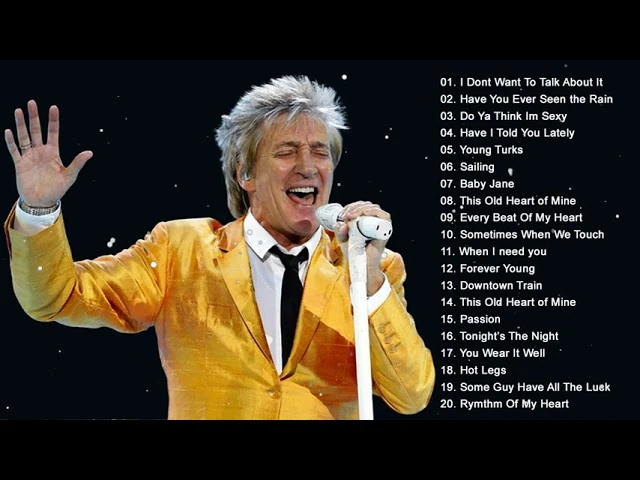
Rod Stewart’s voice does not smooth the edges of a song. It rasps, surges and catches, turning vulnerability into something audible even at arena scale. From the rueful storytelling of Maggie May to the sweep of Sailing and the disco swagger of Da Ya Think I’m Sexy?, he made that grain a signature. His career began in north London’s folk and rhythm-and-blues circles, passed through the Jeff Beck Group and Faces, and grew into one of British popular music’s most enduring solo careers.
Highgate, football and the London club circuit
Born Roderick David Stewart in Highgate on 10 January 1945, Stewart was the youngest of five children. His father, Robert, was Scottish and had worked as a master builder in Leith; his mother, Elsie, was English and had grown up in north London. The family later lived above a newsagent’s shop on Archway Road. At school Stewart captained the football team and played for Middlesex Schoolboys. In 1960 he went for trials at Brentford, but, as he later made clear, was never signed by the club. Music eventually won out over his hopes of becoming a professional footballer.
He left school at 15 and worked briefly as a silk-screen printer, among other jobs. Music came into focus through skiffle, folk and rhythm and blues. He joined a skiffle group with school friends, the Kool Kats, and in 1962 began busking with folk singer Wizz Jones, playing harmonica around London and on trips to France and Spain. The pair travelled as far as Barcelona, where Stewart was deported for vagrancy in 1963. Back in the capital, he entered a busy club scene where he learned by performing rather than through formal musical training.
In 1963 he joined the Dimensions as a harmonica player and occasional singer, then worked with the Hoochie Coochie Men under Long John Baldry. Baldry gave him a place in Steampacket, a revue-style group that also included Brian Auger and Julie Driscoll. Stewart’s sharp dress and hairstyle helped earn him the nickname “Rod the Mod”; the performances gave him an education in timing, stage presence and the demands of singing with a live band. He also made early solo recordings, though these did not yet bring chart success.
Stewart joined Shotgun Express in 1966, alongside musicians including Mick Fleetwood and Peter Green. The group released a single but did not last. Stewart later described it as an unsatisfactory fit: he was still searching for a way beyond other people’s material. The next band would give him a tougher musical setting in which his voice could take centre stage.
The Jeff Beck Group: learning to command a band
In 1967 guitarist Jeff Beck recruited Stewart for the Jeff Beck Group. The pairing placed him alongside a strong, distinctive instrumental voice and gave him the chance to sing against Beck’s forceful guitar. Stewart also played with Ronnie Wood, beginning a friendship that would continue through their work together in Faces. The group toured Britain, Europe and the United States, and released Truth in 1968 and Beck-Ola in 1969. Its blues, folk and rock repertoire provided a demanding framework for a young singer; Stewart later credited the period with helping develop his vocal abilities.
The group’s success in the United States helped establish its place in late-1960s blues-rock, but internal tensions and frequent personnel changes made it an unsettled home. Truth rose to number 15 on the US album chart, while Beck-Ola also reached the US chart and entered the UK chart. Stewart left in 1969, following Wood’s departure. His years with Beck had not simply supplied a route to a larger audience: they had tested how much character a rough voice could carry. He would keep that lesson while moving between bands and musical styles.
Faces, solo beginnings and a breakthrough
In 1969 Stewart and Wood joined the remaining members of Small Faces: Ronnie Lane, Ian McLagan and Kenney Jones. The new line-up became Faces. Its loose, high-energy performances built a devoted live following, while the band’s records combined rock-and-roll drive with fellowship and musical skill. Faces had its own identity and influence; its importance is not merely that Stewart later became more famous as a solo artist. The group’s A Nod Is as Good as a Wink...To a Blind Horse produced its only US top-40 hit, Stay with Me, and its final studio album, Ooh La La, reached number one in the UK.
Stewart’s solo career began alongside the band. An Old Raincoat Won’t Ever Let You Down, also released in the United States as The Rod Stewart Album, brought together original songs and covers, including Ewan MacColl’s Dirty Old Town. Its mix of folk, rock and country blues established a direction that continued on Gasoline Alley, released in 1970. The records drew on music from beyond Britain but were shaped by Stewart’s club experience, choices of material and unmistakable delivery. His own songs sat naturally beside covers, and mandolin became part of the sound.
The turning point came with 1971’s Every Picture Tells a Story. Its single Reason to Believe carried Maggie May on the B-side, but radio listeners took to the latter song and it became Stewart’s breakthrough. The album and single reached number one in the UK and the United States at the same time, a chart first according to the supplied career account. The song’s mandolin gives it a bright, lilting motion; Stewart’s vocal makes its account of young love and regret sound sly, candid and a little embarrassed by itself. He does not stand outside the story to judge it. He sings as if the memory is still close enough to sting.
The album’s title track, driven by a largely acoustic arrangement, conveyed the picaresque movement of its lyrics; Mandolin Wind and a hard-edged reading of (I Know) I’m Losing You showed how readily Stewart could move between folk and soul. Never a Dull Moment followed in 1972. Its single You Wear It Well reached number one in the UK, while the album topped the UK chart. Meanwhile, Faces continued to tour and record. As Stewart’s solo success grew, the balance within the band became harder to sustain. The group broke up in 1975.
Changing sound, lasting recognisability
Stewart entered the middle of the 1970s with his solo profile still rising. Atlantic Crossing (1975) introduced a more polished sound, and its version of the Sutherland Brothers’ Sailing became one of his defining performances. It reached number one in the UK and returned to the charts a year later through its use in a BBC documentary series about HMS Ark Royal. Official Charts identifies it as his biggest-selling UK single. Stewart’s achievement here was interpretation: he could take another writer’s material and give it a performance that seemed to belong to him.
On A Night on the Town (1976), Stewart balanced a “fast side” with a “slow side”. Tonight’s the Night (Gonna Be Alright) topped the US charts for almost two months, while his cover of Cat Stevens’s The First Cut Is the Deepest reached number one in Britain. You’re in My Heart made romantic sentiment into a broad singalong. The Killing of Georgie, meanwhile, told the story of a gay man who is murdered. Its place in a mainstream pop catalogue brought a narrative of sympathy and loss to a wide audience.
By the end of the decade Stewart was changing his approach again. The disco-influenced Da Ya Think I’m Sexy? topped charts in Britain, the United States and elsewhere, although its sound drew criticism from some listeners and critics. The song’s refrain prompted a dispute over its similarity to Jorge Ben Jor’s Taj Mahal. Stewart donated his royalties from the song to UNICEF and performed it at the Music for UNICEF Concert in 1979. The episode captures a recurring feature of his career: he was willing to risk a conspicuous change of style, even when it complicated the reception of his earlier work.
In the early 1980s, Stewart moved towards new wave and synth-pop on releases including Tonight I’m Yours. Young Turks became a US top-five hit, while Baby Jane reached number one in the UK in 1983. Later songs such as Forever Young and Rhythm of My Heart carried his voice into another decade. His 1991 album Vagabond Heart marked a renewed chart presence, and in 1993 he recorded All for Love with Bryan Adams and Sting for the film The Three Musketeers. The single reached number one in the United States and number two in the UK.
Stewart also revisited his earlier work in a quieter form. An MTV Unplugged performance with Wood included songs from Every Picture Tells a Story; the resulting Unplugged...and Seated album reached number two on the US album chart. Such shifts did not always earn the same critical regard as his early-1970s records, but they show why his career cannot be reduced to a single successful period. He kept returning to old strengths while testing different arrangements, collaborators and audiences.
Standards, new songs and public honours
In the early 2000s Stewart turned to standards associated with the Great American Songbook, including work by Cole Porter and George and Ira Gershwin. The project could have looked like a retreat into familiar material. Instead, it gave his phrasing, warmth and sense of timing another setting. The series was commercially successful, and Stardust... The Great American Songbook Volume III won the Grammy Award for Best Traditional Pop Vocal Album in 2005.
In 2013 he returned to original songwriting with Time, after a long period in which he had largely set aside writing his own material. The album went to number one in the UK, his first chart-topping studio album there since A Night on the Town in 1976. Stewart said that writing his autobiography had helped prompt him to write songs again. Subsequent records included Another Country (2015), Blood Red Roses (2018) and The Tears of Hercules (2021). In 2024 he released Swing Fever, recorded with Jools Holland’s Rhythm and Blues Orchestra.
His honours recognise different parts of that public career. Stewart received the Brit Award for Outstanding Contribution to Music in 1993 and was inducted into the Rock and Roll Hall of Fame as a solo artist in 1994. He was inducted again in 2012 as a member of Faces. He was appointed CBE in the 2007 New Year Honours for services to music and knighted in the 2016 Birthday Honours for services to music and charity. He was also inducted into the UK Music Hall of Fame in 2006. The honours sit alongside, rather than replace, the records and performances that made his name.
Why Rod Stewart deserves a place in British Legacy
Rod Stewart deserves a place in British Legacy because his career connects a specifically London musical apprenticeship with a body of work that reached audiences far beyond Britain. He began in the capital’s folk and rhythm-and-blues circuits, busking and singing in working bands before the Jeff Beck Group and Faces gave him different settings in which to develop. His early solo records joined folk, rock, soul and country blues without making the result feel like imitation. Every Picture Tells a Story and Maggie May made that approach internationally visible; Sailing later showed how powerfully he could reinterpret a song written by others. These are not simply famous titles. They demonstrate a singer able to carry a story through texture, timing and personality rather than vocal smoothness.
His lasting significance also lies in the variety of ways he remained present in popular music. Faces was a band with its own force, not just a prelude to solo success. As a solo artist, Stewart moved from the folk-rock of his early records to disco, new wave, ballads, acoustic performance and standards, then returned to writing his own songs with Time. The shifts were not all received equally, but they show how a performer could change direction without losing an identifiable voice. His example widened the space for roughness, humour and vulnerability in British popular singing. The catalogue also offers a vivid route through changing musical fashions, from London club work and 1970s folk-rock to later revivals and standards. That combination of distinctiveness, adaptability and sustained public reach makes Stewart’s career part of Britain’s musical history.
Sources
Rod Stewart — Wikipedia revision 1371942702 · Rod Stewart — Wikipedia
Adapted in part from Rod Stewart by Wikipedia contributors, under CC BY-SA 4.0. Text has been edited and combined with the existing article; this adapted text is shared under the same licence. Contributor history.