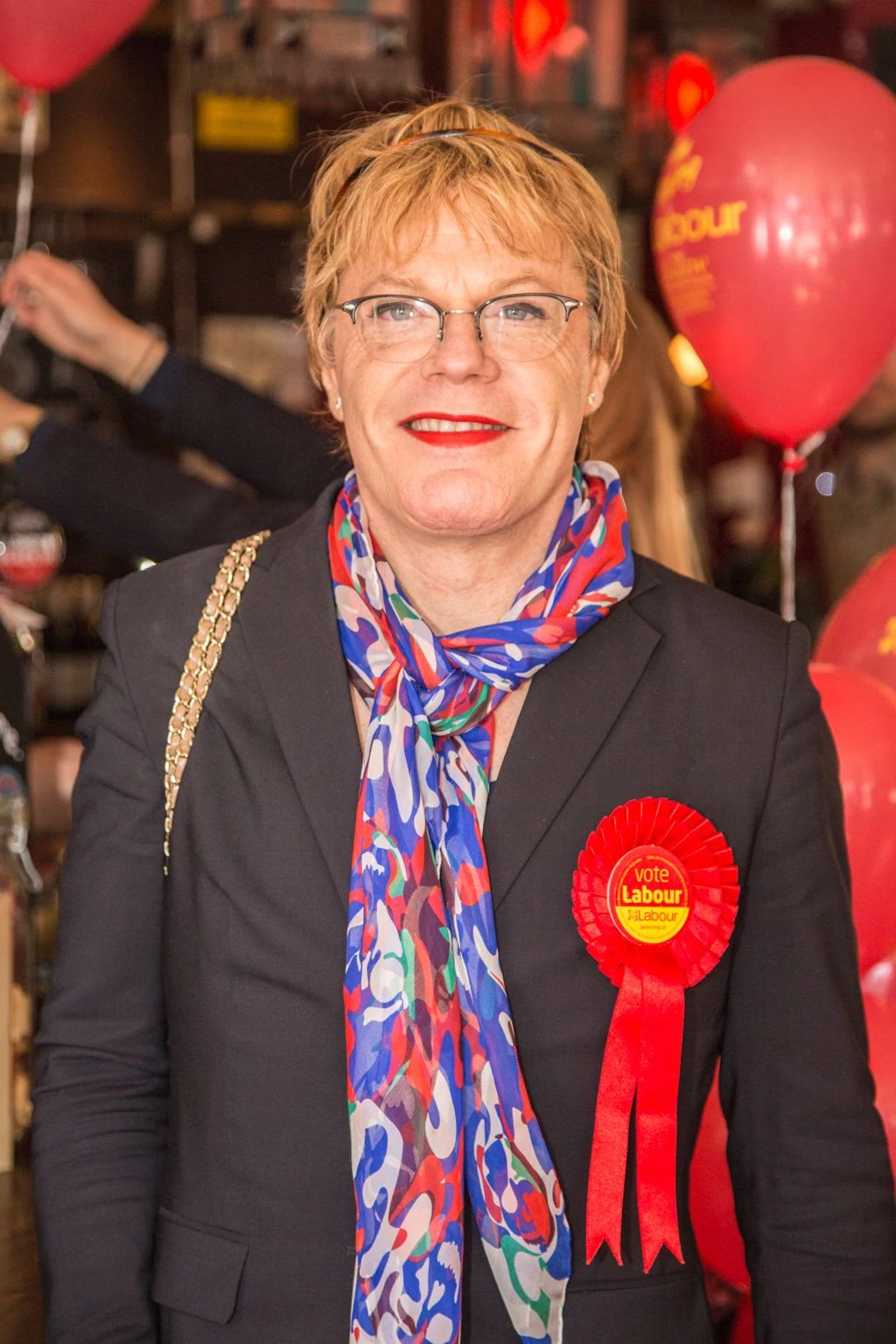
Eddie Izzard built a distinctive comedy career from improvised, free-ranging monologues that could leap between language, history and the surreal. She took that voice from London comedy clubs to international tours and screen roles, while pursuing charitable challenges and a sustained involvement in Labour politics. Her career is not a single story of comedy or activism, but a combination of performance, public campaigning and endurance.
From Aden to the comedy stage
Izzard was born Edward John Izzard on 7 February 1962 in Aden, then a British colony, to English parents Dorothy and Harold Izzard. Her father worked for British Petroleum there. The family moved to Bangor in Northern Ireland when she was a year old, then to Skewen in Wales when she was five. Her mother died of cancer when Izzard was six. Izzard and her older brother, Mark, made a model railway while their mother was ill; it was later donated to Bexhill Museum.
She attended schools in England, including Eastbourne College, and studied drama at the University of Sheffield. Her first experiments in comedy came at university, where she and Rob Ballard took their act to the streets. After they split up, Izzard continued as a street performer in Europe and the United States. She developed a way of speaking directly to audiences during solo escape acts, then moved into British stand-up venues. Her first performance at the Banana Cabaret in Balham preceded a 1987 appearance at the Comedy Store in London.
During the 1980s she refined her material and began earning notice through improvisation in the early 1990s, including at her Soho club, Raging Bull. Her breakthrough came in 1991 after the “raised by wolves” routine on the televised Hysteria 3 AIDS benefit. The stand-up style that followed often appeared to wander, but its shifts between observations, invented scenarios and historical or cultural references gave the performances their particular momentum.
Stand-up and performance
Among Izzard’s best-known tours are Definite Article (1996), Glorious (1997), Dress to Kill (1998), Circle (2000), Stripped (2009), Force Majeure (2013) and Wunderbar (2022). For Dress to Kill, she won two Primetime Emmy Awards in 2000: for individual performance and writing in a variety or music programme. She has performed in French, in which she is fluent, and later began performing in Arabic, German, Russian and Spanish.
Her work has also moved between comedy and drama. Izzard made her West End drama debut in 1994 as the lead in David Mamet’s The Cryptogram, followed by a role in 900 Oneonta. She played the title role in Christopher Marlowe’s Edward II in 1995 and comedian Lenny Bruce in the 1999 production of Lenny. In 2001 she took the lead in Peter Nichols’s A Day in the Death of Joe Egg, repeating the role on Broadway in 2003. That production received four Tony Award nominations, including nominations for Izzard and co-star Victoria Hamilton.
On screen, her film work has included Ocean’s Twelve and Ocean’s Thirteen, in which she played Roman Nagel, and Valkyrie, as Erich Fellgiebel. She voiced Reepicheep in The Chronicles of Narnia: Prince Caspian and appeared as Dr Abel Gideon in the television series Hannibal. Her roles also include Robert Watson-Watt in the BBC drama Castles in the Sky. In 2024, she performed a one-person version of Hamlet in New York before the production transferred to London’s Riverside Studios.
Running for charity
Izzard has repeatedly turned physical endurance into a fundraising effort. In 2009, despite little previous long-distance running experience, she ran 43 marathons in 51 days for Sport Relief. The route crossed the UK, travelling from London to Cardiff, Belfast and Edinburgh before returning to London. She covered more than 1,100 miles, and received a special award at BBC Sports Personality of the Year that year.
In 2016, she ran 27 marathons in 27 days in South Africa in honour of Nelson Mandela, whose 27 years in prison gave the challenge its number. She completed the effort at the Union Buildings in Pretoria and raised more than £1.35 million for Sport Relief. A day in hospital meant she had to run two marathons on the final day. In 2021, she undertook another month-long challenge, combining 31 marathons with 31 stand-up performances to raise funds for several charities. The running raised more than £275,000.
Politics, identity and public life
Izzard joined the Labour Party in 1995 and has remained an active participant in its politics. She appeared in Labour broadcasts and campaigned for the party, and twice stood unsuccessfully for election to its National Executive Committee. After Christine Shawcroft resigned in March 2018, Izzard took her place as the next runner-up, but did not secure re-election later that year. She also sought Labour’s nomination for Sheffield Central in 2022 and Brighton Pavilion in 2023, finishing second in each members’ selection contest.
Her political engagement has included support for European integration and the European Union, and campaigning for the alternative vote in the 2011 referendum. She has also opposed Scottish independence and supported replacing the monarchy with an elected head of state. These positions have made her public life more expansive than party activity alone, though her Labour work is its most sustained institutional strand.
Izzard has described herself as genderfluid and, in 2020, requested she/her pronouns for an appearance on Portrait Artist of the Year, saying she wanted to be based in “girl mode” from then on. In 2023 she said she would use the name Suzy in addition to Eddie, explaining that she had wanted to use Suzy since childhood and that people could choose which name to use. She retained Eddie Izzard as her public name because it was more widely recognised.
Recognition and continuing work
Izzard’s honours include an honorary Doctorate of Letters from the University of East Anglia in 2003, recognising work promoting modern languages and tolerance of other cultures and lifestyles. She received an honorary doctorate from the University of Sheffield in 2006, and was elected honorary president of its Students’ Union in 2010. Other honorary degrees followed from the University of Sunderland in 2012 and York St John University in 2018. In 2013, she received the Outstanding Lifetime Achievement Award in Cultural Humanism, presented at Harvard by humanist organisations and the university’s humanist, atheist and agnostic community.
She has continued to combine stage performance with screen and theatre work, including her 2024 Hamlet. That movement between forms has been characteristic of a career that began in street performance and expanded without abandoning the immediacy of a live audience.
Why Eddie Izzard deserves a place in British Legacy
Izzard’s place in British cultural life rests first on the particular comic voice she developed and carried from London stages to audiences abroad. Her monologues made room for historical allusion, language and surreal invention, while her tours and award-winning Dress to Kill brought that approach to a wide audience. Her career also shows a performer crossing established boundaries between stand-up, drama, film and television: from the West End and Broadway to roles in major films and British television drama. The result is a body of work whose reach is international but whose formative stages are closely tied to British comedy venues, theatre and broadcasting.
Her legacy also includes visible commitments beyond performance. The 2009 UK marathon challenge and the 2016 South African runs turned extraordinary personal effort into substantial fundraising for Sport Relief; the latter honoured Nelson Mandela and raised more than £1.35 million. Izzard has combined this charitable work with long involvement in Labour politics and public advocacy for European integration. These strands matter because they demonstrate how a British entertainer can use an established public platform for causes and campaigns, while continuing to make ambitious work on stage. Her record is not simply one of celebrity or acclaim: it is a sustained, varied contribution across comedy, performance, fundraising and political life.
Sources
Adapted in part from Eddie Izzard by Wikipedia contributors, under CC BY-SA 4.0. Text has been edited and combined with the existing article; this adapted text is shared under the same licence. Contributor history.