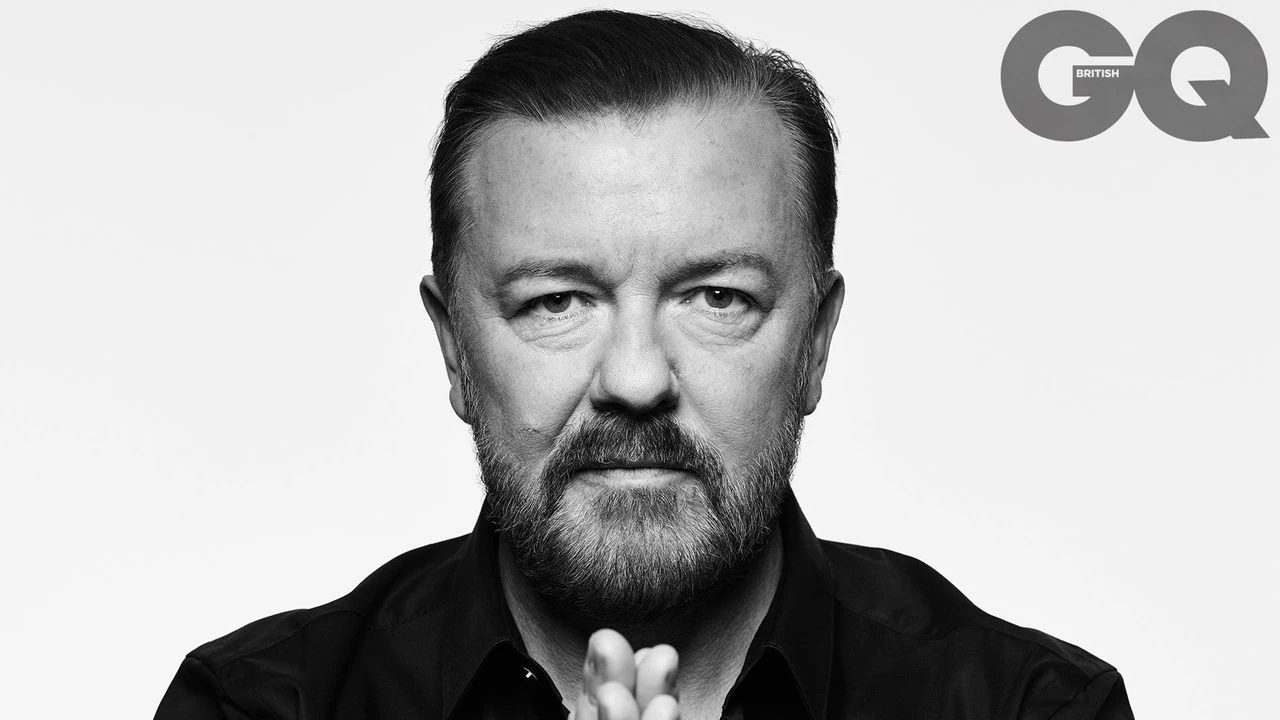
Ricky Gervais’s comedy often begins with ordinary people and the awkwardness of everyday life. The Office, the British sitcom he created and starred in with Stephen Merchant, made that approach internationally recognisable: its paper-company workplace and self-regarding manager, David Brent, became the starting point for adaptations around the world. Gervais’s career has since ranged across television, stand-up, radio, film and books, alongside public campaigning for animal welfare and charitable work.
Reading, university and an early music career
Gervais was born in Reading, Berkshire, on 25 June 1961, the youngest of four children. He attended local schools before studying philosophy at University College London, graduating in 1983. At university he met Jane Fallon, with whom he has been in a relationship since 1982. His route into entertainment was not a direct one: as a student he formed the new-wave duo Seona Dancing with his friend Bill Macrae. London Records released two singles, “More to Lose” and “Bitter Heart”. They did not succeed in the UK singles chart, although “More to Lose” became a hit in the Philippines. Gervais later managed the band Suede before its success.
He also worked in radio, first as an assistant events manager for the University of London Union and later as head of speech at Xfm. There he interviewed Stephen Merchant, who became a key creative partner. Their subsequent radio work, with producer Karl Pilkington, developed into a long-running collaboration that included the podcast The Ricky Gervais Show. These early jobs placed Gervais in the practical world of broadcasting before his work in television brought him a much larger audience.
Making The Office
The Office grew from a short film Merchant made during a BBC production course. The project included a mock documentary about office life and a character who developed into David Brent. A pilot script by Merchant and Gervais led to a six-episode BBC series, first broadcast in 2001. Its initial reception was modest; word of mouth, repeats and home-video releases helped it find an audience before a second six-episode series followed.
Gervais and Merchant wrote, performed in and helped shape the programme’s mock-documentary form. Brent’s confidence, and the gap between his opinion of himself and other people’s response to him, gave the comedy its central tension. The show’s British workplace setting travelled well: versions were made in numerous countries, including the United States. Gervais and Merchant produced the American adaptation and appeared in it; they also co-wrote an episode. The original series brought Gervais a Golden Globe for best actor in a musical or comedy television series in 2004, as well as the programme’s international recognition.
His next major sitcom, Extras, followed in 2005. Gervais and Merchant co-created and co-wrote the series, in which Gervais played Andy Millman, an aspiring actor working as an extra. The comedy used guest appearances by prominent performers to play with celebrity image and the entertainment industry. Gervais won a Primetime Emmy for his performance in its second series. Other television projects took different forms: Life’s Too Short, made with Merchant and Warwick Davis, centred on a fictionalised version of Davis; Derek focused on a care-home worker; and After Life, which Gervais created, wrote, directed and starred in, ran from 2019 to 2022.
Beyond the sitcom
Gervais’s work has not been confined to scripted television. His stand-up shows include Animals, Politics, Fame, Science, Humanity and SuperNature. He has also toured internationally and released filmed performances. As a presenter, he hosted the Golden Globe Awards five times, in 2010, 2011, 2012, 2016 and 2020. His hosting style attracted both praise and criticism, particularly for jokes aimed at the awards ceremony’s guests and public figures.
Radio and recorded conversation have remained part of his career. The Ricky Gervais Show, made with Merchant and Pilkington, began as a radio programme and became a widely downloaded podcast; an animated television version followed. Gervais has also acted in films, including Ghost Town and Muppets Most Wanted, and written, directed and starred in projects such as The Invention of Lying and David Brent: Life on the Road. His books include the Flanimals series, illustrated nonsense creatures for children. The range matters: the familiar television characters sit alongside work in live comedy, animation, film and audio.
Public causes and animal welfare
Gervais has used social media to draw attention to animal welfare, including campaigns against trophy hunting and the keeping of animals in captivity. He has promoted animal adoption and supported animal charities. The Humane Society recognised his social-media advocacy with a Genesis Award in 2015; Animal Defenders International gave him its Lord Houghton Award for Service to Animal Welfare in 2017, and Humane Society International presented him with the Cecil Award in 2018.
His charitable activity has included a 2002 Comic Relief boxing match against Grant Bovey. Gervais won on a split decision and donated his £5,000 prize money to the training of a Macmillan nurse specialising in cancer support. He has also supported animal charities through fundraising and donations. In 2021 he contributed a comic story, “Bullfight”, to a collection intended to raise awareness of climate and biodiversity issues. These actions are distinct from his entertainment work, but they draw on the public attention his career has given him.
Why Ricky Gervais deserves a place in British Legacy
Gervais’s place in British cultural history rests first on the creative achievement of The Office. Made for British television with Stephen Merchant, it turned the routines and social discomforts of an ordinary workplace into a comedy whose format could be adapted internationally. Its influence is visible not simply in its popularity, but in the way the original programme travelled: Gervais and Merchant were involved in the American version, while adaptations were produced in many other countries. That reach links a distinctly British television creation to audiences well beyond Britain.
His wider career reinforces that contribution. From Extras and Derek to stand-up, radio and film, Gervais has worked across forms rather than relying on a single character or programme. His public profile has also been put to practical use: the Comic Relief boxing match raised funds for cancer support, while his campaigning and fundraising have drawn attention to animal welfare. These are specific achievements, not proof that every claim made in his name has produced measurable change. Taken together, his writing and performance helped make British comedy a global export, while his charitable work shows how an entertainer’s reach can also serve causes outside the screen.
Sources
Ricky Gervais — Wikipedia revision 1378549927
Adapted in part from Ricky Gervais by Wikipedia contributors, under CC BY-SA 4.0. Text has been edited and combined with the existing article; this adapted text is shared under the same licence. Contributor history.