
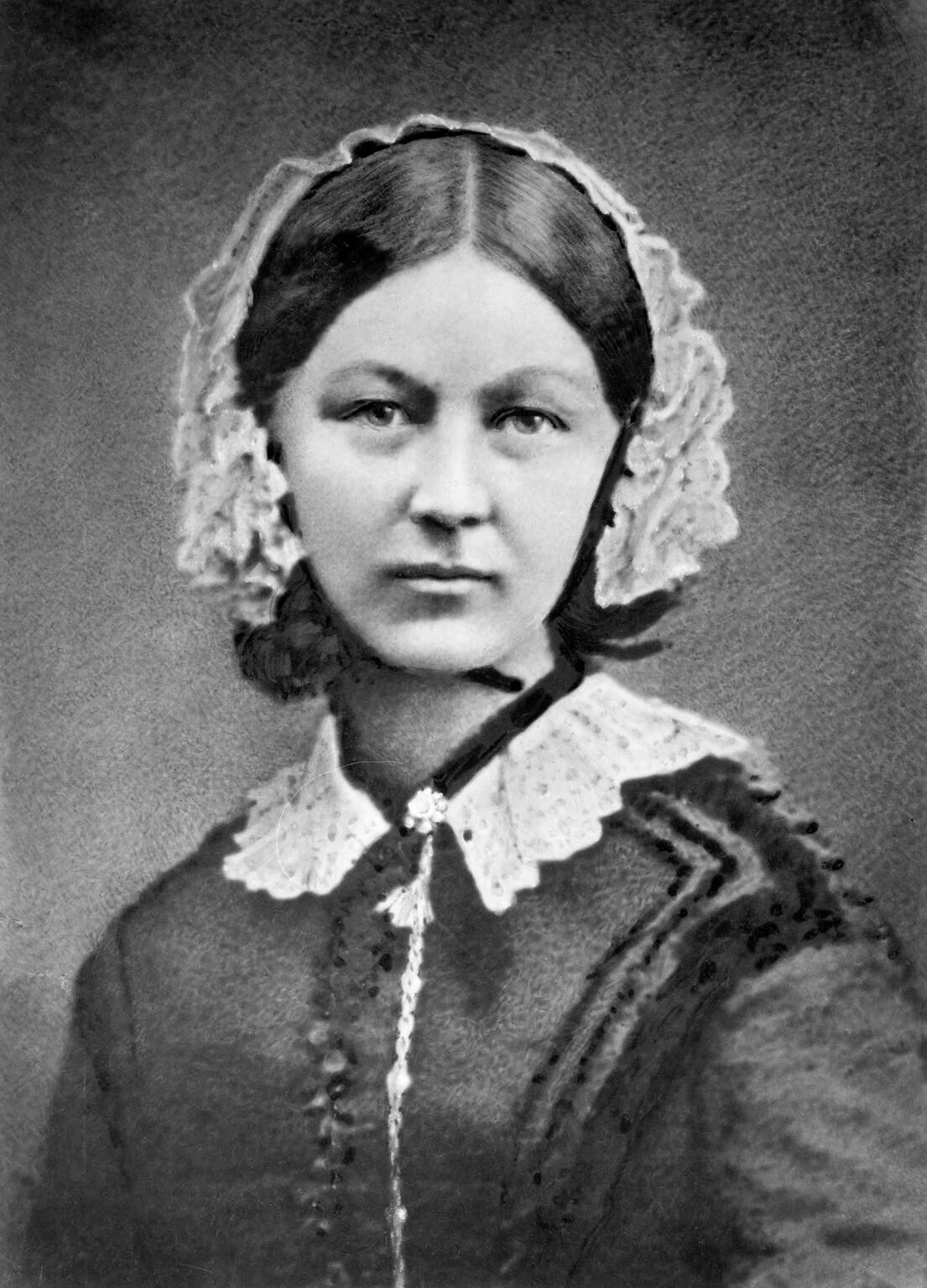
Florence Nightingale became famous as the Lady with the Lamp, but her most enduring work extended well beyond the night rounds that fixed that image in the public imagination. She helped establish professional nursing in Britain, pressed for better hospital and living conditions, and made statistics accessible to decision-makers. Her career joined direct care with a sustained campaign to change the systems that shaped people’s health.
A vocation shaped by study and resistance
Nightingale was born in Florence, then part of the Grand Duchy of Tuscany, on 12 May 1820. Her parents, William Edward Nightingale and Frances “Fanny” Smith, named her after her birthplace. The family returned to England in 1821 and divided its time between homes in Derbyshire and Hampshire, with periods in London. Her father, who believed in educating his daughters, taught her subjects including mathematics, languages, history and literature. That grounding in mathematics would later inform her use of statistics.
On 7 February 1837, aged 16, Nightingale recorded what she described as a call from God to service. It took years for her to settle on nursing, and her mother and sister resisted a vocation that ran against the expectations for a woman of her social position. Nightingale continued to educate herself in nursing and, in 1850, visited the Lutheran community at Kaiserswerth in Germany. She observed its work with the sick and deprived and received four months of medical training there. Her account of the institution, published anonymously in 1851, was her first published work.
In 1853, she became superintendent of the Institute for the Care of Sick Gentlewomen in Upper Harley Street, London. She held the post until October 1854. The role gave her experience in organising nursing care before the crisis that would make her a national figure.
Scutari and the limits of the lamp-lit legend
During the Crimean War, reports of poor conditions for wounded British soldiers at the military hospital at Scutari prompted Nightingale to lead a party of nurses to the Ottoman Empire. She and 38 women volunteers, together with 15 Catholic nuns, travelled under the authority of the Secretary at War, Sidney Herbert. Nightingale arrived at Selimiye Barracks in November 1854. The hospital faced shortages of medicines and equipment, overcrowding, neglected hygiene and widespread infection.
Nightingale and her nurses worked in difficult conditions to organise care. She also brought attention to what she saw, sending a plea to The Times that helped prompt the government to commission a prefabricated hospital designed by Isambard Kingdom Brunel. The public image of Nightingale making solitary rounds with a lamp came from newspaper reporting and was popularised by Henry Wadsworth Longfellow’s 1857 poem. It expressed a recognisable part of her work, but cannot by itself explain the scale or causes of the hospital’s mortality.
Death rates at Scutari fell sharply, but the history is more complex than attributing the decline to Nightingale’s personal reforms alone. Overcrowding, defective sewers and poor ventilation contributed to the crisis. A government Sanitary Commission, sent in March 1855, flushed out sewers and improved ventilation. Nightingale later concluded that poor living conditions had been responsible for many deaths. The experience helped turn her attention towards sanitation as a matter of public policy, as well as hospital practice.
Turning evidence into reform
After the war, Nightingale returned to Britain and worked to improve army health and medical care. She collected evidence for the Royal Commission on the Health of the Army and used statistical graphics to make patterns of mortality legible to officials and members of Parliament. Her polar-area diagrams, often called Nightingale rose diagrams, showed the seasonal sources of deaths among soldiers. The form was not her invention, but her use of it helped make complex evidence vivid and useful in debate.
Her concern with sanitation extended to India. Nightingale studied the effects of poor drainage, contaminated water, overcrowding and inadequate ventilation on the health of soldiers and the wider population. She lobbied for a Royal Commission on the Indian situation and reported to it, arguing that the health of the army and the people could not be separated. She also campaigned for better sanitation in rural India. Her work linked the numerical analysis of disease and death with practical proposals for public-health reform.
Nightingale also pursued change in Britain’s hospitals and institutions. From the 1860s, she helped introduce trained nurses into the workhouse system, where sick people had often been cared for by other residents rather than trained staff. Her commitment to nursing leadership included advocating for matrons to have authority over nursing staff. These efforts made professional training and organisation part of the argument for better care, not simply the personal virtues of individual nurses.
Building a profession and a wider legacy
Notes on Nursing: What It Is and What It Is Not, published in 1859, set out practical guidance on nursing and hygiene. Written for people caring for patients at home as well as those interested in nursing, it reached beyond a specialist readership. In 1860, the Nightingale Training School opened at St Thomas’ Hospital in London, funded by the Nightingale Fund established in 1855. Its training model helped establish nursing as a profession with formal standards. The first nurses trained there began work at Liverpool Workhouse Infirmary in 1865, and Nightingale-trained nurses went on to senior posts in hospitals in Britain and overseas.
Her influence was not confined to nursing education. Nightingale remained a prolific writer and a campaigner on public health, hospital design and the conditions of working-class homes. In 1859 she became the first woman elected to the Royal Statistical Society. She was also the first woman to receive the Order of Merit, in 1907, following the Royal Red Cross in 1883 and appointment as a Lady of Grace of the Order of St John in 1904.
Nightingale died in Mayfair, London, on 13 August 1910, aged 90. She was buried in the churchyard of St Margaret’s Church, East Wellow, Hampshire. Her name has since been attached to nursing institutions and honours, including the Florence Nightingale Medal, established by the International Committee of the Red Cross in 1912. International Nurses Day is held on her birthday. Such recognitions preserve the public symbol, but her record is also one of analysis, organisation and argument: she used evidence to press institutions to take preventable illness seriously.
Why Florence Nightingale deserves a place in British Legacy
Nightingale’s place in British history rests not only on the familiar image of a nurse carrying a lamp, but on the work behind it. At Scutari she confronted the practical failures of military hospital care; afterwards, she treated those failures as evidence of a wider need for sanitation and administrative reform. Her statistical diagrams helped present mortality data to people able to influence policy. Her campaigns addressed the British Army, hospitals, workhouses and public health in India, making the case that better outcomes required more than individual acts of compassion.
Her contribution to nursing was similarly structural. The school at St Thomas’ Hospital gave professional training an institutional base, while her writing explained nursing principles to readers beyond the hospital. Trained nurses went on to work in hospitals in Britain and abroad, extending the reach of that model. These achievements connect her legacy directly to British institutions and public life: she worked through London hospitals, British commissions and campaigns for reforms at home and in India. Remembering her well means recognising both the care she helped organise and the evidence-led methods she used to argue for change. Those methods—careful observation, clear presentation of data and attention to the conditions in which people live—remain central to public health and professional nursing.
Sources
Florence Nightingale — Wikipedia revision
Adapted in part from Florence Nightingale by Wikipedia contributors, under CC BY-SA 4.0. Text has been edited and combined with the existing article; this adapted text is shared under the same licence. Contributor history.
.jpg)