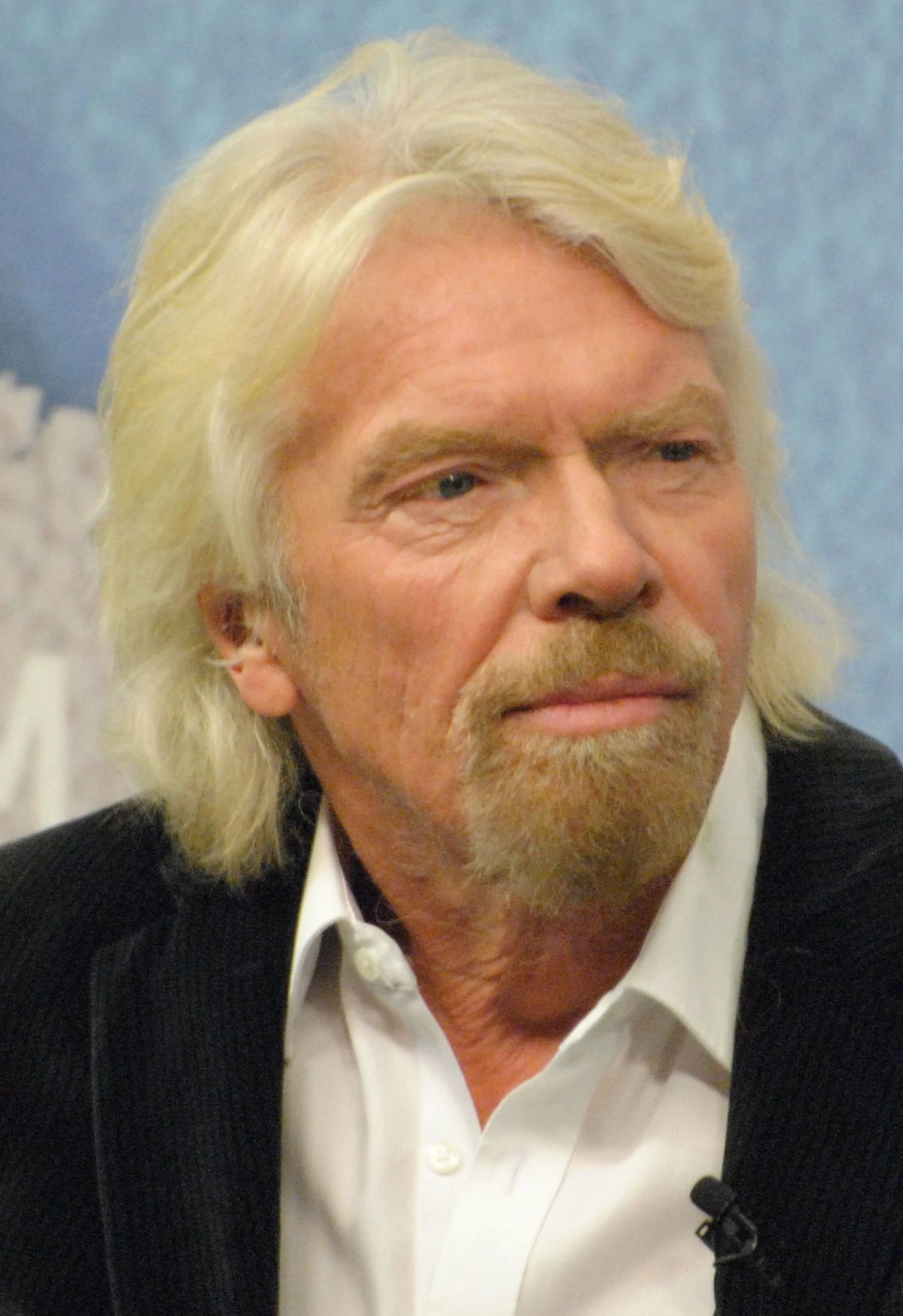
Richard Branson’s business career began not with a global brand but with a magazine for young people. From that early publishing venture, he built a record business that became Virgin Records, then carried the Virgin name into aviation, rail transport and commercial spaceflight. His path combined bold expansion with conspicuous failures, while his philanthropic work ranged from support for entrepreneurs to international campaigns on conflict and climate.
A magazine becomes a record business
Born in Blackheath, London, on 18 July 1950, Branson attended Stowe School until he was 16. He left without following a conventional academic route and turned towards business. In 1966, at 16, he launched Student magazine with Nik Powell. Its first issue appeared in January 1968. The magazine did not initially fulfil its ambitions, but it helped create a route into selling records: Branson advertised albums in its pages and built a mail-order business from the same London church premises.
In 1970, Branson established a record business, and in 1971 he was questioned over the sale of records declared as export stock. The matter was settled without a court case after he agreed to repay purchase tax and pay a fine; his parents remortgaged their home to help meet the settlement. The episode is a reminder that the story of a celebrated entrepreneur includes difficult episodes as well as expansion.
Virgin Records followed in 1972, founded with Powell. Its first release, Mike Oldfield’s Tubular Bells (1973), became a chart-topping bestseller. The label took chances on artists and groups that other companies were reluctant to sign, including the Sex Pistols, and went on to work with performers such as the Rolling Stones, Peter Gabriel, XTC, UB40 and Steve Winwood. It grew into one of the world’s largest independent record labels. In 1992 Branson sold it to EMI for £500 million to help keep his airline business afloat, later describing the sale as an emotional moment because the record company had been the beginning of the Virgin enterprise.
Virgin takes to the air and the railways
Branson’s move into aviation grew from a cancelled flight to Puerto Rico: he chartered a plane and offered places to other stranded passengers to help cover the cost. Virgin Atlantic and Virgin Cargo began in 1984. The airline became one of the best-known extensions of the Virgin brand, but its early growth was not frictionless. Virgin Atlantic and British Airways became embroiled in disputes in the early 1990s; a court case over alleged dirty tricks ended in a settlement, with compensation distributed among Virgin Atlantic staff.
Branson also brought Virgin into British rail after the privatisation of British Rail. Virgin Rail Group won the InterCity West Coast and CrossCountry franchises in 1997. The West Coast service continued under Virgin until December 2019, while the CrossCountry franchise ended in 2007. A further joint venture operated the East Coast franchise from 2015 to 2018. The West Coast replacement process became contentious: after the government initially awarded the contract to FirstGroup in 2012, an investigation found significant technical flaws in the bidding process and the decision was scrapped. Virgin continued operating the line until the franchise changed in 2019.
Virgin’s range was wider than transport and music. Branson launched Virgin Mobile in 1999, and the company became part of Virgin Media after its sale to NTL:Telewest in 2006. The brand also appeared in businesses that did not endure, including Virgin Cola, Virgin Cars, Virgin Publishing, Virgin Clothing and Virgin Brides. Branson has presented failure as something to learn from; the record of ventures that closed sits alongside the companies that lasted.
Adventure, records and the space frontier
Branson repeatedly attached his public profile to physical challenges. In 1986, sailing in Virgin Atlantic Challenger II with Daniel McCarthy, he set a new record for the fastest Atlantic crossing by boat. The following year, his balloon Virgin Atlantic Flyer crossed the Atlantic. In 1991, a balloon flight across the Pacific from Japan to Arctic Canada set another record. He later crossed the English Channel in an amphibious vehicle, setting a record for the Dover–Calais crossing in 2004. Not every attempt succeeded: a 2008 effort to set an eastbound sailing record across the Atlantic ended after severe weather damaged the boat’s sail.
Spaceflight became another long-running ambition. In 2004, Branson announced Virgin Galactic, which would license technology behind SpaceShipOne for planned suborbital passenger flights. Virgin Galactic’s SpaceShipTwo was manufactured by the Spaceship Company, founded by Branson and engineer Burt Rutan. On 11 July 2021, Branson flew aboard VSS Unity to an altitude of 86.1 kilometres. The flight placed him among the company’s passengers at the edge of space, but the wider project remained a commercial venture rather than simply a personal adventure.
Philanthropy and climate commitments
Branson’s charitable work includes support for efforts aimed at business development and international issues. In the late 1990s, he and musician Peter Gabriel discussed with Nelson Mandela the idea of a group of experienced leaders working to address difficult global conflicts. Mandela announced the formation of The Elders in Johannesburg in 2007. Branson and Gabriel were among its funders; Kofi Annan became its chair, with Gro Harlem Brundtland as deputy chair. The organisation’s work has included issues such as conflict, women’s rights and global health.
In South Africa, Branson’s work also included the Branson School of Entrepreneurship, established in 2005 through Virgin Unite and entrepreneur Taddy Blecher. Its stated purpose was to support start-ups and micro-enterprises with skills, mentoring, services, networks and finance. In the UK, Virgin StartUp became a delivery partner for the Start Up Loans programme, offering loans to entrepreneurs aged 18 to 30. These initiatives show a practical strand of his philanthropy: helping new businesses obtain support and funding, rather than relying only on high-profile appeals.
Climate action has been a prominent part of Branson’s public commitments. In 2006 he pledged to invest US$3 billion over the following decade in research into environmentally friendly fuels, with Virgin Atlantic and Virgin Trains profits named as sources. The pledge drew criticism: Naomi Klein later argued that the amount invested was well below the announced target and that Virgin airlines’ emissions had risen. In 2007 Branson announced the Virgin Earth Challenge, a US$25 million prize for a commercially viable design to remove greenhouse gases from the atmosphere. Virgin Unite and the Carbon War Room were also associated with his environmental work. These efforts and their criticisms belong together in an account of his record.
Why Richard Branson deserves a place in British Legacy
Richard Branson’s place in British Legacy rests first on the scale and range of the businesses he built from a British starting point. A London teenager’s magazine helped establish a mail-order record business; Virgin Records then became an influential label, with Tubular Bells its first release and artists such as the Sex Pistols among its signings. Virgin Atlantic brought a new British competitor into aviation, while Virgin’s railway operations made the group part of the country’s post-privatisation transport landscape. These are specific changes in British commercial life, not simply a story of personal wealth or celebrity.
His legacy also includes a willingness to take ventures into unfamiliar territory, from ballooning and record-setting crossings to commercial spaceflight, alongside failures and contested commitments. His philanthropic work connected business experience with support for entrepreneurs in South Africa and the UK, and with the international work of The Elders. The climate pledges and the criticism they attracted are part of that record too: ambition matters, but so does scrutiny of what was delivered. Together, Branson’s businesses, public experiments and charitable initiatives offer a complex account of British entrepreneurship with effects extending well beyond Britain.
Sources
Richard Branson — Wikipedia revision 1377721043 · Richard Branson — Wikipedia
Adapted in part from Richard Branson by Wikipedia contributors, under CC BY-SA 4.0. Text has been edited and combined with the existing article; this adapted text is shared under the same licence. Contributor history.