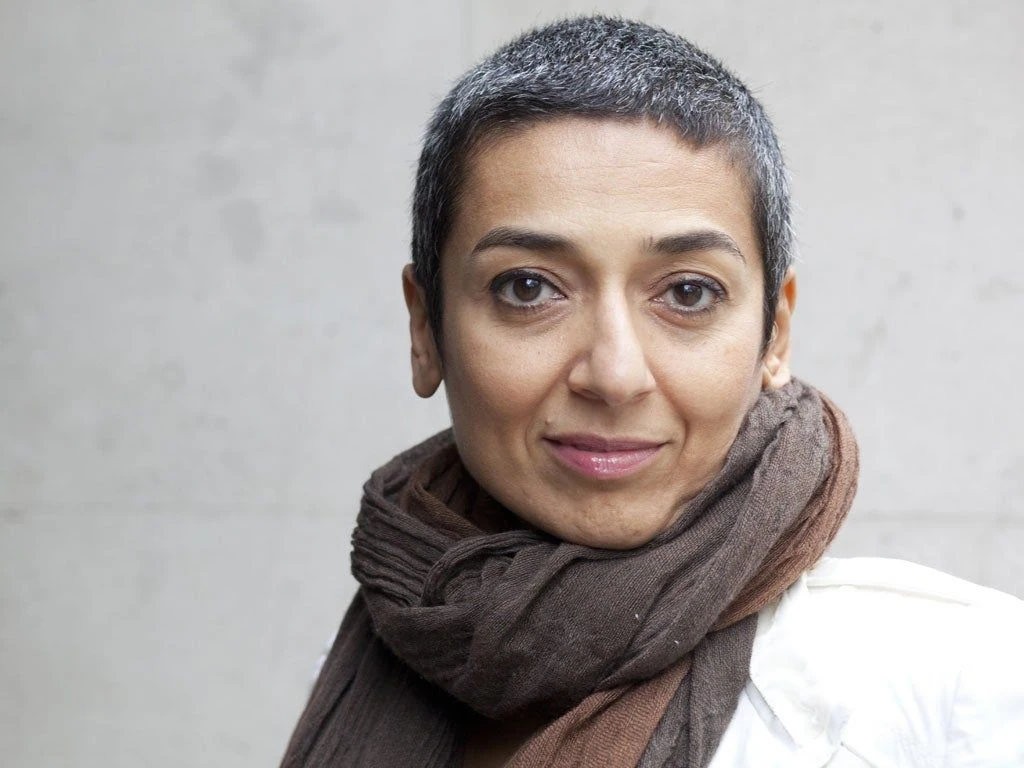
Zainab Salbi’s work has connected practical support for women affected by conflict with efforts to make their experiences heard. In 1993, while studying in the United States, she co-founded Women for Women International after learning about the systematic rape of women during the Bosnian war. The organisation began by supporting women in Bosnia-Herzegovina and Croatia, and later expanded its work to other countries. Salbi’s career also took her into writing, television and podcasting; a significant part of her connection to Britain came through postgraduate study at the London School of Economics.
From Baghdad to the United States
Salbi was born in Baghdad in 1969 and grew up there with her younger brother. Her mother, Alia, was a biology teacher; her father was an airline pilot. When Salbi was 11, her father became Saddam Hussein’s personal pilot, and Hussein began visiting the family home. The Iran–Iraq War, including missile attacks on Baghdad, formed part of her childhood.
In 1990, aged 20, Salbi left Iraq for the United States in an arranged marriage. She later left the marriage after it became abusive. With the start of the first Gulf War, returning to Iraq was not possible, and she moved to Washington, DC, where she worked as a translator. She married Palestinian-American lawyer Amjad Atallah. These events precede her public humanitarian work, but the available account of her career is more than a story of personal experience: it is also about building an organisation with a specific response to women’s needs after conflict.
Salbi studied languages at an Iraqi university, then completed a bachelor’s degree in sociology and women’s studies at George Mason University. She became a United States citizen in 1996. In 2001, she earned a master’s degree in development studies from the London School of Economics. That British academic connection sits alongside, rather than replacing, the central fact of her career: the organisation she helped establish was an international initiative based in the United States.
Creating Women for Women International
While studying at George Mason, Salbi learned about systematic rape during the Bosnian war. In 1993, she and Atallah launched Women for Women International (WfWI). Salbi became its president, and its early programme linked sponsors in North America with women in Bosnia. The organisation’s focus was supporting women affected by conflict and sexual violence, including through direct assistance and development work.
Its work grew beyond its initial focus in Bosnia-Herzegovina and Croatia. The organisation later expanded to Iraq, in 2003, and worked in countries including Afghanistan, the Democratic Republic of the Congo, Kosovo, Nigeria, Rwanda and Sudan. The current account describes a year-long programme combining financial help, mentorship and skills development. These details make clear that WfWI’s approach was not limited to emergency relief: it also aimed to give participants resources and support as they rebuilt their lives.
During Salbi’s leadership, which ended with her resignation in 2011, the organisation helped 315,000 women and distributed more than $108 million in direct aid and micro-credit loans. That figure gives a concrete measure of its activity over that period. It is distinct from a higher total sometimes given for the organisation’s overall history; the account of Salbi’s tenure records 315,000 women helped during her leadership.
Salbi also spoke publicly about sexual violence in conflict and women’s participation in post-conflict recovery. She contributed to the 2003 report Winning the Peace Conference Report: Women’s Role in Post-Conflict Iraq, published by Women Waging Peace and the Woodrow Wilson Center, and later testified before the United States Congress about its contents. In January 2005, WfWI published findings from a survey of 1,000 Iraqi women, which conveyed their concerns about personal safety during the war.
Books and broadcasting
Salbi’s books have carried women’s experiences of war and political upheaval to readers. Her 2005 memoir, Between Two Worlds: Escape from Tyranny: Growing Up in the Shadow of Saddam, recounts her childhood in Iraq and the circumstances that led to her departure for the United States. The following year, The Other Side of War: Women’s Stories of Survival & Hope documented the lives of women who had experienced conflict and inequality and gone on to community leadership and business. She later published If You Knew Me You Would Care and Freedom Is an Inside Job.
Television gave Salbi another way to discuss women’s lives and public issues. By 2006, she had appeared on The Oprah Winfrey Show six times to discuss WfWI’s work. In 2015, she launched the talk show The Calling on TLC Arabia; broadcast in 22 countries in the Middle East and North Africa, it focused on Arab and Muslim women. She went on to create The Zainab Salbi Project, an online series addressing social issues, and in 2018 hosted the PBS programme #MeToo, Now What?, a five-part series exploring possible change after the MeToo movement, with attention to gender, race and social class. The same year, she hosted Yahoo! News’s Through Her Eyes, focused on global issues affecting women. In 2022, she began hosting the Redefined podcast.
Recognition and further work
Recognition for Salbi’s humanitarian and public work has come from several countries and institutions. In 1995, President Bill Clinton honoured her at the White House and called her a “21st Century Heroine”. WfWI received the Hilton Humanitarian Prize in 2006. Salbi was named one of The Guardian’s Top 100 Women Activists and Campaigners in 2011, and received the Eleanor Roosevelt Val-Kill Award in 2019 for her writing and television work raising awareness of issues affecting women. She has also received honorary doctorates from the University of York, George Mason University and the University of Glasgow.
Her work has continued beyond WfWI. In February 2022, she co-founded Daughters for Earth, a fund and movement focused on climate solutions to protect and restore the natural environment. In September 2023, she received a TIME100 Impact Award. These later roles add to a career that has moved between humanitarian organisation-building, public discussion and writing without reducing its central concern: the conditions facing women and the scope for them to shape their own lives.
Why Zainab Salbi deserves a place in British Legacy
Salbi’s connection to Britain is specific and documented. She completed a master’s degree in development studies at the London School of Economics in 2001, and later received honorary doctorates from the University of York and the University of Glasgow. Those links do not make her a British-born figure, nor was Women for Women International a British organisation. They do, however, place British education within the story of a career focused on international development and women affected by conflict.
Her wider contribution also has relevance to a British legacy concerned with humanitarian work and public life. Through WfWI, Salbi helped build a programme that connected supporters with women in conflict-affected communities and, during her leadership, delivered direct aid and micro-credit to hundreds of thousands of women. Her reports, testimony and broadcasts brought questions of sexual violence, safety and women’s role in post-conflict society to wider audiences. Her memoir and other books gave readers access to experiences often absent from conventional accounts of war. Taken together, these achievements show a sustained effort to join material support with public attention and women’s own accounts. Salbi’s British educational ties are part of that international story; the reason to include her is not a generic claim of shared values, but the evidenced combination of study in Britain and work whose themes remain pertinent to British debates about development, conflict and women’s rights.
Sources
Zainab Salbi — Wikipedia, revision 1372795129
Adapted in part from Zainab Salbi by Wikipedia contributors, under CC BY-SA 4.0. Text has been edited and combined with the existing article; this adapted text is shared under the same licence. Contributor history.