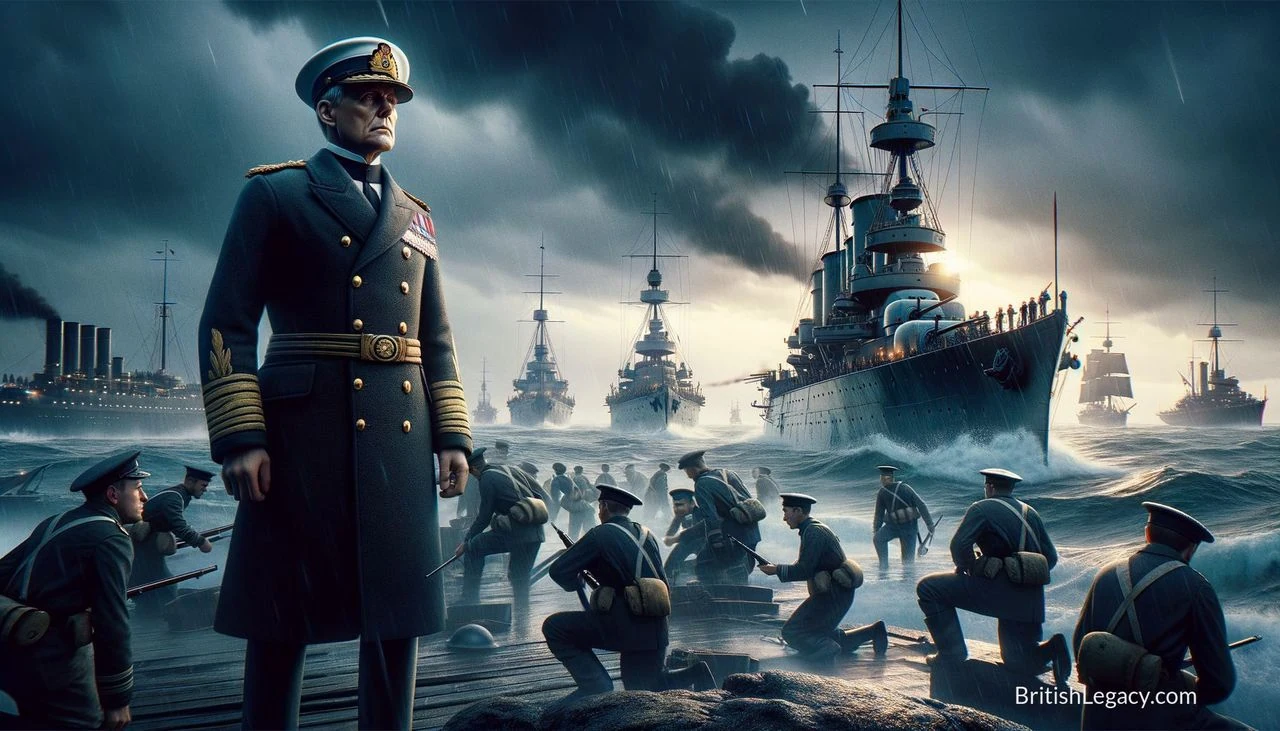
John Rushworth Jellicoe rose from Royal Navy cadet to commander of the British Grand Fleet during the First World War. His career is most closely associated with the Battle of Jutland in 1916, an immense and fiercely contested encounter whose immediate military result was inconclusive but whose strategic consequences shaped the balance of power at sea.
From cadet to senior officer
Born in Southampton on 5 December 1859, Jellicoe entered the Royal Navy as a cadet in 1872. A decade later, he saw action during the bombardment of Alexandria in 1882. His subsequent career unfolded alongside the modernisation of the Navy; his contributions to artillery and navigation are noted, although the particular changes are not specified.
In August 1914, at the beginning of the First World War, Jellicoe became Commander-in-Chief of the British Grand Fleet. The appointment was made by Winston Churchill, then First Lord of the Admiralty. As commander of the fleet, Jellicoe held a central responsibility in a war in which control of the seas was crucial to Britain.
Jutland: an uncertain battle, a strategic outcome
On 31 May 1916, the British Grand Fleet met the German High Seas Fleet off Denmark’s Jutland Peninsula. The German force was led by Vice-Admiral Reinhard Scheer. The battle involved more than 250 ships and nearly 100,000 men, and Jellicoe had to direct his fleet through a complex engagement against an opponent seeking to challenge British naval strength.
The account of Jutland describes Jellicoe manoeuvring the fleet to bring its broadsides to bear on the German line, a tactic known as crossing the T. The battle was indecisive in strictly military terms. Its strategic result, however, was more consequential: the Royal Navy retained its dominance, while the German fleet remained contained and did not break the British blockade. Jellicoe’s cautious approach was criticised, but the account presents the continued containment of the German fleet as a significant outcome.
Service after Jutland
Jellicoe’s wartime service continued beyond command of the Grand Fleet. He served as First Sea Lord from 1916 to 1917, then took up the post of Governor-General of New Zealand, which he held from 1920 to 1924. His career therefore spanned fleet command, senior naval leadership and a further public appointment overseas.
He is also credited with contributions to naval reform and strategic planning. Those claims are not tied to particular policies or examples here, so the clearest account of his record rests on his naval appointments and his command during the war. At Jutland, the battle’s contested character and the subsequent containment of the German fleet make the strategic stakes of that command plain.
Why John Jellicoe deserves a place in British Legacy
Jellicoe’s place in British history rests on the responsibility he carried as Commander-in-Chief of the Grand Fleet during the First World War. At Jutland, he directed Britain’s principal fleet in a battle involving hundreds of ships and tens of thousands of men. The engagement did not yield an uncomplicated military victory, but the German fleet remained contained and the Royal Navy retained its dominance at sea. That outcome connects Jellicoe’s command to the protection of Britain’s maritime position during wartime.
His later service as First Sea Lord and Governor-General of New Zealand adds to the record of public responsibilities he held after Jutland. The account does not establish specific reforms or a lasting influence on naval doctrine, so his legacy is best set out through the roles he occupied and the strategic consequence associated with the battle. Jellicoe’s story belongs in British Legacy as a focused account of naval leadership under pressure, and of the importance of keeping command of the sea during a conflict in which Britain’s maritime security was at stake.