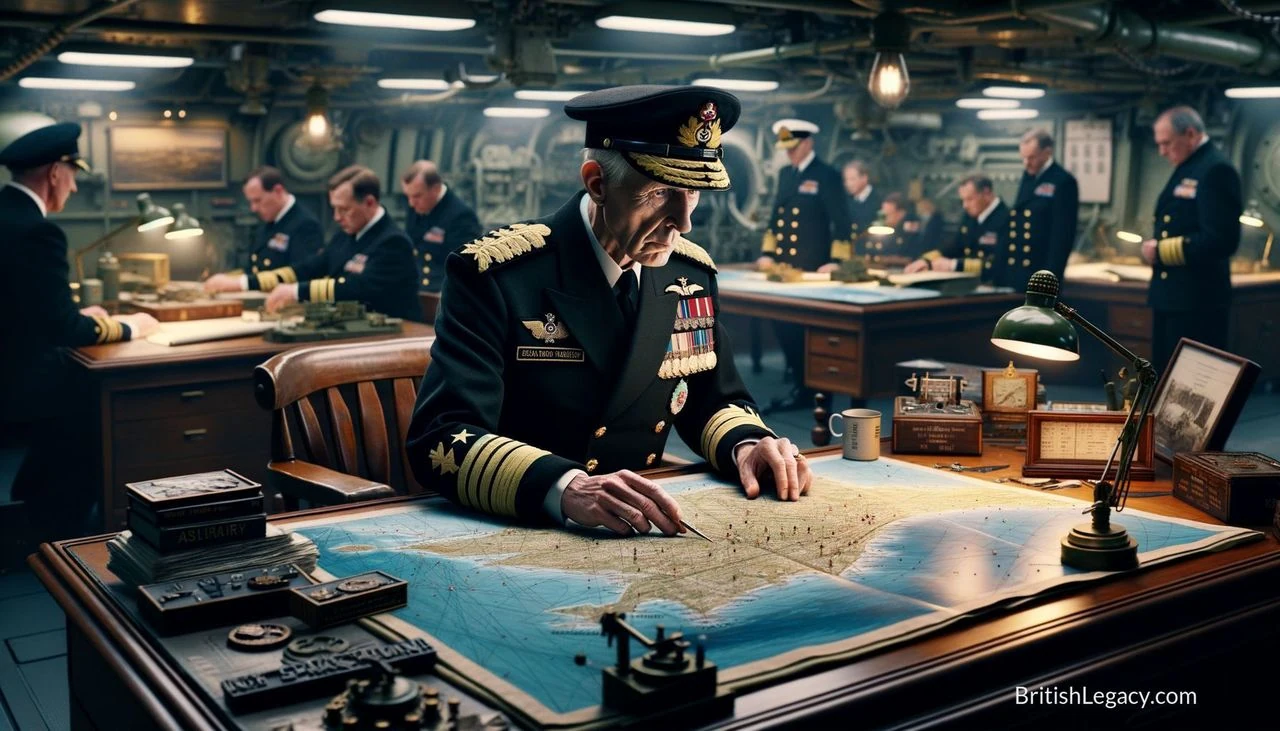
Admiral Sir Bertram Ramsay’s wartime work spanned two operations on a vast scale: the evacuation of Allied troops from Dunkirk in 1940 and the naval assault on Normandy four years later. At Dunkirk, he and his staff worked from tunnels beneath Dover Castle to bring more than 338,000 British and allied soldiers back across the Channel. For D-Day, he planned and commanded the naval forces supporting the landings. These were distinct challenges—one a withdrawal under pressure, the other an immense amphibious invasion—and Ramsay’s career included important naval service before and between them.
From naval cadet to wartime commander
Bertram Home Ramsay was born on 20 January 1883 at Hampton Court Palace. He attended Colchester Royal Grammar School and joined the Royal Navy in 1898. As a cadet he served aboard HMS Crescent, later moving to HMS Britannia. He became a midshipman within a year, an acting sub-lieutenant by the middle of 1902 and a lieutenant in December 1904.
During the First World War, Ramsay received his first command in August 1915, taking charge of the small monitor HMS M25. For two years the ship served with the Dover Patrol off the Belgian coast. Promoted to commander in June 1916, he took command of the destroyer HMS Broke in October 1917. On 9 May 1918, Broke took part in the Second Ostend Raid, a follow-up to the Zeebrugge Raid. Ramsay was mentioned in despatches for his service.
His career did not proceed as an uninterrupted ascent. In 1935, he resigned as Chief of Staff to the Home Fleet’s Commander-in-Chief, Sir Roger Backhouse, after Backhouse refused to delegate his authority. Ramsay retired from the Navy in 1938. A year later, Winston Churchill persuaded him to return to service as the threat of war grew. Appointed Commander-in-Chief, Dover, in August 1939, he was responsible for defending the Channel approaches, protecting cross-Channel military traffic and preventing submarines from passing through the Straits of Dover.
Operation Dynamo: bringing the troops home
In May 1940, German forces had trapped British and Allied troops around Dunkirk in northern France. Ramsay, serving as Vice-Admiral Dover, was responsible for Operation Dynamo, the evacuation across the Channel. From the tunnels beneath Dover Castle, he and his staff worked for nine days to coordinate the operation. Between 26 May and 4 June, naval vessels and a wide range of civilian craft carried troops from the beaches and the mole at Dunkirk.
The evacuation brought 338,226 British and allied soldiers to safety. Ramsay’s work involved more than directing ships across the Channel: it required coordination under immediate military pressure, with the fate of the trapped force depending on a sustained flow of vessels and personnel. The troops who returned could continue the war, although the evacuation itself did not end the danger to Britain or the Allied cause. King George VI asked Ramsay to report on the operation in person; Ramsay was made a Knight Commander of the Order of the Bath in 1940.
The task changed once Dynamo ended. Ramsay then had to help defend the waters off Dover against the expected German invasion. For nearly two years he commanded forces seeking to maintain control of the Channel. In February 1942, he was in command when the German battleships Scharnhorst and Gneisenau and their escorts passed through the Channel. British forces had drawn up Operation Fuller to deal with the passage, but were taken by surprise and failed to stop the ships. Ramsay received a second Mention in Despatches.
Planning the Allied return to western Europe
Ramsay’s next appointments brought him into the planning of Allied amphibious operations. He was appointed Naval Force Commander for an invasion of Europe in April 1942, but the operation was postponed. Instead, he became deputy naval commander for the Allied invasion of North Africa. In July 1943, during Operation Husky, the invasion of Sicily, he served as Naval Commanding Officer of the Eastern Task Force and prepared the amphibious landings.
In April 1944, Ramsay returned to the active list and was promoted to admiral. He became Naval Commander-in-Chief of the Allied Naval Expeditionary Force for the invasion of France. The naval operation, Operation Neptune, formed part of the wider invasion known as Operation Overlord. On 6 June, D-Day, Ramsay coordinated a fleet of almost 7,000 vessels and helped deliver more than 160,000 men to the Normandy beaches. By the end of June, more than 875,000 had been disembarked.
The scale of the operation demanded coordination among ships, landing forces and the other services, as well as a plan that could keep reinforcements moving after the initial assault. Ramsay also intervened when Churchill proposed observing the landings aboard HMS Belfast, which was assigned to bombardment duties. King George VI said he would accompany the Prime Minister. Ramsay refused to take responsibility for either man’s safety, pointing to the ship’s operational role, the danger of the journey and the need for both men to remain at home if the invasion went badly. Churchill and the King stayed ashore.
After the landings, the opening of Antwerp’s port became a crucial question for Allied supply. Ramsay and Admiral Andrew Cunningham warned Allied commanders that the port could not be useful while German forces controlled its approaches. The delay before the Battle of the Scheldt opened the way to Antwerp, and the resulting delay in using the port hindered the Allied build-up before winter.
Death and remembrance
Ramsay was killed on 2 January 1945 when a plane crashed during take-off at Toussus-le-Noble, south-west of Paris. Four other people aboard also died. He was travelling to a conference with Field Marshal Bernard Montgomery in Brussels. Ramsay was buried at Saint-Germain-en-Laye New Communal Cemetery, near Paris. In May 1995, a memorial to those killed in the crash was erected at Toussus-le-Noble.
His honours reflected service across several campaigns and recognition from Britain and its allies. They included Knight Commander of the Order of the Bath, Knight Commander of the Order of the British Empire, membership of the Royal Victorian Order, the French Légion d’honneur, the United States Legion of Merit and the Soviet Order of Ushakov. Ramsay also received two Mentions in Despatches.
His name and memory have been kept in places connected with his life and work. A statue was erected at Dover Castle in November 2000, close to the tunnels from which he directed Operation Dynamo. Colchester Royal Grammar School, where he was educated, includes his name on its war memorial and displays a portrait. The Royal Navy named its Apprenticeship Centre at HMS Collingwood in Fareham the Ramsay Building; his son opened it in March 2012. These commemorations reflect both his personal history and his contribution to naval service.
Why Admiral Sir Bertram Ramsay deserves a place in British Legacy
Ramsay’s place in British history rests on work that had immediate consequences for people and for the conduct of the war. At Dunkirk, he directed an evacuation that brought 338,226 British and allied soldiers back from France. The operation depended on sustained coordination from Dover, not simply on the presence of ships at sea. Its importance lies in what it achieved: troops who might otherwise have been captured could return to continue the fight. Ramsay’s subsequent responsibility for defending the Channel also shows that the evacuation was one demanding episode in a continuing command, not the whole of his wartime service.
His role in the Normandy landings demonstrates another kind of achievement. As naval commander-in-chief, he helped coordinate almost 7,000 vessels and the movement of more than 160,000 men on D-Day, followed by a much larger flow of troops during June. That planning enabled an Allied force to establish itself in France and sustain the invasion. His service in the First World War, at Dover and in the North African and Sicilian operations gives that achievement its proper context: a career built across different naval duties and campaigns. Ramsay’s story connects British naval command to the practical work of moving and protecting forces, while the statue at Dover Castle and the Royal Navy’s Ramsay Building keep that history visible in the places where it is remembered and taught.
Sources
Adapted in part from Bertram Ramsay by Wikipedia contributors, under CC BY-SA 4.0. Text has been edited and combined with the existing article; this adapted text is shared under the same licence. Contributor history.