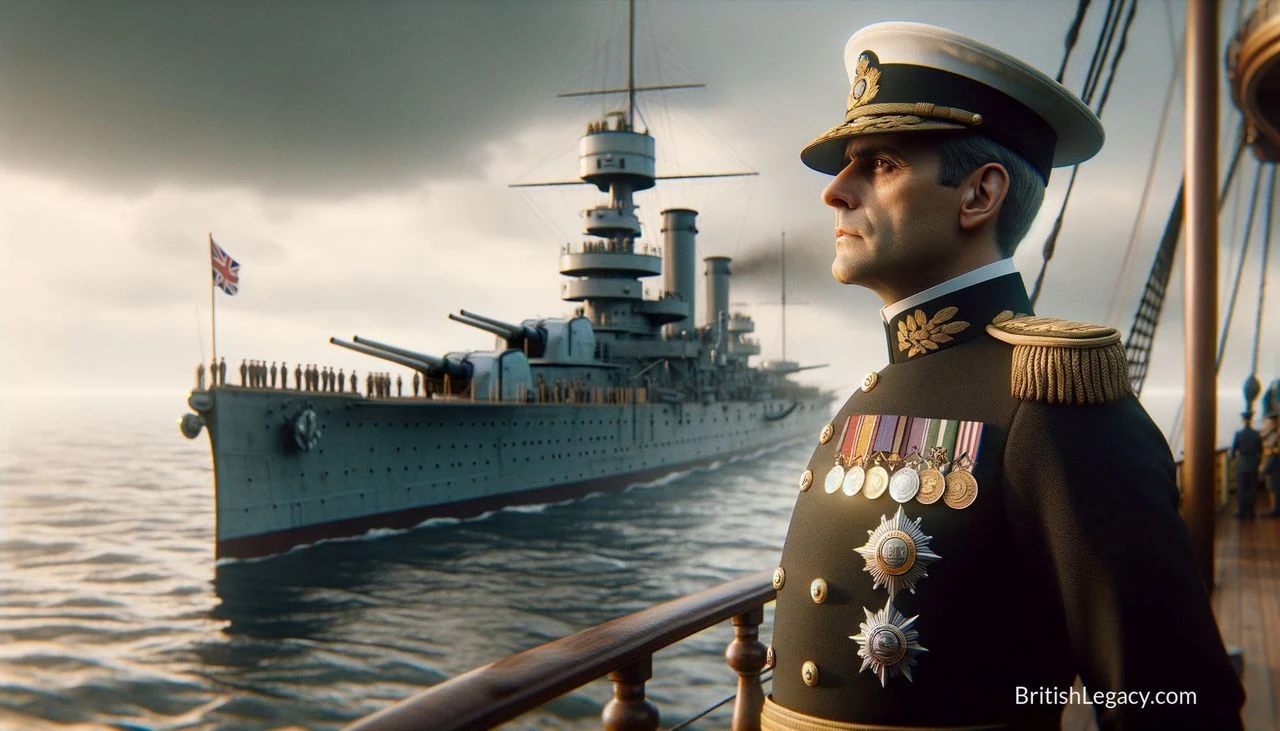
Admiral Sir David Beatty’s career joined a prominent role in the Royal Navy’s largest First World War sea battle with senior service in the years that followed. As commander of the Battlecruiser Fleet at Jutland in 1916, he led British ships through an engagement marked by heavy losses on both sides. After the war, he became First Sea Lord, holding the post from 1919 to 1927, and was raised to the peerage as Earl Beatty.
From Cheshire to the Royal Navy
Beatty was born at Howbeck Lodge, Stapeley, Cheshire, in 1871. He entered the Royal Navy at the age of thirteen, beginning a career that took him on operations in different parts of the world. Among his early service were the Nile Expedition alongside Lord Kitchener and the China War, including involvement in the relief of Peking.
These postings preceded his rise to senior command. By 1914 Beatty held the rank of Rear-Admiral and commanded the Battlecruiser Fleet. The fleet’s role brought him into the centre of the naval war between Britain and Germany. His most prominent wartime command came at the Battle of Jutland, fought in the North Sea on 31 May 1916.
Command at Jutland
Beatty led his battlecruisers from HMS Lion during the engagement, the largest naval battle of the First World War. The battle involved British and German dreadnoughts and battlecruisers in a confused exchange of gunfire and manoeuvres. It was costly for both sides, and the British battlecruisers suffered devastating losses.
Beatty is associated with the remark, “There seems to be something wrong with our bloody ships today,” made after the destruction of HMS Indefatigable and HMS Queen Mary. The line captures the shock of the ships’ losses, but the battle was not simply a story of a single commander’s resolve. Jutland was a complex fleet action, and neither side won an unambiguous tactical victory. The German High Seas Fleet did not break British control of the North Sea, while the scale of the losses made the engagement anything but a straightforward triumph.
Beatty’s command at Jutland became the defining episode of his wartime career. The battle brought the risks of naval combat into sharp view: powerful ships and concentrated firepower could not guarantee that a fleet would emerge without grave damage. Its outcome and meaning have to be understood through the losses and the wider contest for control of the North Sea, rather than through a simple claim of decisive victory.
First Sea Lord and Earl Beatty
After the war, Beatty continued in naval leadership. He became Admiral of the Fleet and served as First Sea Lord from 1919 until 1927. During his tenure, he oversaw the modernisation of the Royal Navy. The role placed him in a position to influence the service beyond the immediate demands of wartime command, as it addressed the work of maintaining and adapting the fleet in the post-war years.
In 1919 he was elevated to the peerage as Earl Beatty. The honour marked his place among the senior figures of the wartime navy, while his long period as First Sea Lord extended his influence into the institution’s post-war organisation. His public reputation, however, remained closely tied to Jutland and to the losses suffered by the British battlecruisers there.
Why David Beatty deserves a place in British Legacy
Beatty’s place in British Legacy rests on the combination of his wartime command and his later responsibility for the Royal Navy. At Jutland, he led the Battlecruiser Fleet in an exceptionally costly engagement that exposed the dangers of naval warfare as well as the limits of any easy victory narrative. Remembering his role means keeping both aspects in view: he commanded British forces in a major fleet battle, and those forces suffered severe losses. The episode remains important not only as a test of leadership but as a reminder of the human and material consequences of battle at sea.
His service as First Sea Lord from 1919 to 1927 gives his legacy a further institutional dimension. Beatty’s career did not end with Jutland; he held the navy’s senior professional post in the years after the war and oversaw its modernisation. That link between combat command and the continuing work of maintaining a national service makes his story relevant to Britain’s naval history. His honours, including the title of Earl Beatty, reflected the public recognition attached to his service, while the battle itself remains a complex episode rather than a simple tale of triumph.