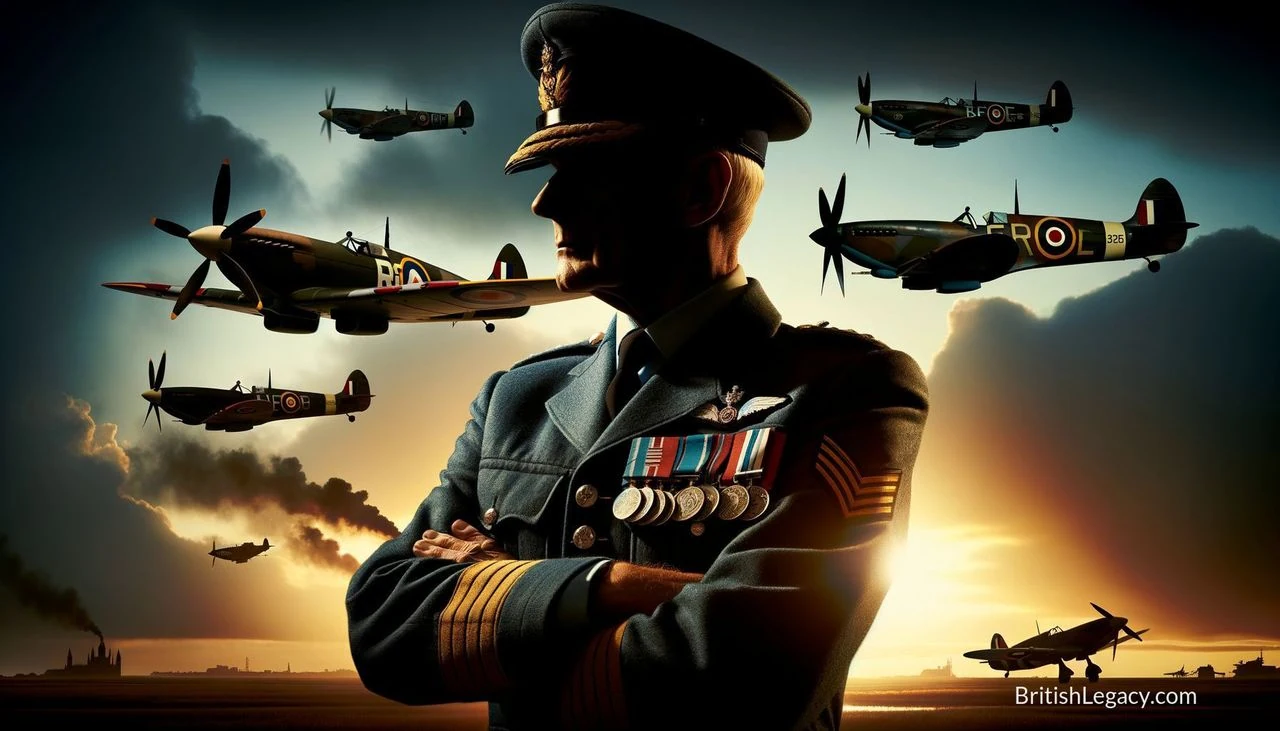
When the Luftwaffe attacked Britain in 1940, Hugh Dowding’s task was not simply to send fighters into the air. He had to make a limited force ready for a sustained battle, direct it towards incoming raids and avoid spending aircraft and pilots faster than they could be replaced. The air-defence system developed under his leadership linked radar, human observers, plotting and radio control. Its value lay in the way those parts worked together.
Dowding commanded RAF Fighter Command through the Battle of Britain, but his contribution began years earlier, in the preparation of Britain’s defences. His approach combined technical foresight with a reluctance to squander scarce resources. It also brought him into conflict with senior colleagues and left his departure from Fighter Command contentious. His story is not only one of victory, but of the difficult decisions and institutional tensions behind it.
From the Army to the Royal Flying Corps
Hugh Caswall Tremenheere Dowding was born in Moffat, Scotland, on 24 April 1882. He attended St Ninian’s School and Winchester College before training at the Royal Military Academy, Woolwich. Commissioned into the Royal Garrison Artillery in 1900, he served in Gibraltar, Ceylon, Hong Kong and India. His military career initially belonged to the army, not the air.
After developing an interest in aviation, Dowding gained his aviator’s certificate in 1913 and attended the Central Flying School. He joined the Royal Flying Corps as a pilot in August 1914. During the First World War he served in several flying and staff roles, including as commanding officer of No. 16 Squadron in France. His disagreement with RFC commander Hugh Trenchard over giving pilots time to rest foreshadowed a concern that remained important in 1940: people and machines could not be treated as an inexhaustible supply.
Dowding received a permanent commission in the Royal Air Force in 1919. In the inter-war years he held commands and senior posts, including Air Member for Supply and Research and Air Officer Commanding Fighting Area, Air Defence of Great Britain. He was more interested in fighters than many colleagues in an RAF where strategic bombing held considerable influence. His technical responsibilities also brought him into contact with the changing demands of aircraft design and air defence.
Building a connected air-defence system
In July 1936 Dowding became the first commander of the newly created RAF Fighter Command. He oversaw preparations for a future war and the development of a system later known as the Dowding system. It brought together radar, the Royal Observer Corps and other human observers, the plotting of raids, and radio control of aircraft. The network’s centre was at RAF Bentley Priory, with information moving through communications that included protected telephone cables.
Radar could detect incoming aircraft, but early equipment did not provide everything commanders needed, including reliable information about altitude. Observers helped fill such gaps. Plotting and communications turned reports into information that could guide fighter squadrons towards raids. The system was not a single invention by one man: Dowding’s significance lay in recognising radar’s potential and overseeing an integrated means of using it.
Preparation also meant getting modern fighters into service. The Hurricane and Spitfire became central to Fighter Command, and Dowding pressed for pilots to have bullet-proof windscreens. He was concerned, too, about the supply of trained aircrew. Before the war he warned of shortages, and in 1940 the loss of experienced pilots placed growing pressure on the command. Aircraft could be produced more readily than trained pilots could be replaced.
Holding the line in 1940
After the fall of France, the Luftwaffe sought air superiority as a precondition for Operation Sea Lion, Germany’s planned invasion of Britain. Dowding and Chief of the Air Staff Sir Cyril Newall resisted pressure to send further fighter squadrons to France when doing so would weaken home defence. During the Battle of France, Dowding warned that Fighter Command’s resources were being reduced dangerously. He later worked with Air Vice-Marshal Keith Park to provide cover for the evacuation of the British Expeditionary Force from Dunkirk.
During the Battle of Britain, Dowding managed the overall supply of aircraft and aircrew while leaving subordinate commanders room to direct the fighting in their sectors. He sought to maintain a reserve rather than commit every available fighter at once. The Channel fighting brought difficult choices: sending more aircraft against German raids could help protect shipping, but could also expose British fighters and pilots to costly losses. Dowding had to balance immediate danger against the need to keep Fighter Command capable of fighting on.
The pressure intensified as the Luftwaffe attacked south-east England and London. Fighter Command’s pilots included personnel from Commonwealth countries and occupied European nations, alongside the British majority. Losses and fatigue made rotation and replacement urgent. Dowding was remembered for his concern for his pilots; that concern also formed part of the calculation needed to preserve an effective fighting force.
On 15 September 1940, a major air battle became a defining moment of the campaign. The Luftwaffe did not secure the air superiority required for an invasion, and Hitler postponed Operation Sea Lion. The Battle of Britain did not end all German attacks, but preventing the Luftwaffe from controlling the skies denied the invasion plan its essential condition. Dowding’s preparation of the defence and management of its resources were central to that outcome.
Victory, disagreement and departure
Dowding’s methods were contested within the RAF. Trafford Leigh-Mallory and others advocated the “Big Wing” approach, in which larger formations of fighters would assemble before attacking. Dowding and Park favoured a more flexible response, including smaller groups able to engage raids without waiting for a large formation to gather. The disagreement involved operational choices as well as command politics; it does not alter the fact that Fighter Command prevented the Luftwaffe from gaining air superiority.
As German night bombing intensified during the Blitz, pressure grew for changes to Britain’s air defences. The existing system lacked the airborne radar needed for an effective night-fighter response. Dowding approved only some recommendations from a review of night defence, and his relationship with senior figures had become difficult. He was replaced by Sholto Douglas in November 1940, against his wishes. The circumstances of his removal involved both the night-defence dispute and wider disagreements over tactics and influence.
After leaving Fighter Command, Dowding undertook work in the United States for the Ministry of Aircraft Production and later led a study of RAF manpower. He retired from the RAF in July 1942 and was made Baron Dowding of Bentley Priory in 1943. In later life he wrote and spoke about spiritualism, joined the Theosophical Society and became involved in animal-rights causes. He died in Royal Tunbridge Wells on 15 February 1970, aged 87. His ashes were placed beneath the Battle of Britain Memorial Window in the RAF chapel at Westminster Abbey.
Remembering Dowding
Dowding’s honours included appointment as a Knight Grand Cross of the Order of the Bath in October 1940, as well as the Knight Grand Cross of the Royal Victorian Order and the Companion of the Order of St Michael and St George. A statue stands outside St Clement Danes on London’s Strand, commemorating his command of Fighter Command and his role in preparing its aircraft and air-defence system. Other monuments include one in Moffat, where he was born, and one in Tunbridge Wells, near where he died.
His public remembrance has often concentrated on the Battle of Britain, but the record also includes the preparation that preceded it, the strain on pilots and aircraft, and his contentious removal soon after the victory. These elements belong together. They show how an effective defence depended on technical systems, command judgement and the ability to preserve a force under pressure—and how success did not settle disagreements about how that force should be led.
Why Hugh Dowding deserves a place in British Legacy
Hugh Dowding deserves a place in British Legacy because his work helped Britain meet a direct military threat with a defence built around coordination rather than a single weapon or dramatic gesture. As head of Fighter Command, he oversaw the integration of radar, observers, raid plotting and radio control. That system helped turn early warnings into decisions about where fighters were needed. He also pressed for modern aircraft and protective equipment, while paying close attention to a resource that could not be rapidly manufactured: trained pilots.
The benefit was practical and consequential. Fighter Command remained able to resist the Luftwaffe in 1940, and Germany failed to obtain the air superiority on which Operation Sea Lion depended. Dowding’s contribution was not solitary: pilots, ground crews, observers, technical specialists and other commanders all formed part of the defence. But his preparation and management helped make their work effective. His later removal, amid disputes about tactics and night defence, adds complexity to the legacy. Remembering Dowding means recognising both the value of carefully organised national defence and the difficult judgements required to sustain it. His British connection is concrete: he led an RAF command preparing and operating the United Kingdom’s air defences at a moment when control of its skies was essential to the invasion plan’s defeat.
Sources
Hugh Dowding — Wikipedia revision 1379806898
Adapted in part from Hugh Dowding by Wikipedia contributors, under CC BY-SA 4.0. Text has been edited and combined with the existing article; this adapted text is shared under the same licence. Contributor history.