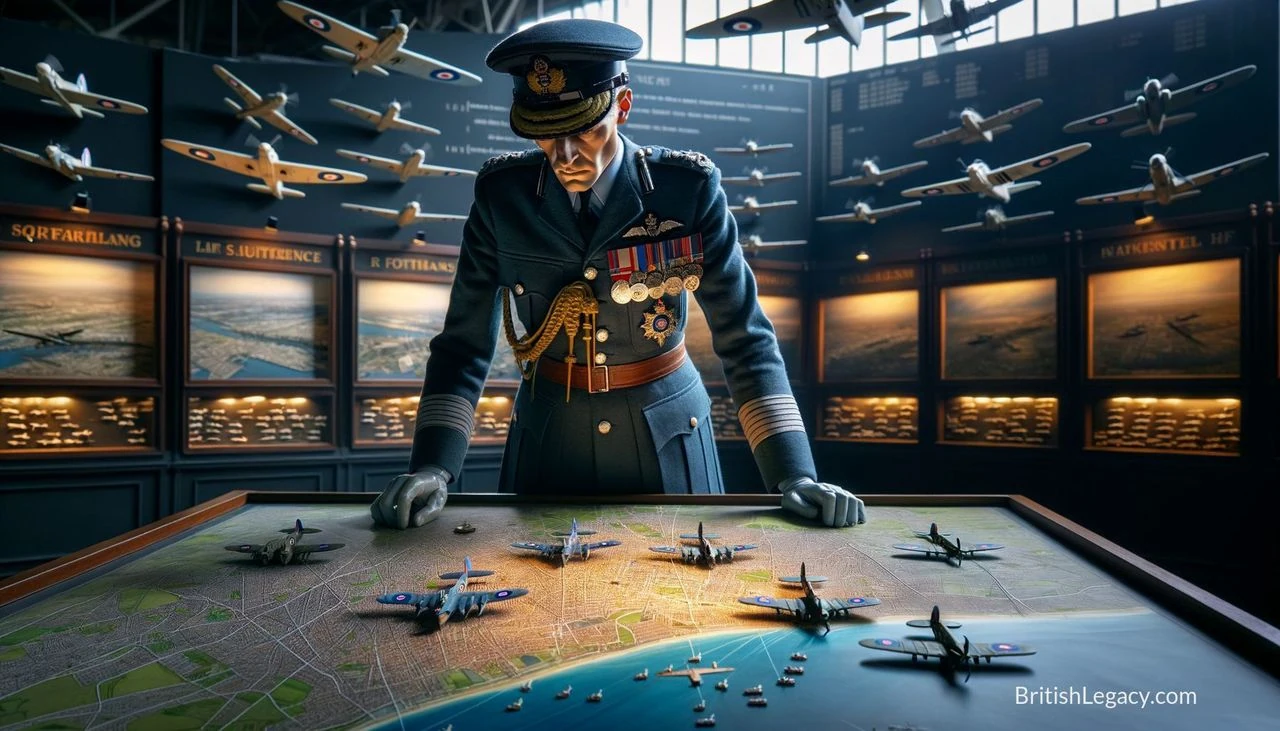
When German raids threatened south-east England in 1940, Keith Park had minutes to decide which warnings represented the main attack, which squadrons could respond and how many fighters to keep ready. As commander of RAF No. 11 Group, he directed the defence of London and the surrounding region during the Battle of Britain. His command depended not on a single tactic, but on using radar reports, plotting tables, aircraft and pilots in a fast-moving system under pressure.
Park was born in New Zealand and served in the Royal Air Force from 1918 to 1946. His wartime career connected him to Britain through the defence of its skies and to a wider Allied effort that later extended from Malta to South-East Asia. He retired as an air chief marshal; his best-known command remains No. 11 Group.
From New Zealand artillery to the Royal Flying Corps
Keith Rodney Park was born in Thames, New Zealand, on 15 June 1892. His father, James Livingstone Park, was a Scottish geologist; his mother was Frances Rogers. Keith attended King's College in Auckland and Otago Boys' High School in Dunedin. After leaving school, he worked for the Union Steam Ship Company, serving as a purser, and joined the New Zealand Field Artillery as a Territorial soldier in 1911.
He enlisted in the New Zealand Expeditionary Force in December 1914 and served with artillery at Gallipoli, where he landed in April 1915. He later transferred to the British Army and went with his battery to the Western Front. Wounded during the Battle of the Somme in October 1916, he was evacuated to England. After recovering, he joined the Royal Flying Corps and trained as a pilot.
Posted to No. 48 Squadron in France in July 1917, Park flew Bristol Fighters on patrol and reconnaissance duties. He became a successful combat pilot and, in 1918, took command of the squadron. His First World War record is not straightforward to reduce to one number: the squadron's records, Air Ministry records and his biographer's assessment give different totals for aircraft destroyed or driven out of control.
After the war, Park received a permanent commission in the newly established RAF. He held training and staff appointments, commanded No. 111 Squadron and served at the Air Defence of Great Britain headquarters at Uxbridge. In the 1930s, postings included an air attaché role in South America and command of RAF station Tangmere. In 1938 he became senior air staff officer to Hugh Dowding at Fighter Command. The two worked on a system for directing fighters, incorporating radio direction finding—then commonly called RDF—and information from other sources into operational decisions.
Commanding No. 11 Group
Park took command of No. 11 Group on 20 April 1940. Its area included London and south-east England, and its position meant that it faced a large share of the German air assault. During the evacuation from Dunkirk, the group provided fighter cover. Park observed the operation from the air and favoured concentrated patrols over attempts to maintain continuous cover with the limited aircraft available.
When the Battle of Britain began, No. 11 Group had to respond to raids approaching across the Channel and south-eastern coast. Park and his controllers used plotting tables to assess the location and scale of incoming formations, judge which attacks posed the greatest threat and direct squadrons towards them. Radar gave warning, but the time between detecting a build-up and an interception could be short. Park had to balance the need to engage bombers against the risks of sending fighters after diversions or exhausting aircraft and pilots.
Park visited airfields and kept in contact with the people operating his command, often flying his Hurricane between stations. This gave him first-hand knowledge of conditions at bases under attack and kept him visible to pilots and ground crews. Winston Churchill visited Park's headquarters at Uxbridge in August 1940. The following month, on 15 September, Park committed his available aircraft against a major German raid; fighters from No. 12 Group also joined the defence. The date became known as Battle of Britain Day.
Park's approach was contested. Air Vice-Marshal Trafford Leigh-Mallory, commanding No. 12 Group, advocated assembling larger formations known as “Big Wings”. Park argued that, in the short time available over south-east England, the delay involved could leave targets exposed while those formations assembled. The dispute became part of wider tensions within Fighter Command. Park was replaced as No. 11 Group commander in December 1940, and Leigh-Mallory succeeded him. Park believed his removal was connected to the disagreement; the official explanation was that he needed rest. The change of command did not erase the work he had led through the battle's most intense period.
From training command to Malta and South-East Asia
After leaving No. 11 Group, Park commanded No. 23 Group in Training Command. He inspected its schools, worked to improve their organisation and equipment, and addressed what he saw as a lack of readiness for wartime demands. In late 1941 he was posted to the Middle East, taking command in Egypt in 1942.
In July 1942 Park went to Malta, where Axis aircraft were attacking the island. He changed the defensive approach, directing fighters to intercept enemy formations before they reached their targets. His plan divided the work among aircraft tasked with engaging high-cover fighters, closer escorts and bombers. The island's air forces later took on an increasingly offensive role, attacking shipping, airfields and other targets in support of Allied operations in North Africa and the Mediterranean. Park was appointed a Knight Commander of the Order of the British Empire in 1942.
Promoted to air marshal in 1944, Park returned to senior command in the Middle East before becoming Allied Air Commander, South-East Asia Command, in 1945. His responsibilities included supporting the advance of the British Fourteenth Army through Burma, notably by arranging large-scale air supply. After Japan's surrender, his command helped repatriate Allied prisoners and internees. He was promoted to air chief marshal and retired from the RAF in December 1946.
Life after the RAF and public remembrance
After retiring, Park represented the British aircraft manufacturer Hawker Siddeley in the Pacific. He later served on Auckland City Council, having been elected in 1962, and took part in work on Auckland International Airport. He died in Auckland on 6 February 1975, aged 82, after a series of heart attacks. He received a military funeral, and his ashes were scattered over Waitematā Harbour.
Memorials in Britain reflect the importance of his wartime command. A temporary statue of Park stood on the Fourth Plinth in Trafalgar Square from 2009 to 2010 before moving to the Royal Air Force Museum in London. A bronze statue was unveiled in Waterloo Place on 15 September 2010, the 70th anniversary of Battle of Britain Day. Keith Park Crescent near the former RAF station at Biggin Hill and Keith Park Road in Uxbridge also bear his name.
Why Keith Park deserves a place in British Legacy
Park's place in British history rests on a specific responsibility: he commanded the RAF group charged with defending London and south-east England during the Battle of Britain. The job involved making decisions with incomplete information and little time to act. His use of radar-derived warnings and plotting tables helped controllers direct fighters towards incoming attacks, while his attention to aircraft availability and the condition of airfields addressed the practical limits of the defence. His leadership was not separate from the work of pilots, ground crews and controllers; it was exercised through the system that coordinated them.
His British connection is also part of a larger Commonwealth and Allied history. Born in New Zealand, Park served in the New Zealand forces before joining the British Army and the RAF. He later commanded air operations in the Mediterranean and South-East Asia, including the supply effort supporting the Fourteenth Army in Burma. In Britain, his name is commemorated in London and near former RAF sites, while his service forms part of the history of Fighter Command. Remembering Park therefore gives British Legacy a way to tell both a national and an international story: how a New Zealand-born officer helped organise Britain's air defence, and how the same career continued across Allied campaigns far beyond it.
Sources
Adapted in part from Keith Park by Wikipedia contributors, under CC BY-SA 4.0. Text has been edited and combined with the existing article; this adapted text is shared under the same licence. Contributor history.