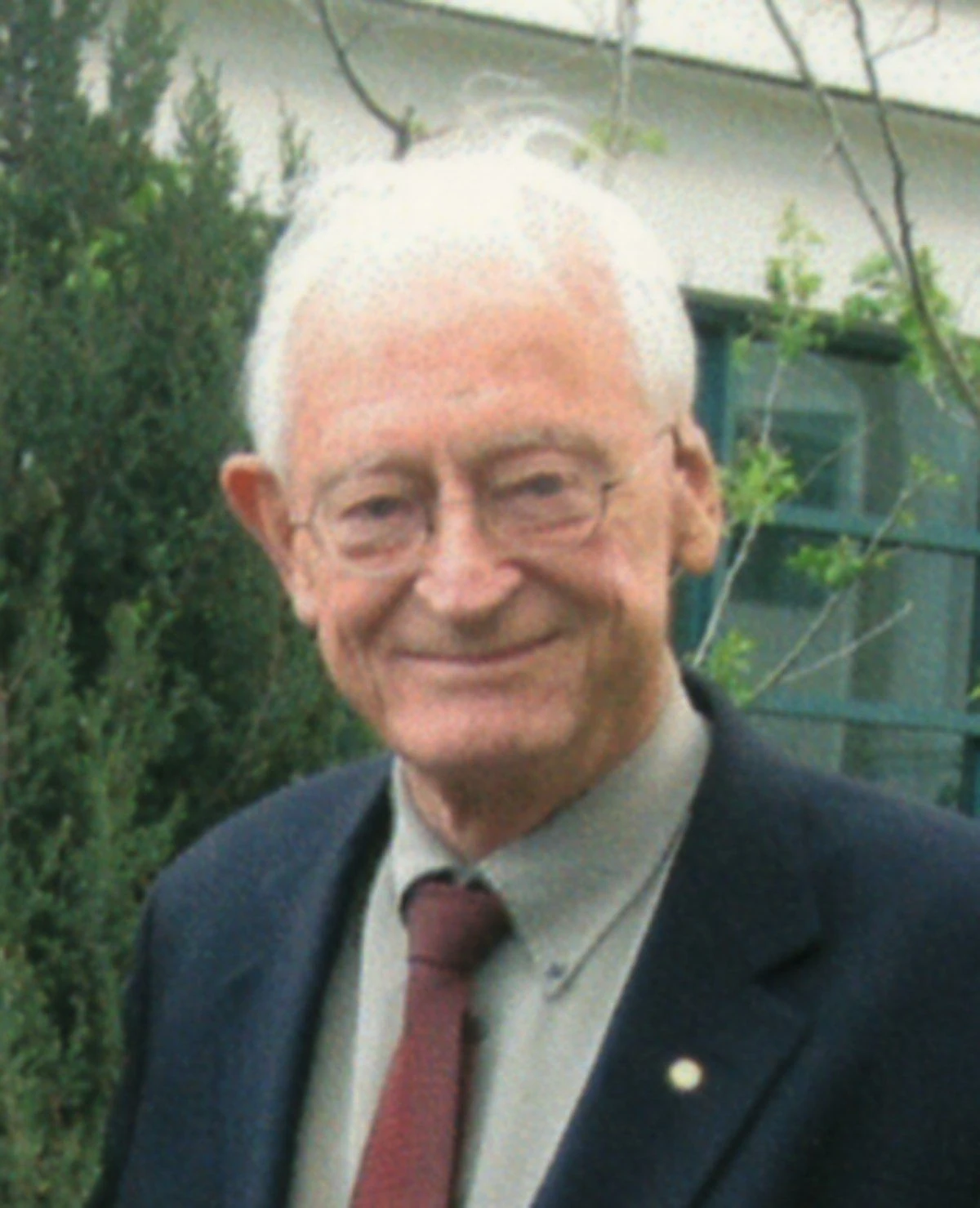
Plastic is usually valued as an electrical insulator. In research published in 1977, chemists Alan MacDiarmid and Hideki Shirakawa, working with physicist Alan Heeger, helped establish that modified plastics could conduct electricity. The discovery opened a new field of materials science and earned the three researchers the 2000 Nobel Prize in Chemistry. MacDiarmid’s connection to Britain was one chapter in a career that began in New Zealand and was spent largely in the United States: he completed a second doctorate at Cambridge and worked for a year at the University of St Andrews before moving to the University of Pennsylvania.
A scientific education across continents
Alan Graham MacDiarmid was born in Masterton, New Zealand, on 14 April 1927. One of five children, he grew up in a family whose circumstances were made harder by the Great Depression; the family moved to Lower Hutt, near Wellington. At about ten, he became interested in chemistry after finding one of his father’s old textbooks. He taught himself from it and from books borrowed from the library.
After attending Hutt Valley High School, MacDiarmid studied at Victoria University of Wellington. He passed the University of New Zealand’s University Entrance and Medical Preliminary examinations in 1943, then worked part-time as a laboratory assistant, or “lab boy”, at the university while studying for his bachelor’s degree. He completed that degree in 1947, became a demonstrator in the undergraduate laboratories and continued with postgraduate chemistry. He graduated with first-class honours in 1951.
A Fulbright Fellowship took him to the University of Wisconsin–Madison, where he received a master’s degree in 1952 and a doctorate in 1953. A Shell Graduate Scholarship then enabled him to study at Sidney Sussex College, Cambridge. There he completed a second PhD in 1955, with a thesis on derivatives of the silyl radical. Cambridge was a significant part of his training, but not the end of his British academic experience.
From St Andrews to Pennsylvania
MacDiarmid spent a year on the junior faculty of the School of Chemistry at the University of St Andrews in Scotland. He then took a chemistry post at the University of Pennsylvania, where he became a full professor in 1964. He spent the greater part of his career there, working on its chemistry faculty for 45 years, and was appointed Blanchard Professor of Chemistry in 1988. In 2002, he also joined the faculty of the University of Texas at Dallas.
His early research at Pennsylvania focused on silicon chemistry. Conductive polymers became the best-known part of his scientific career, but they were not its only subject. The record of his work includes more than 600 published papers and 20 patents. MacDiarmid also travelled internationally to speak about the value of making innovation a global endeavour. In 2001, one of his courses included a small seminar for incoming students about his research.
How plastic became an electrical material
MacDiarmid’s most recognised research developed through collaboration with the Japanese chemist Hideki Shirakawa and the American physicist Alan Heeger. Their work showed that plastics could be made electrically conductive through particular modifications. The first results were published in 1977, and the research that followed helped establish conductive polymers as a field of study.
One important material was polyacetylene. A 1978 paper by a larger research team, including MacDiarmid, Heeger and Shirakawa, reported highly conducting films made from polyacetylene derivatives. MacDiarmid also worked on other polymers, including polyaniline. Research into these materials explored how their chemical composition and treatment affected their electrical properties, extending the investigation beyond the initial finding.
The practical promise of the work reached beyond laboratory chemistry. Conductive plastics have been used in anti-static materials for photographic film and in “smart” windows designed to exclude light. Semi-conductive polymers have been applied in light-emitting diodes, solar cells and displays in mobile telephones. These uses illustrate why a material that combines characteristics of plastics with the ability to conduct electricity attracted attention across both chemistry and electronics.
In 2000, MacDiarmid shared the Nobel Prize in Chemistry with Heeger and Shirakawa. The Nobel award recognised their discovery that plastics could be made electrically conductive after modification. It marked the international significance of their collaborative research; it was not a prize specifically for work conducted in Britain.
Recognition and remembrance
MacDiarmid received honours in New Zealand, the United States and internationally. Victoria University of Wellington awarded him an honorary doctorate in 1999, and the Royal Society of New Zealand awarded him the Rutherford Medal in 2000. He was appointed to the Order of New Zealand in the 2002 New Year Honours and elected a Fellow of the Royal Society in 2003. His other awards included the American Chemical Society’s Award in Materials Chemistry in 1999 and China’s Friendship Award in 2004.
He died on 7 February 2007, aged 79, in Drexel Hill, Pennsylvania. He had been ill with myelodysplastic syndrome and was planning to travel to New Zealand when he fell down the stairs at home. He is buried at Arlington Cemetery in Drexel Hill. His scientific work also became part of the institutions and places that commemorated him: Victoria University of Wellington named its physical chemistry chair after him in 2001, and opened a MacDiarmid building in 2011. His widow presented his Nobel medal to the university, where it was put on display.
Why Alan MacDiarmid deserves a place in British Legacy
MacDiarmid’s place in British Legacy rests on a specific part of his international career, rather than on a claim that he was British or that his Nobel-winning research was based in Britain. He was born and educated in New Zealand, completed his second doctorate at Cambridge, and spent a year on the junior faculty at St Andrews before establishing the long-running US chapter of his career at Pennsylvania. That path connects British universities with a scientist whose work became internationally consequential, while keeping the scale and location of his contribution clear.
The scientific achievement itself merits attention because it changed what researchers could expect of a familiar class of materials. Work by MacDiarmid, Shirakawa and Heeger demonstrated that plastics need not be electrical insulators in every form. Research on polyacetylene and later polymers helped build a field with applications that include anti-static photographic materials, smart windows, light-emitting diodes, solar cells and mobile-phone displays. The Nobel Prize recognised that advance, while MacDiarmid’s extensive publication and patent record reflects a broader career in chemistry. Remembering his British academic chapter alongside his New Zealand origins and American career offers a more accurate account of how scientific knowledge crosses institutions and borders.
Sources
Alan MacDiarmid — Wikipedia revision 1371962478
Adapted in part from Alan MacDiarmid by Wikipedia contributors, under CC BY-SA 4.0. Text has been edited and combined with the existing article; this adapted text is shared under the same licence. Contributor history.