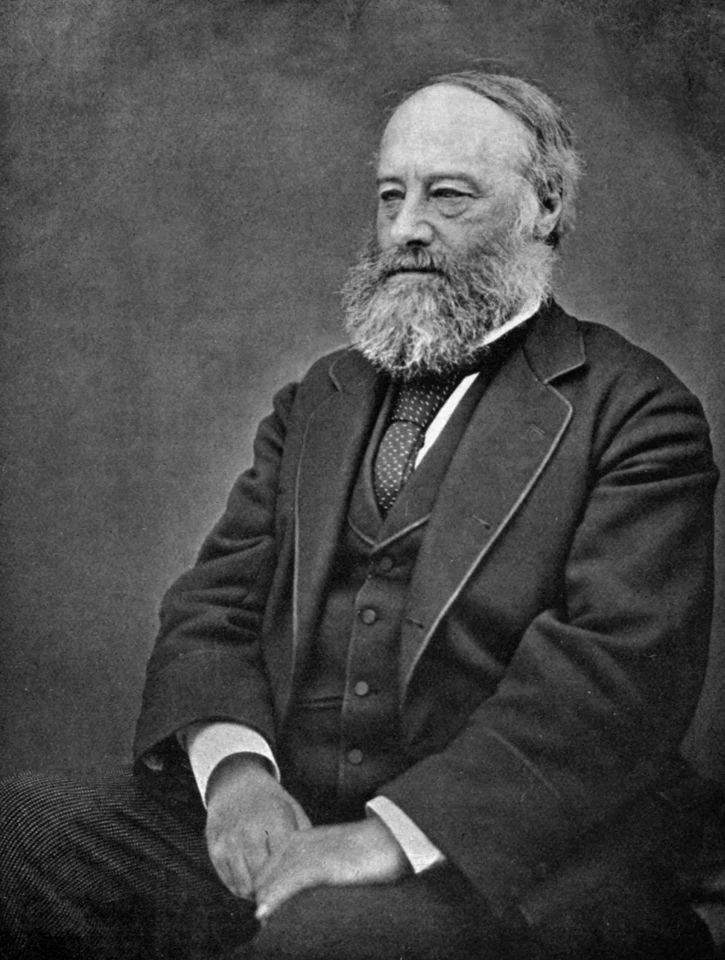
James Prescott Joule approached heat as something that could be measured against work. In experiments with electricity, moving water and falling weights, he gathered evidence that heat was not an indestructible fluid, as the prevailing caloric theory proposed, but could be produced through the expenditure of mechanical energy. His results helped shape the first law of thermodynamics and gave science a way to compare different forms of energy.
A brewer’s son with a practical scientific education
Joule was born in Salford, Lancashire, on 24 December 1818, the son of Benjamin Joule, a wealthy brewer, and Alice Prescott. His scientific education included tuition from John Dalton, whose work on atomic theory had a strong influence on him. Joule also encountered the ideas of chemist William Henry and Manchester engineers Peter Ewart and Eaton Hodgkinson. He did not follow a conventional academic career: as an adult, he managed the family brewery, while science remained a serious pursuit alongside the business.
Around 1840, Joule began investigating whether the brewery’s steam engines could be replaced by electric motors. The practical question of which source of power was more economical led him to compare their outputs. He expressed that output in foot-pounds: the work needed to raise a one-pound mass by one foot. In 1841, he described a relationship between electric current and the heat produced in a conductor, now known as Joule’s first law. His investigations soon widened from the efficiency of particular machines to a more fundamental question: how work and heat were related.
Experiments that challenged the caloric theory
In 1843, Joule published experimental results arguing that the heating effect of an electric current came from heat generated in the conductor, rather than heat transferred from elsewhere in the apparatus. That conclusion challenged the caloric theory, which treated heat as a substance that could neither be created nor destroyed. Joule’s argument was not immediately accepted. His work depended on measurements of small temperature changes, and the idea that mechanical work could be converted into heat required a significant shift in how scientists understood physical processes.
He tested the relationship by more than one method. In one experiment, he forced water through a perforated cylinder and measured the slight heating caused by the fluid’s resistance to motion. In another, he studied the temperature change associated with compressing a gas. These approaches gave him different estimates of the mechanical equivalent of heat, but their agreement helped make the case that work and heat were quantitatively connected.
Joule’s best-known experiment used a falling weight to turn a paddle wheel inside an insulated barrel of water. As the weight descended, the wheel stirred the water and raised its temperature. Joule reported the results to the British Association for the Advancement of Science at Cambridge in June 1845. In 1850, after further work, he published a more refined measurement of the mechanical equivalent of heat. The unit of energy later named the joule commemorates the connection his experiments helped establish between heat and mechanical work.
From resistance to recognition
Joule’s proposals met resistance in part because they rested on unusually precise measurements. He claimed to be able to measure temperature to within one two-hundredth of a degree Fahrenheit. His experience with brewing and access to its practical techniques supported his experimental work; so did the assistance of scientific instrument-maker John Benjamin Dancer. The evidence accumulated across experiments, but the wider scientific argument about the nature of heat took time to settle.
At a British Association meeting in Oxford in 1847, Joule presented work that caught the attention of William Thomson, later Lord Kelvin. Thomson was intrigued but initially sceptical. The two men subsequently developed a substantial scientific exchange, with Joule conducting experiments and Thomson analysing the results and proposing further investigations. Their collaboration, which lasted from 1852 to 1856, included work on what became known as the Joule–Thomson effect: the change in a gas’s temperature when it expands without doing external work. Their results helped bring broader acceptance to Joule’s work. Joule also worked with Thomson on the development of an absolute thermodynamic temperature scale, later known as the Kelvin scale.
Joule’s scientific interests extended beyond the mechanical equivalent of heat. His work included observations of magnetostriction—the change in a material’s dimensions under magnetisation—as well as research into electricity and heat. In 1847, the German physicist Hermann Helmholtz’s account of the conservation of energy credited both Joule and Julius Robert von Mayer, whose work had also been neglected. Joule’s experiments formed part of a wider scientific transition, rather than a discovery made in isolation.
Honours, family and remembrance
Joule became a Fellow of the Royal Society in 1850. The Society awarded him its Royal Medal in 1852 for work on the mechanical equivalent of heat, and its Copley Medal in 1870 for experimental research into the dynamical theory of heat. He served as president of the Manchester Literary and Philosophical Society in 1860 and of the British Association for the Advancement of Science in 1872 and 1887. In 1878, he received a civil list pension of £200 a year for services to science; the Royal Society of Arts awarded him its Albert Medal in 1880.
Joule married Amelia Grimes in 1847. They had three children; Amelia died in 1854. Joule died at home in Sale, Cheshire, on 11 October 1889, aged 70, and was buried in Brooklands Cemetery there. His memory is also marked by a memorial in the north choir aisle of Westminster Abbey and a statue by Alfred Gilbert in Manchester Town Hall. He is not buried at Westminster Abbey.
Why James Prescott Joule deserves a place in British Legacy
Joule’s place in British Legacy rests on the substance of his contribution and on the way he reached it. Working outside an academic post while managing a brewery, he brought a practical concern with engines and efficiency to questions about the nature of heat. Rather than rely on a single striking demonstration, he tested the relationship between work and heat through electrical, fluid and mechanical experiments. His measurements challenged a dominant theory and helped establish a framework in which different forms of energy could be understood in relation to one another.
That framework has consequences beyond the history of physics. The first law of thermodynamics provides a basic account of energy transformation, while the joule remains the SI unit used to measure energy. Joule’s collaboration with Thomson also contributed to thermodynamics and to work on gas expansion and absolute temperature. His story makes a specifically British contribution visible: a Salford-born experimentalist, embedded in the industrial and scientific life of nineteenth-century Britain, helped give engineers and scientists a common measure for connecting heat, electricity and mechanical work. The memorial in Manchester Town Hall and his burial in Sale reflect that regional connection, while the enduring unit named for him carries his achievement far beyond it.
Sources
James Prescott Joule — revision 1373616390 · James Prescott Joule
Adapted in part from James Prescott Joule by Wikipedia contributors, under CC BY-SA 4.0. Text has been edited and combined with the existing article; this adapted text is shared under the same licence. Contributor history.