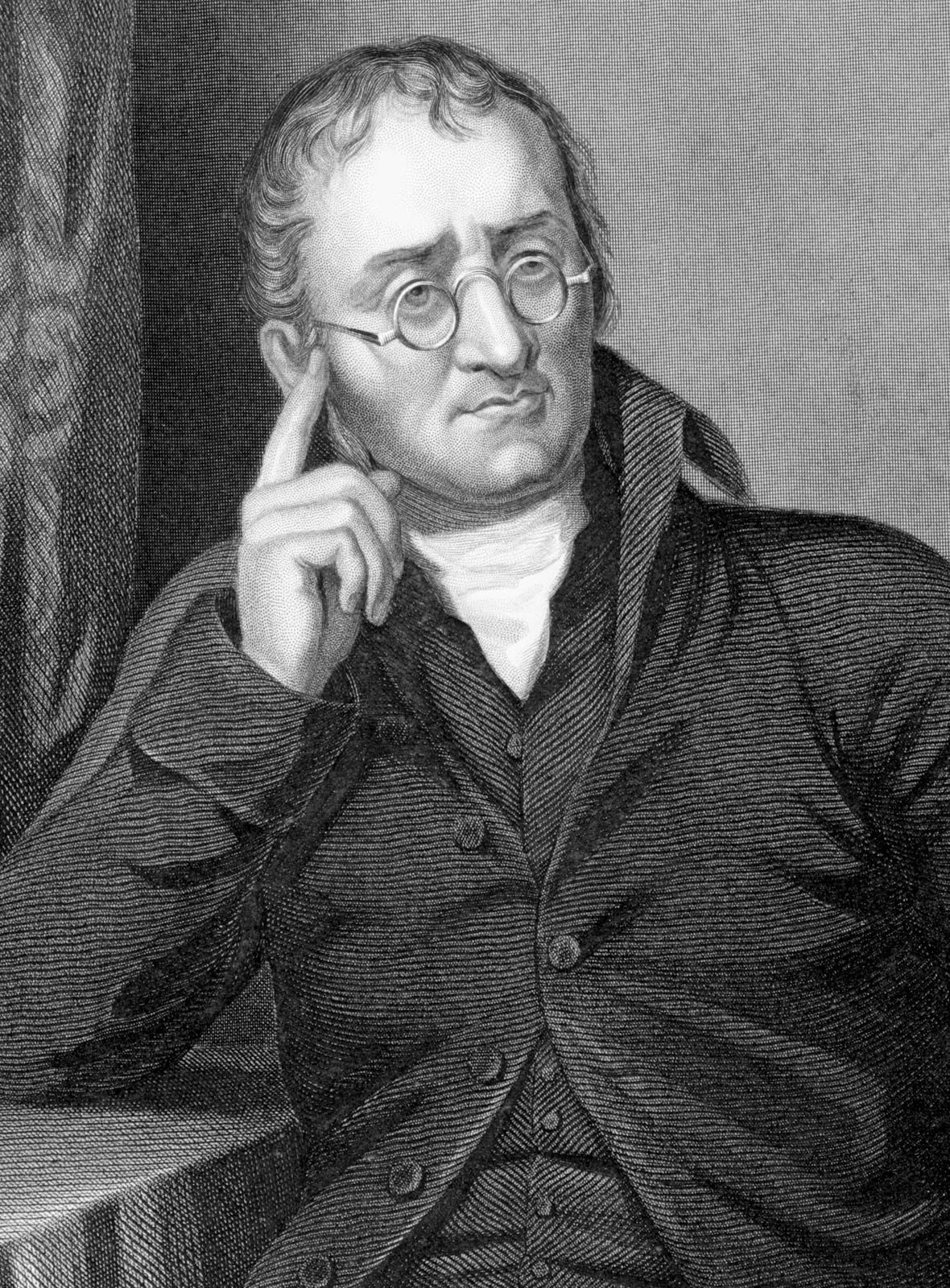
John Dalton’s atomic theory turned the idea of matter made from indivisible particles into a practical framework for chemistry. His contribution was not simply to revive an ancient idea: he assigned relative weights to atoms and used whole-number ratios to describe how elements combine. That quantitative approach helped shape nineteenth-century chemistry. Dalton’s work also ranged across meteorology, the behaviour of gases and colour vision, while a lifelong record of weather observations reflected the disciplined attention to measurement that ran through his research.
A Quaker upbringing and a life in Manchester
Dalton was born in 1766 into a Quaker family in Eaglesfield, Cumberland, in the English Lake District. His father was a weaver. He received early teaching from his father and from John Fletcher, who ran a private school at Pardshaw Hall. The family had limited means, and Dalton began earning his living at about ten, working for the local Quaker Elihu Robinson. Robinson, a meteorologist and instrument-maker, encouraged his interest in mathematics and the weather.
Dalton’s early working life included teaching. In 1787, aged 21, he began keeping a meteorological diary. He continued it for 57 years, recording more than 200,000 observations. His interest in weather was practical as well as theoretical: during annual visits to the Lake District, he climbed hills to measure temperature and humidity at altitude, using a barometer to estimate height. His work on the region’s mountains also intersected with that of Jonathan Otley, who used Dalton’s figures to check his own measurements.
Dalton’s first book, Meteorological Observations and Essays, appeared in 1793. It received little attention from other scholars at the time, but meteorology remained central to his working life. He later contributed to the Manchester Literary and Philosophical Society, becoming its secretary in 1800 and, eventually, its president. From 1817 until his death he contributed 117 papers to the society’s memoirs.
Investigating gases, weather and colour
Dalton’s research crossed boundaries that later became distinct scientific disciplines. In 1794, soon after arriving in Manchester, he joined the Manchester Literary and Philosophical Society and presented a paper on unusual facts about colour vision. He and his brother were colour-blind, and Dalton recognised that the condition could run in families. He proposed an explanation based on discolouration of the eye’s fluid, which was later disproved. Yet his investigation helped establish the scientific study of colour-vision deficiency. Examination of his preserved eye in 1995 identified his condition as deuteranopia, a form of congenital red-green colour blindness.
His study of gases grew partly from his work in meteorology. In 1801 he presented lectures on mixed gases, vapour pressure, evaporation and the expansion of gases when heated. A paper on the absorption of gases by water and other liquids, read in 1803 and published in 1805, set out the law of partial pressures now associated with his name: the pressure of a mixture of gases is the sum of the pressures each gas would exert separately. His investigations of the atmosphere and gas behaviour formed a substantial part of his scientific work, not merely a prelude to atomic theory.
Dalton also wrote on rain, dew, springs, heat, steam, light and English grammar. His research was independent-minded, though not always readily persuaded by other scientists’ conclusions. He sometimes relied on instruments that were rougher than those available to him. At the same time, historians who replicated some of his important experiments confirmed his skill and precision. His approach combined extensive observation with a determination to test ideas against evidence.
Atoms, weights and chemical combinations
Dalton developed his chemical atomic theory in 1803. Its first extended published discussion came in A New System of Chemical Philosophy, published in 1808. He proposed that each element consisted of atoms with a characteristic weight, and that atoms of different elements combined in fixed, simple whole-number proportions. Chemical reactions, in this account, rearranged atoms rather than creating or destroying them. These ideas offered a way to explain chemical combinations through quantities that could be compared.
Dalton’s first table of relative atomic weights covered six elements—hydrogen, oxygen, nitrogen, carbon, sulphur and phosphorus—with hydrogen taken as the reference weight of 1. He also devised symbols to represent atoms and compounds. Some of his proposed formulas were wrong. His “rule of greatest simplicity”, an assumption about the numbers of atoms in compounds, led him to represent water as OH and ammonia as NH, rather than by their modern formulas. The limitation matters: Dalton’s model was not a finished account of molecular structure. Its lasting importance lay in making relative atomic weights and quantitative combinations central to chemical theory.
The origins of his atomic ideas are not entirely settled. Accounts have linked them to his research on gases and to the analysis of chemical compounds. The evidence presented in studies of his laboratory notebooks has also suggested that his concept of atoms developed as a physical idea through his investigation of the atmosphere and other gases, and that he later used it to address chemical composition. What is clear is the distinctive step his theory took: it offered a method for assigning relative atomic weights and a framework for relating those weights to the proportions in which elements combine.
Recognition, teaching and remembrance
Dalton’s reputation grew during his lifetime. He was elected a Fellow of the Royal Society in 1822 and received its Royal Medal in 1826. He was also a corresponding member of the French Académie des Sciences, later becoming one of its foreign associates. In 1833 the government granted him a pension, which was increased in 1836. The honours recognised a career that had combined sustained observation, public scientific work and theoretical innovation.
He never married and lived modestly as a Quaker. For the 26 years before his death, he occupied a room in the Manchester home of the botanist the Reverend W. Johns and his wife. Dalton taught James Prescott Joule in his final years; Joule went on to publish important work on heat and its relation to mechanical work. After strokes in 1837 and 1838 impaired Dalton’s speech, he continued to conduct experiments. He made his last meteorological entry on 26 July 1844 and died in Manchester the following day, aged 77.
Manchester honoured Dalton with a civic funeral. His body lay in state at the town hall for four days, and more than 40,000 people filed past the coffin. His name remains attached to places and institutions in the city: John Dalton Street links Deansgate and Albert Square, while Manchester Metropolitan University’s John Dalton building houses its Faculty of Science and Engineering. The Manchester Literary and Philosophical Society awards a Dalton Medal, and the Royal Society of Chemistry names its inorganic division the Dalton Division. The unit of mass known as the dalton also commemorates his work.
Why John Dalton deserves a place in British Legacy
Dalton deserves a place in British Legacy because his work changed how chemistry could describe matter. Earlier ideas about atoms existed, but Dalton connected atoms to characteristic relative weights and to the measurable proportions in which elements combine. His theory was not correct in every detail: some of his formulas and assumptions were later superseded. Its enduring contribution was to provide a quantitative structure that helped move chemistry towards a more mathematical science. That is a more precise legacy than claiming that he single-handedly created modern science or directly produced every later development.
His example also reaches beyond atomic theory. For decades he recorded weather observations, studied gases and their pressures, and investigated colour vision through a condition he experienced himself. His work linked patient measurement with questions about the composition and behaviour of the natural world. In Manchester, the institutions and streets that bear his name, alongside the Dalton Medal and the mass unit, make that scientific history visible in public life. Dalton’s British legacy lies in both the ideas he developed and the working habits behind them: long-term observation, quantitative reasoning and the willingness to test a theory against experiment. Those methods helped establish a foundation on which later chemists could build.
Sources
John Dalton — Wikipedia, revision 1374984610 · John Dalton — Wikipedia
Adapted in part from John Dalton by Wikipedia contributors, under CC BY-SA 4.0. Text has been edited and combined with the existing article; this adapted text is shared under the same licence. Contributor history.