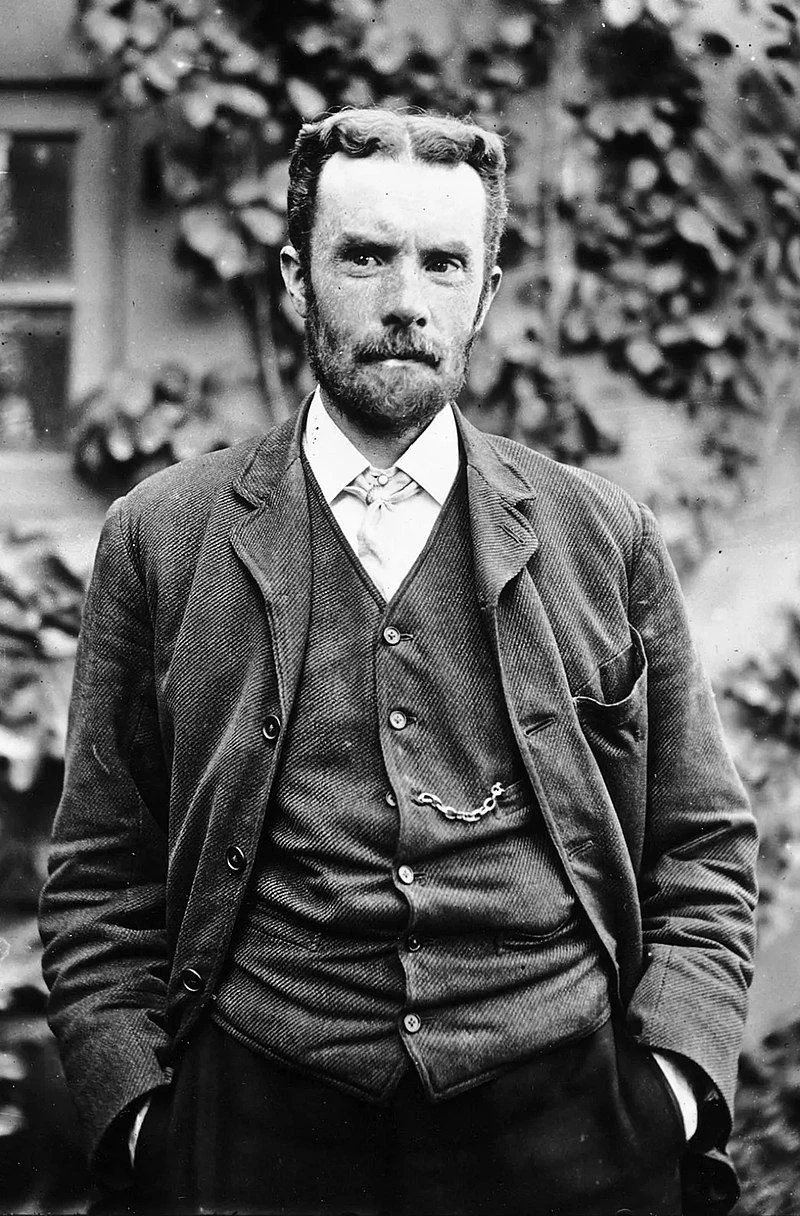
Oliver Heaviside worked on problems that connected mathematical theory with the practical limits of Victorian communications. His analysis of telegraph lines showed how electrical inductance could reduce signal distortion; his reformulation of Maxwell’s electromagnetic theory gave scientists and engineers a more compact way to work with it. Largely self-educated and often at odds with the scientific establishment, he became one of the most consequential British figures in the development of electrical engineering.
A Camden education, then work on the wires
Heaviside was born in Camden Town, London, on 18 May 1850, the youngest of three children of Thomas Heaviside, a draughtsman and wood engraver, and Rachel Elizabeth West. Scarlet fever in childhood left him with a hearing impairment. His family later moved to a better part of Camden, and he attended Camden House Grammar School. He did well, placing fifth among 500 pupils in 1865, but his parents could not afford to keep him there beyond the age of 16. He studied by himself for a further year and received no further formal education.
His uncle by marriage, the telegraphy and electromagnetism expert Charles Wheatstone, helped shape his early working life. In 1867 Wheatstone sent him north to Newcastle upon Tyne, where Heaviside worked with his older brother Arthur, who managed one of Wheatstone’s telegraph companies. Two years later, Heaviside joined the Danish Great Northern Telegraph Company as a telegraph operator on a cable project between Newcastle and Denmark, carried out with British contractors. He soon became an electrician, continuing his own studies alongside the work.
He began publishing technical writing while still in his early twenties. His 1872 paper on arranging Wheatstone’s bridge to measure resistance addressed a problem that other physicists had struggled to solve. William Thomson, later Lord Kelvin, and James Clerk Maxwell took notice. In a paper on duplex telegraphy, Heaviside also challenged the view that sending messages in both directions over a cable was impractical. His application to join the Society of Telegraph Engineers was initially rejected; with Thomson’s support, he was admitted in 1873.
That year he encountered Maxwell’s newly published Treatise on Electricity and Magnetism. He later recalled that mastering it took him several years. He then pursued his own approach to its ideas, drawing on his experience of telegraphy and his developing mathematical methods.
Making a telegraph line carry a clearer signal
Heaviside’s analysis of transmission lines became known as the telegrapher’s equations. He showed mathematically that adding uniformly distributed inductance to a telegraph line could reduce both signal attenuation and distortion. With sufficient inductance and suitable insulation, currents of different frequencies could travel at equal speeds. The work offered a way to improve communication over long cables, including transatlantic links, and helped further the implementation of telegraphy.
He advocated adding loading coils—inductors placed along telephone and telegraph lines—to correct distortion. The proposal met resistance from William Henry Preece, a senior Post Office engineer who had publicly argued against self-inductance. In 1887, a paper that Heaviside prepared with his brother Arthur on telephony was blocked by Arthur’s superior. The dispute was part of a wider professional conflict, and Heaviside’s work did not immediately receive the recognition its later importance would bring.
From 1882 to 1902, apart from three years, Heaviside contributed regular articles to the trade paper The Electrician. He was paid £40 a year. Many of the articles written in the 1880s later formed the substance of his books Electrical Papers and Electromagnetic Theory. The periodical gave him a place to develop ideas, even as the mathematical methods he used could be difficult for other readers to follow.
In 1897, AT&T researchers George A. Campbell and Michael I. Pupin extended work related to Heaviside’s analysis, and the company filed patents covering their research and a method of constructing loading coils that Heaviside had previously described. AT&T later offered him money in exchange for rights, but he refused unless the company also gave him full recognition. This episode captures a recurring tension in his career: his work could be valuable to engineering and commerce while its author remained poor and contested.
Equations, operators and new language for electricity
In 1884, Heaviside recast Maxwell’s mathematical analysis in vector notation. Maxwell’s original formulation contained 20 equations; Heaviside’s use of vector methods reduced 12 of them to the four differential equations in two unknowns now commonly recognised as Maxwell’s equations. This made the theory of electric charges, magnetic fields and their relationship more manageable for those applying it. He did not merely shorten a piece of mathematics: he helped establish the form in which electromagnetic theory would be taught and used.
Between 1880 and 1887, he developed operational calculus, a way of solving linear differential equations by treating the differential operator algebraically. The method offered a direct route to problems in applied mathematics and electrical engineering, though its lack of a rigorous foundation caused controversy. Heaviside was comfortable working experimentally with mathematical methods and did not regard formal definitions as a necessary starting point. Later work supplied a rigorous justification for the operator method, which resembles the Laplace-transform approach.
His mathematical contributions extended beyond these best-known achievements. He developed vector methods and calculus independently, used the step function to calculate current when an electrical circuit is switched on, and was the first to use the unit impulse function now usually called the Dirac delta function. He also independently discovered the Poynting vector. In 1880, he patented coaxial cable in England, and his work on the skin effect explored how current behaves in telegraph transmission lines.
Heaviside helped give electrical engineering a vocabulary as well as a mathematical toolkit. Among the terms he coined in electromagnetic theory were impedance, inductance, conductance, permeability and admittance. He also worked on the behaviour of electromagnetic fields around moving charges, the magnetic force on a moving charged particle and the concept of electromagnetic mass. These contributions belonged to a wide and demanding body of work, rather than to one isolated invention.
Recognition, isolation and the Faraday Medal
The Royal Society elected Heaviside a Fellow in 1891, recognising his contribution to the mathematical description of electromagnetic phenomena. The following year, its Philosophical Transactions devoted more than 50 pages to his vector methods and electromagnetic theory. He was also elected an honorary member of the Manchester Literary and Philosophical Society in 1894 and received an honorary doctorate from the University of Göttingen in 1905.
In later life he lived in Devon. Friends FitzGerald and John Perry persuaded him in 1896 to accept a Civil List pension of £120 a year after he had declined other charitable offers. He proposed the existence of an ionised layer in the upper atmosphere in 1902, now known as the Kennelly–Heaviside layer. The existence of the ionosphere was confirmed in 1923. The proposal showed that his interests reached beyond cables and circuit analysis to the behaviour of radio signals around the Earth.
Heaviside’s relations with established science remained difficult, and in later years his health declined. He became increasingly reclusive. In 1922, he received the first Faraday Medal, established that year. He died in Torquay on 3 February 1925, aged 74, after falling from a ladder. He was buried in Paignton beside his parents. His recognition during his lifetime was uneven, but his methods and ideas continued to gain wider attention.
Why Oliver Heaviside deserves a place in British Legacy
Heaviside deserves a place in British Legacy because his work changed how electrical theory could be used. By analysing transmission lines, he identified how inductance could limit signal distortion and help messages travel more effectively over long cables. By recasting Maxwell’s equations in vector form, he made a complex account of electromagnetism more practical for engineers and physicists. These were not abstract achievements detached from everyday technology: they addressed the design and performance of the telegraph and telephone systems that carried information across distance.
His legacy also lies in the tools he left to people working beyond his own immediate field. Operational calculus offered a powerful approach to differential equations; vector methods, the step function and the impulse function remain part of the mathematical language used to describe physical systems. His vocabulary for electrical properties helped make the subject discussable with greater precision. Heaviside’s career is a specifically British story of technical work rooted in the country’s telegraph industry, developed by a London-born, largely self-taught engineer and mathematician, and recognised by institutions including the Royal Society and the Institution of Electrical Engineers. It also shows that useful ideas may be resisted, appropriated or appreciated only gradually. His influence is best understood not as a claim that he single-handedly created modern technology, but as a body of precise mathematical and engineering contributions that made electrical communication and electromagnetic theory more workable for others.
Sources
Oliver Heaviside — Wikipedia, revision 1377803377 · Oliver Heaviside — Wikipedia
Adapted in part from Oliver Heaviside by Wikipedia contributors, under CC BY-SA 4.0. Text has been edited and combined with the existing article; this adapted text is shared under the same licence. Contributor history.