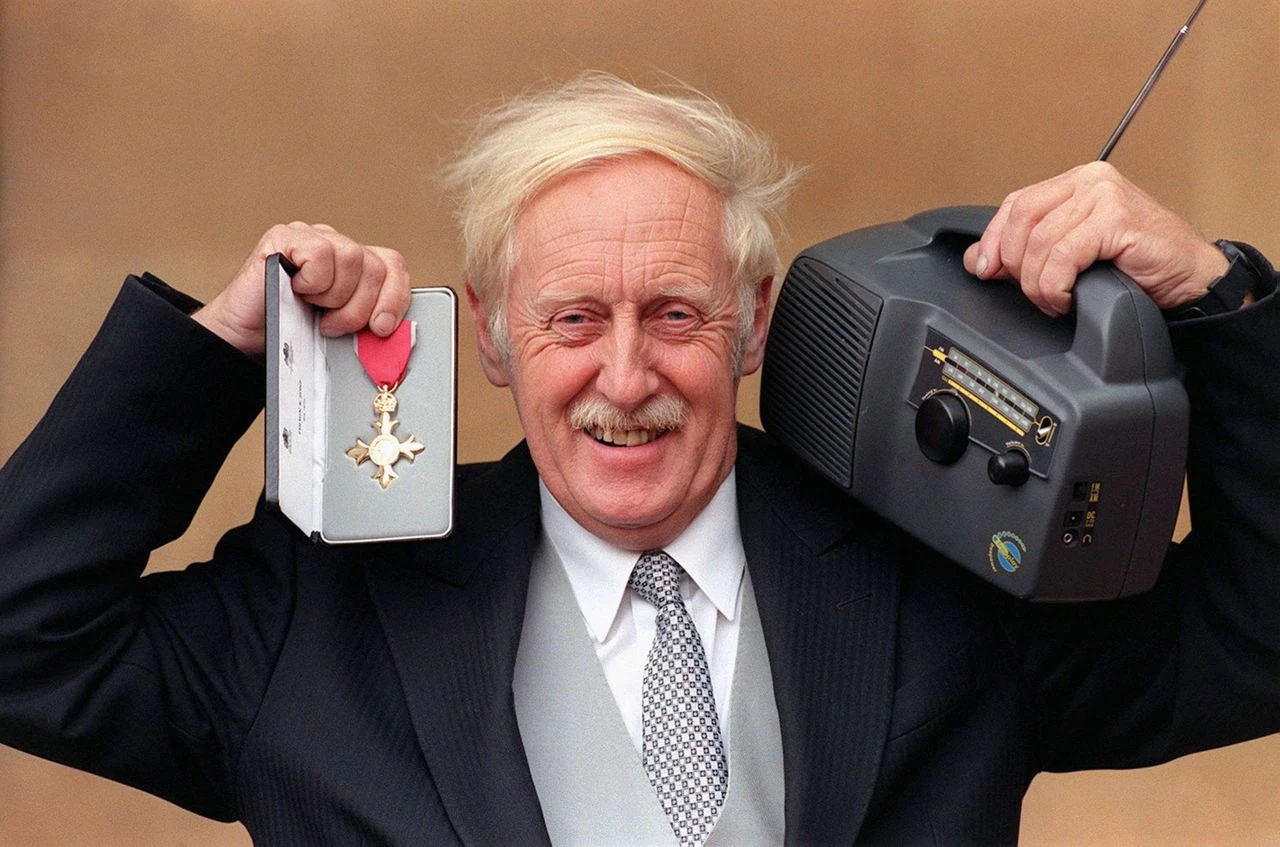
Trevor Graham Baylis was an English inventor whose best-known creation addressed a straightforward but urgent problem: how to power a radio where batteries and mains electricity could not be relied upon. His answer was the wind-up radio, driven by a crank that stored energy in a spring and used it to turn an electrical generator. The invention made Baylis a familiar public figure, but it also grew from a career marked by physical performance, practical engineering and a determination to help other inventors.
From Southall to the swimming pool
Baylis was born in Kilburn, London, on 13 May 1937, to Gladys Jane Brown, an artist, and Cecil Archibald Walter Baylis, an engineer. He grew up in Southall, Middlesex, and attended North Primary School and Dormers Wells Secondary Modern School. His first job was in a soil mechanics laboratory in Southall, while day-release study enabled him to pursue mechanical and structural engineering at a local technical college.
Swimming became an important part of his early life. At 15, he swam for Great Britain and narrowly missed qualification for the 1956 Summer Olympics. He began National Service in 1959 as a physical-training instructor with the Royal Sussex Regiment, swimming for the Army and Imperial Services during that period. After leaving the army, he joined Purley Pools, initially in sales before moving into research and development.
His ability in the water also helped him demonstrate swimming pools at public shows. He went on to form an aquatic-display company, performing as a professional swimmer, stunt performer and entertainer, including high dives into a glass-sided tank. Money earned as an underwater-escape artist with the Berlin Circus helped him establish Shotline Steel Swimming Pools, which supplied pools to schools.
The idea behind the wind-up radio
Working as a stunt performer exposed Baylis to the needs of disabled people, including colleagues whose injuries had ended their performing careers. By 1985, this experience had led him to develop Orange Aids, a range of products for disabled people.
The wind-up radio emerged after Baylis saw a television programme about the spread of AIDS in Africa in the late 1980s or early 1990s. He concluded that radio could help educate people and distribute information about the disease, including in places without dependable electrical power. Within 30 minutes, he had assembled the first prototype. It combined a small transistor radio, an electric motor from a toy car and the clockwork mechanism from a music box.
The prototype functioned, but turning an ingenious model into a manufactured product proved difficult. Baylis filed his first patent in 1992 and struggled to find a production partner. The breakthrough came in 1994, when a film about the prototype, made by Liz Tucker for the BBC programme Tomorrow's World, brought an investor forward to support the product.
Freeplay and a wider public profile
With investment behind him, Baylis formed Freeplay Energy. In 1996, the Freeplay radio received BBC Design Awards for Best Product and Best Design. The same year brought a meeting with Queen Elizabeth II and Nelson Mandela at a state banquet, a journey to Africa with the Dutch Television Service to make a documentary about his life, and the World Vision Award for Development Initiative.
In 1997, a new generation of the Freeplay radio was produced in South Africa. It was smaller and cheaper, and was designed for the Western consumer market, using rechargeable cells with a generic crank generator. During the 1990s Baylis was also a regular presence on Channel 4's breakfast programme, The Big Breakfast, helping make an engineering story part of popular television culture.
His inventive work continued beyond the radio. In 2001, he walked 100 miles across the Namib Desert to demonstrate his electric shoes and raise money for the Mines Advisory Group. Developed with the UK's Defence Evaluation and Research Agency, the shoes used piezoelectric contacts in their heels to charge a small battery. That battery could operate a radio transceiver or a cellular telephone.
Supporting inventors and engineers
Baylis's interest in practical invention extended into advocacy. He established the Trevor Baylis Foundation to promote invention by encouraging and supporting inventors and engineers. In September 2002, this led to Trevor Baylis Brands PLC, based in Richmond, Greater London. The company offered professional partnerships and services intended to help inventors establish the originality of their ideas, protect them through patents or other means, and find a route to market.
Its primary aim was to secure licence agreements for inventors, although it also considered creating new companies around promising ideas. The business was reported in 2013 to be struggling financially and relying mainly on Baylis's personal finances. A few months after his death, it became insolvent and ceased trading in early 2019. The difficulty of that venture forms part of the fuller story: invention can be celebrated in public while the commercial control and rewards surrounding it remain uncertain.
Later years, honours and remembrance
For many years Baylis lived on Eel Pie Island on the River Thames and regularly attended jazz performances at the Eel Pie Island Hotel. He received the Pipe Smoker of the Year award from the British Pipesmokers' Council in 1999. His autobiography, Clock This, was published in 1999, and in 2010 he spoke publicly about having been sexually abused at the age of five by a Church of England curate.
Baylis died on 5 March 2018, aged 80, after a heart attack; he had also been afflicted by Crohn's disease in his final years. He was unmarried and had no living next-of-kin. At his funeral at Mortlake Crematorium on 13 March, his body was cremated in a novelty coffin fashioned as the wind-up radio he had invented.
His honours included appointment as an Officer of the Order of the British Empire for humanitarian services in the 1997 Birthday Honours and as a Commander of the Order of the British Empire in the 2015 New Year Honours for services to intellectual property. He was awarded 11 honorary degrees from UK universities, including honorary doctorates from the Open University in 2001, Heriot-Watt University in 2003, Leeds Metropolitan University in 2005 and the University of Northampton in 2009.
Why Trevor Baylis deserves a place in British Legacy
Trevor Baylis deserves a place in British Legacy because his most recognised invention joined mechanical simplicity to a clear social purpose. The wind-up radio did not depend on batteries or an external electrical source: its user supplied the energy by turning a crank. Baylis developed the idea after considering how radio could carry information about AIDS to people in Africa, then persisted through the less visible work of patenting, finding investment and reaching production. Its story shows that useful invention is not only about novelty; it is also about identifying a practical barrier and designing around it.
His legacy is broader than one radio. From Orange Aids and the electric shoes to the Trevor Baylis Foundation and his company supporting inventors, he repeatedly tried to connect ideas with people who could use them. That combination of engineering, public communication and encouragement for other creators remains relevant to BritishLegacy.com. Baylis's career also offers a candid lesson about invention: recognition and commercial security do not always arrive together. British Legacy can therefore remember him both for a celebrated British design and for his sustained effort to make invention more accessible to others.