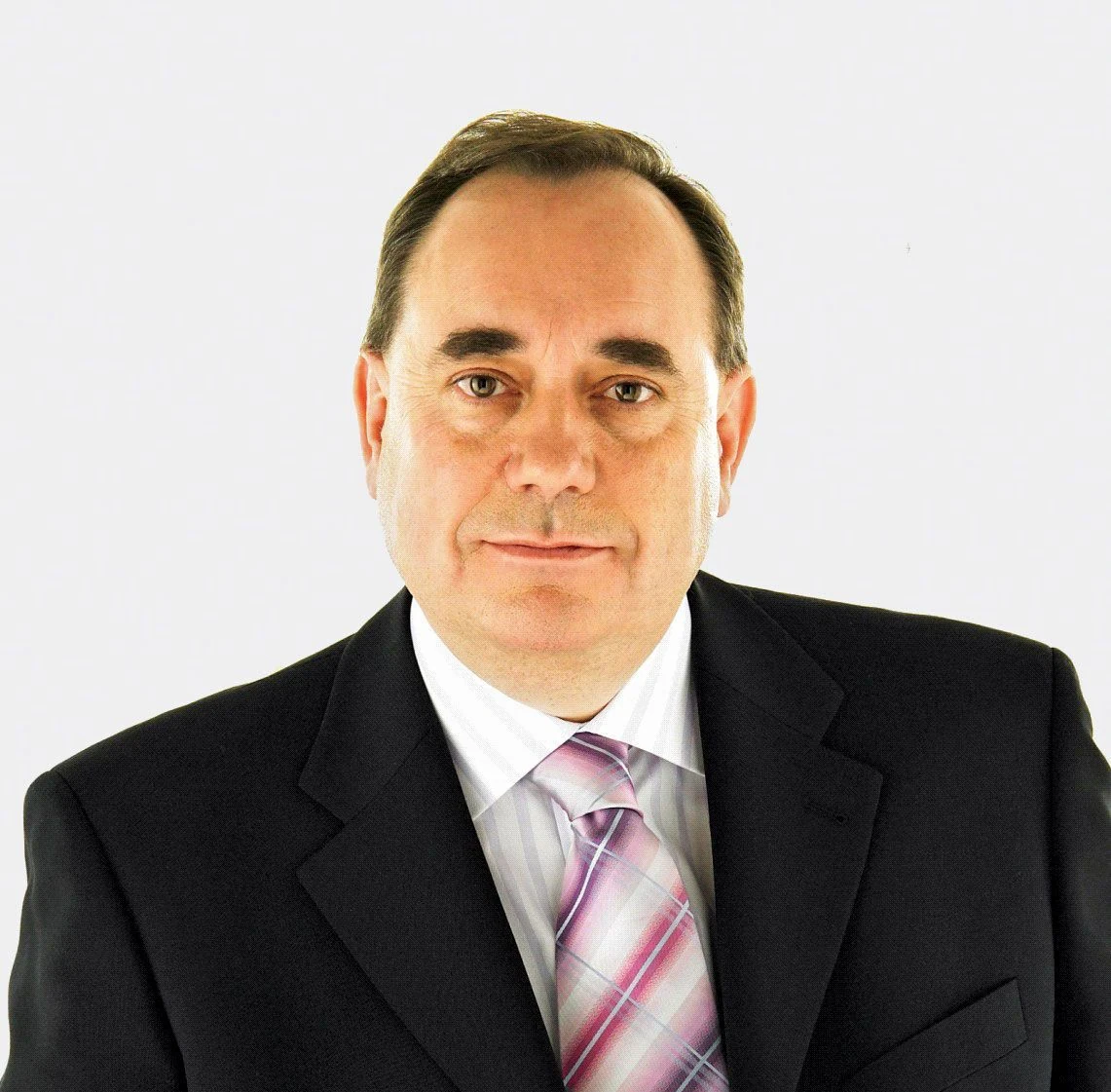
Alex Salmond spent decades campaigning for Scottish independence, but his most consequential achievement was to bring the constitutional question to a lawful referendum. As First Minister, he negotiated the Edinburgh Agreement with the UK Government, creating the framework for the 2014 vote. Scotland chose to remain in the United Kingdom, but the contest placed questions of sovereignty, devolution and national identity at the centre of British politics.
From Linlithgow to the SNP
Alexander Elliot Anderson Salmond was born in Linlithgow, West Lothian, on 31 December 1954. He studied at Edinburgh College of Commerce before going to the University of St Andrews, where he graduated in economics and medieval history in 1978. He began his working life as an assistant economist in the Scottish Office’s Government Economic Service. In 1980 he joined the Royal Bank of Scotland, later working as an oil economist and writing and broadcasting on economic affairs.
Salmond joined the Scottish National Party in 1973 while a student at St Andrews. His early politics were on the left, and he became a leading figure in the SNP’s socialist 79 Group. The group was suspended after it was banned within the party; Salmond and its other members were readmitted the following month. His early party career included service as vice-convener for publicity and, from 1987, deputy leader.
That year he won Banff and Buchan, defeating the sitting Conservative MP, Albert McQuarrie. He served in the House of Commons and on its Energy Select Committee before winning the SNP leadership in 1990. Salmond led the party through a period of political change, supporting the campaign for a devolved Scottish Parliament while continuing to advocate independence. In the 1997 devolution referendum, he joined Scottish Labour leader Donald Dewar and Scottish Liberal Democrat leader Jim Wallace in campaigning for a parliament in Edinburgh.
Salmond was elected to the new Scottish Parliament in 1999, where the SNP became the largest opposition party. He resigned as party leader in 2000 and left Holyrood the following year to lead the SNP group at Westminster. He returned to the leadership in 2004, then won the Gordon constituency in the 2007 Scottish Parliament election. The SNP finished ahead of Labour by one seat and, with support from the Scottish Greens, formed a minority government.
First Minister and the route to a referendum
Salmond became First Minister on 17 May 2007, the first nationalist politician to hold the office. His first government was a minority administration. It pursued a range of policies, including the abolition of university tuition fees and prescription charges, alongside commitments to renewable energy. In 2011, the SNP won an overall majority at Holyrood, an unprecedented result under the electoral system used for Scottish Parliament elections.
The majority strengthened Salmond’s mandate to seek a referendum on independence. In October 2012, he and Prime Minister David Cameron signed the Edinburgh Agreement, establishing the legal framework for a vote. The Scottish Government announced that the referendum would take place on 18 September 2014. A white paper, Scotland’s Future, set out the government’s case for independence.
The campaign was a major political event, but it was not Salmond’s alone: Nicola Sturgeon led the Yes Scotland campaign. The result was 55 per cent against independence and 45 per cent in favour. Salmond announced his resignation the following day, saying he would step down as First Minister in November. Nicola Sturgeon succeeded him as SNP leader and First Minister. His departure did not settle the constitutional question; the referendum had brought it into sustained public and political debate.
Westminster, Alba and a contested public life
After leaving office, Salmond returned to Westminster as MP for Gordon, winning the seat at the 2015 general election. He served as the SNP’s international affairs and Europe spokesperson. In 2017, he lost the seat to Conservative candidate Colin Clark. His electoral career then took a different course. In 2018, he resigned from the SNP amid allegations of sexual misconduct, which he denied.
In 2019, Salmond challenged the Scottish Government’s handling of complaints against him. The government conceded that its procedures had been flawed, and he received compensation for legal expenses. He was charged with 14 offences and went on trial in 2020. The jury found him not guilty of 12 charges; one charge had been dropped during the trial, and one was found not proven. These proceedings and the subsequent dispute over the government’s complaints process became a significant and contested part of his later political story.
In 2021, Salmond became leader of the newly formed Alba Party, another pro-independence party. Alba won no seats in the 2021 Scottish Parliament election or the 2022 local elections. Salmond remained its leader until his death. He died aged 69 in Ohrid, North Macedonia, on 12 October 2024. The cause was reported as a heart attack. He had spoken at a school for young leaders earlier that day.
Why Alex Salmond deserves a place in British Legacy
Salmond’s place in British political history rests above all on the constitutional process he helped make possible. As First Minister, he negotiated with the UK Government to secure an agreed framework for the 2014 Scottish independence referendum. The vote did not deliver independence, but it gave voters a direct decision on the question and placed Scotland’s relationship with the United Kingdom at the centre of political life. That is a specific and lasting contribution: the referendum altered the terms of debate about how the UK is governed, rather than simply adding another episode to party politics.
His career also connects the institutions of the Union across several decades. He represented Scottish constituencies at Westminster and Holyrood, led the SNP twice, and became the first nationalist First Minister. His governments pursued measures including the abolition of tuition fees and prescription charges and made renewable energy a policy priority. Those decisions belong to a record that, like his pursuit of independence, remains open to argument. Salmond’s legacy is not a simple story of victory: voters rejected independence in 2014, and his later public life was marked by serious controversy. British Legacy can nevertheless recognise the scale of his political influence, while keeping that influence in view alongside the disagreements and events that shaped it.
Sources
Alex Salmond — Wikipedia revision 1379702793 · Alex Salmond — Wikipedia
Adapted in part from Alex Salmond by Wikipedia contributors, under CC BY-SA 4.0. Text has been edited and combined with the existing article; this adapted text is shared under the same licence. Contributor history.