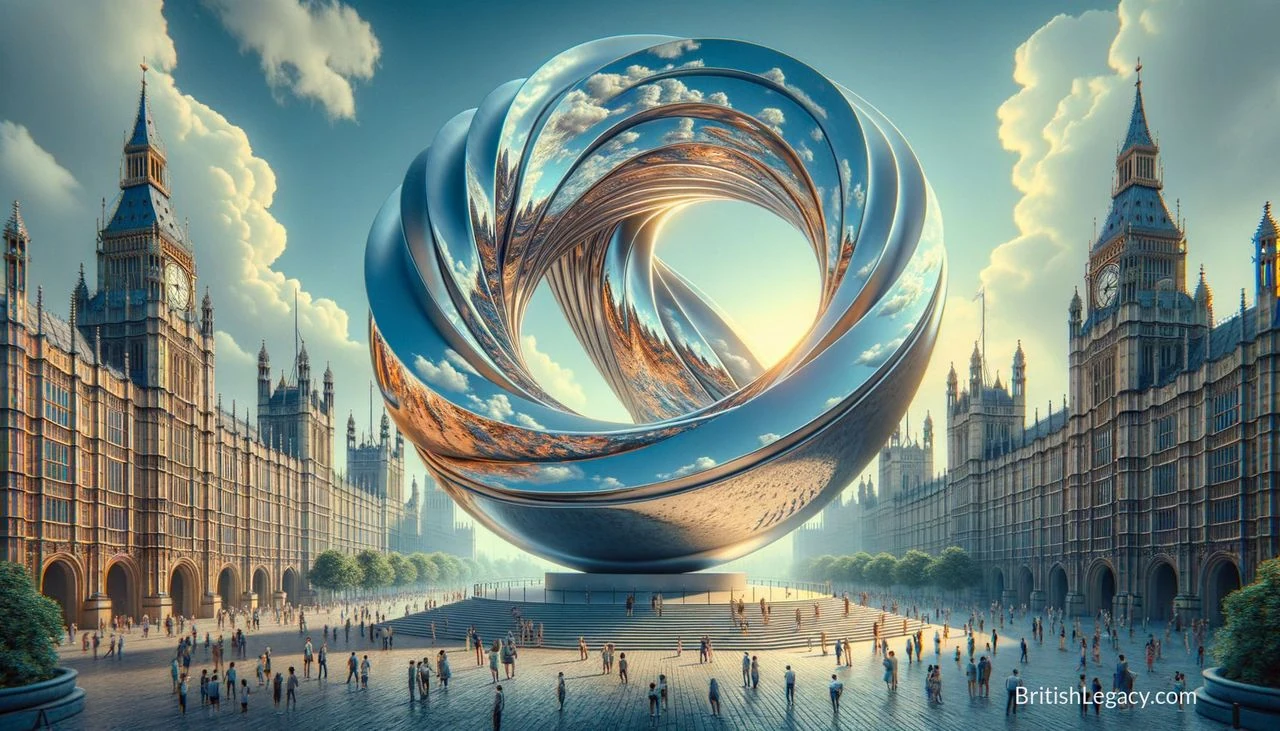
Anish Kapoor’s sculptures make space feel uncertain. A polished surface can turn a familiar skyline upside down; a dark opening can seem to continue beyond the object that contains it. Kapoor, born in Mumbai and based in London since the early 1970s, has developed this language across intimate works, monumental installations and public commissions. His career connects Britain’s galleries and cities with an international audience, while resisting any single definition of what sculpture can be.
From Mumbai to a new British sculpture
Kapoor was born in Mumbai in 1954. After attending The Doon School in India and spending a period in Israel, he moved to Britain in 1973 to study at Hornsey College of Art and Chelsea School of Art and Design. He later taught at Wolverhampton Polytechnic and was artist in residence at Liverpool’s Walker Art Gallery in 1982. He has lived and worked in London since the early 1970s.
His first prominent works used brightly coloured pigment and simple materials including granite, limestone, marble and plaster. Geometric or biomorphic forms appeared to emerge from, or sink into, their surroundings. Kapoor’s first high-profile exhibition was New Sculpture at London’s Hayward Gallery in 1978. These works established concerns that remained central to his practice: how an object occupies a space, where its boundaries lie, and whether what seems present might also suggest absence.
In the late 1980s and 1990s, he explored the void through freestanding sculptures and installations. From 1987 he also worked with quarried stone, carving apertures and cavities into solid forms. In 1990 he represented Britain at the Venice Biennale, and in 1991 he won the Turner Prize. The recognition placed him among the artists associated with the New British Sculpture scene, but his materials and subjects continued to change.
Mirrors, scale and the public realm
From 1995, Kapoor made works with highly polished stainless steel. Their reflective surfaces return an image of the viewer and surroundings, but bend, stretch or reverse what they show. Sky Mirror, first commissioned for a site outside Nottingham Playhouse in 2001, brings the changing sky into the public setting through a large concave mirror. A second, ten-metre version was installed at Rockefeller Center in New York in 2006 and later shown in Kensington Gardens in 2010.
His public works in Britain have also tested what sculpture can do to a landscape or building. Taratantara, a 35-metre-high work, was installed in Gateshead’s Baltic Flour Mills before the building became the Baltic Centre for Contemporary Art. For the Turbine Hall at Tate Modern, Marsyas (2002) joined three steel rings with a vast span of PVC membrane. The scale made the work part of the architecture as well as an object within it.
Kapoor’s public commissions include Temenos, the first of the Tees Valley Giants, at Middlehaven Dock in Middlesbrough. Unveiled in 2010, it stretches 110 metres and rises 50 metres; steel wire mesh is held between two large hoops. In 2012, ArcelorMittal Orbit was completed as a permanent artwork for London’s Olympic Park. At 115 metres tall, it became the tallest sculpture in the UK. Kapoor developed it with engineer Cecil Balmond, part of a wider pattern of working with architects and engineers on projects that sit between sculpture and architecture.
Landmark works and exhibitions
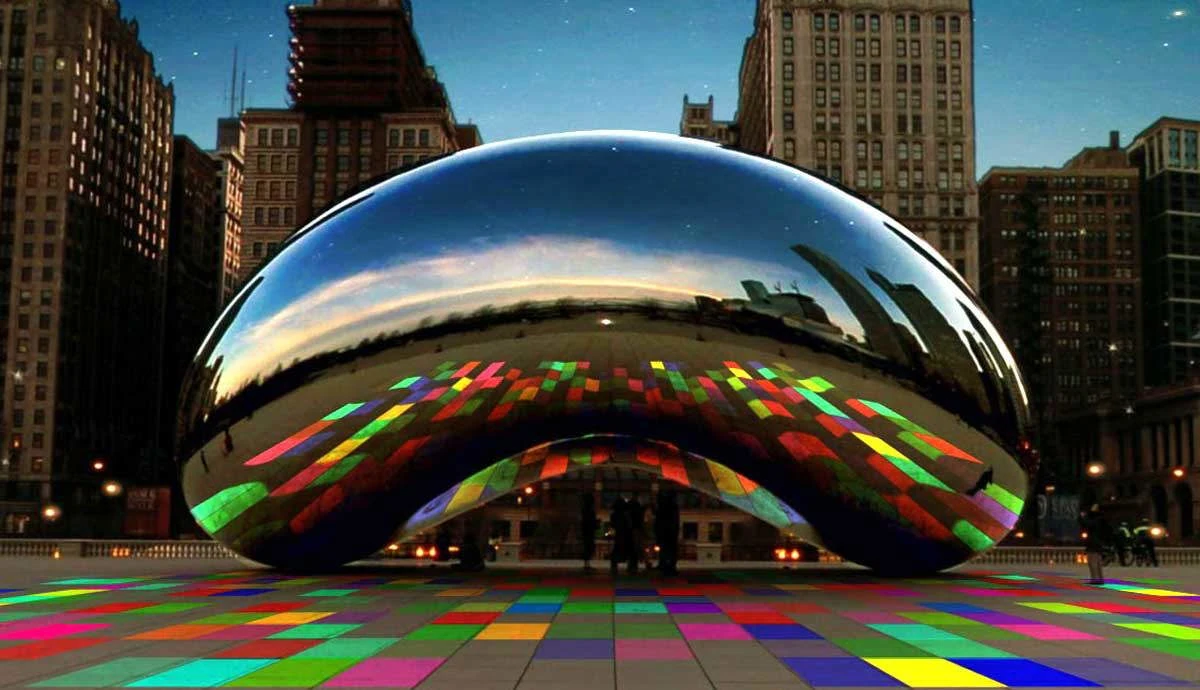
Cloud Gate, Kapoor’s best-known work in Chicago, was completed in 2006 and installed in Millennium Park. Its polished stainless-steel surface reflects the city and visitors in distorted forms; people can walk beneath it and look up into a concave space in the sculpture. The work is often called “The Bean”. Though outside Britain, it shows how Kapoor’s approach to reflection and public participation has travelled internationally.
Kapoor’s work has also taken less reflective forms. At the Royal Academy in London in 2009, he became the first living artist to have a solo exhibition there. The exhibition included cement sculptures and Non-Object mirror works, as well as Shooting into the Corner, in which a cannon fired wax pellets into a gallery corner. The wax accumulated over time, making the process of the work part of the work itself. He had earlier served as Brighton Festival’s first guest artistic director, in 2009, presenting works across the city.
His commissions and exhibitions have continued to range widely. He created Leviathan for the Grand Palais in Paris in 2011, while a major outdoor presentation at Houghton Hall in Norfolk in 2020 brought together 21 sculptures and drawings. In 2024, Liverpool Cathedral hosted Monadic Singularity to mark its centenary. Such settings—an urban park, a gallery, a historic building—are not merely backdrops: they alter how a viewer encounters scale, colour and form.
Materials, recognition and debate
Kapoor’s work with Vantablack, a material known for its very low reflectivity, prompted debate after he secured exclusive rights to use it for artistic purposes. Artist Stuart Semple criticised the arrangement and made his “pinkest pink” pigment available to everyone except Kapoor and people affiliated with him. The dispute became a public exchange about access to materials and the limits of exclusivity in art. It also sits within a career in which Kapoor has repeatedly treated material not as a neutral surface but as a force that changes how viewers perceive an object.
Kapoor was elected a Royal Academician in 1999 and received a CBE in 2003. He was knighted in the 2013 Birthday Honours for services to visual arts. Other distinctions include the Praemium Imperiale in 2011, an honorary doctorate from the University of Oxford in 2014 and the Genesis Prize in 2017. His image was included in the British cultural icons section of the redesigned British passport in 2015.
Why Anish Kapoor deserves a place in British Legacy
Kapoor’s place in British Legacy rests on a sustained, identifiable contribution to the country’s visual culture. He came to Britain to train, developed his practice in its art schools and galleries, taught at Wolverhampton Polytechnic, and has lived and worked in London for decades. His connection is not simply one of residence or honour: works such as Sky Mirror, Taratantara, Marsyas, Temenos and ArcelorMittal Orbit have changed how people encounter public spaces and cultural buildings across Britain. Their scale and materials make sculpture part of the experience of a place rather than an object viewed at a distance.
His achievement also lies in keeping that public work open to different kinds of encounter. A reflective surface returns viewers to themselves and their surroundings; a monumental form can draw people into a park, gallery or city centre; an installation can make architecture feel newly visible. At the same time, Kapoor’s career has reached well beyond Britain, from Cloud Gate in Chicago to major exhibitions abroad. That international reach gives the British story its proper dimension: an artist formed and established here whose work circulates globally. His honours, commissions and exhibitions record recognition, but the lasting case for his place is the range of ways his art has made space, perception and public experience available for reconsideration.
Sources
Anish Kapoor — Wikipedia, revision 1378303401 · Anish Kapoor — Wikipedia
Adapted in part from Anish Kapoor by Wikipedia contributors, under CC BY-SA 4.0. Text has been edited and combined with the existing article; this adapted text is shared under the same licence. Contributor history.