In Damien Hirst’s best-known work, a tiger shark hangs in a glass tank of formaldehyde. The title, The Physical Impossibility of Death in the Mind of Someone Living, gives the preserved animal a second presence: it is at once a thing to look at and a challenge to think about mortality. The work helped make Hirst one of the most recognisable artists associated with the Young British Artists, a generation that brought contemporary art into British headlines and galleries during the 1990s.
From Leeds to Goldsmiths
Hirst was born Damien Steven Brennan in Bristol on 7 June 1965 and grew up in Leeds. He attended Jacob Kramer College before moving to London to study fine art at Goldsmiths College from 1986 to 1989. His route into higher art education was not immediate: he was refused a place at Jacob Kramer on his first application and later entered its foundation diploma course. Before Goldsmiths, he spent two years working on London building sites. At college, a placement in a mortuary provided an experience that would resonate with the subjects and materials of his later work.
In July 1988, while in his second year, Hirst organised Freeze, an independent exhibition in a disused administrative building in London’s Docklands. He secured sponsorship from the London Docklands Development Corporation. His own contribution was a cluster of cardboard boxes painted with household paint; the exhibition’s importance lay not only in the objects on display but in the chance it created for a group of young artists to show work on their own terms. Charles Saatchi, Norman Rosenthal and Nicholas Serota visited. Hirst subsequently helped organise two warehouse exhibitions, Modern Medicine and Gambler, in Bermondsey in 1990, extending that do-it-yourself exhibition culture.
Animals, mortality and the gallery
Saatchi offered to fund a work of Hirst’s choosing in 1991. The result was The Physical Impossibility of Death in the Mind of Someone Living, made that year and shown in the first Young British Artists exhibition at the Saatchi Gallery in 1992. A commissioned fisherman caught the shark in Australia; Hirst presented it immersed in formaldehyde inside a clear display case. The work made a large, dead animal the focus of a direct encounter, while its title turned that encounter towards the limits of human understanding. Hirst was nominated for the 1992 Turner Prize for his contribution to the exhibition, though the prize went to Grenville Davey.
In 1993, Hirst made his first major international presentation at the Venice Biennale with Mother and Child Divided. A cow and calf were cut into sections and displayed in separate vitrines, exposing their interiors to view. The work extended his use of preserved animals while making separation and the body part of the encounter. Other pieces, including Away from the Flock, a sheep in a formaldehyde tank, and A Thousand Years, with maggots and flies feeding on a cow’s head, brought life cycles and decay into the gallery.
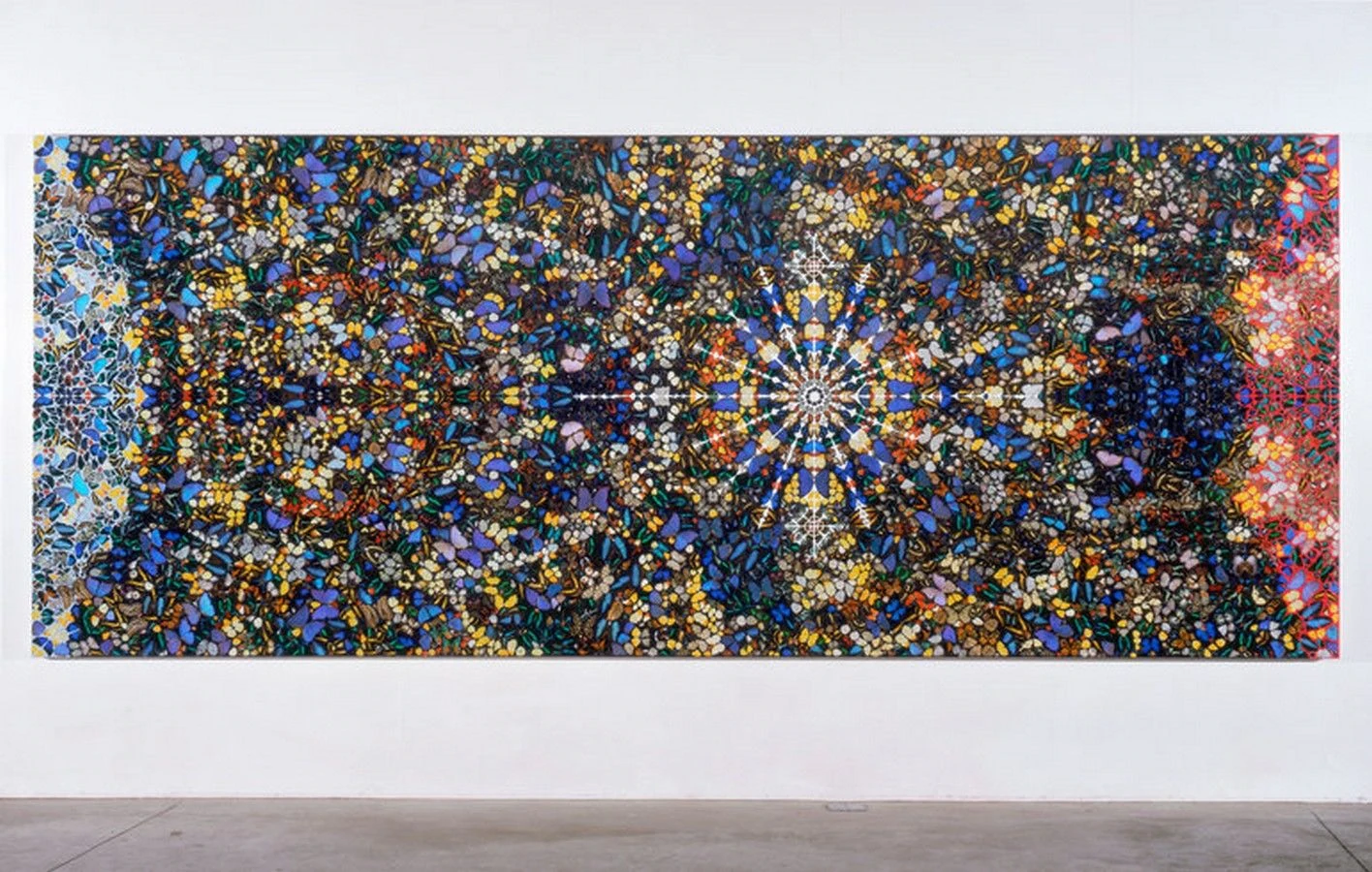
Death became a recurring subject, but Hirst’s practice was not confined to animal installations. His work included paintings, spot patterns, medicine cabinets and sculptures. He often worked with assistants, regarding the conception of an artwork as distinct from its physical execution. That approach became part of the debate around his practice: who makes a work, what counts as an original, and how much of its value rests on the artist’s idea or name?
Prizes, disputes and a landmark sale
Hirst won the Turner Prize in 1995. Two years later, his work appeared in Sensation at the Royal Academy in London, an exhibition widely associated with the arrival of the Young British Artists in the cultural establishment. The show’s controversy centred largely on works by other artists, but it helped make the group a national talking point. Hirst also became a highly visible public figure beyond gallery walls: with Blur’s Alex James and actor Keith Allen, he formed the band Fat Les, whose football song “Vindaloo” reached number two in the charts in 1998.
His relationship with Saatchi, a major early patron, became increasingly strained and ended in 2003. Hirst also faced criticism over originality and authorship. In the case of Hymn, a large sculpture based on a child’s anatomy toy, legal proceedings ended in an out-of-court settlement. Such disputes sit alongside the arguments provoked by the work itself: supporters have seen Hirst as a force for widening interest in contemporary art, while critics have questioned its substance, methods and commercial machinery.
In September 2008, Hirst took the unusual step of selling a complete body of new work directly at Sotheby’s, bypassing his long-standing galleries. The two-day sale, titled Beautiful Inside My Head Forever, raised £111 million for 218 items and set a record for a one-artist auction. The sale put the connection between art and money at the centre of the story. Its scale strengthened Hirst’s position in the international art market, while the decision to sell directly challenged established routes between artists, dealers and buyers.
Building a collection and an institution
Hirst has also collected art. In 2006, he curated In the darkest hour there may be light at the Serpentine Gallery, presenting part of what became known as the murderme collection. In October 2015, Newport Street Gallery opened in Vauxhall, London, in former theatre carpentry and scenery workshops redesigned by architects Peter St John and Adam Caruso. The gallery gave a permanent public setting to exhibitions connected with Hirst’s collection and extended his involvement from making and selling art to shaping a place where it could be shown.
His career has continued across different forms and locations. Hirst designed the Union Flag arena centrepiece for the closing ceremony of the London 2012 Olympic Games, placing his visual language within a major British public event. In 2017, Treasures from the Wreck of the Unbelievable occupied two venues in Venice during the Biennale. The elaborate presentation, framed as recovered ancient treasure, combined historical-looking forms with contemporary and popular imagery. These projects show the breadth of his practice, but they also retain a characteristic uncertainty: viewers are asked to decide how much to believe in what they see.
Why Damien Hirst deserves a place in British Legacy
Hirst’s place in British cultural history rests on more than the notoriety of the shark in its tank. By organising Freeze as a student, he helped create a platform for artists to exhibit beyond established institutions. The later warehouse shows carried that initiative forward, while the 1997 Royal Academy exhibition Sensation helped bring the Young British Artists into a wider national conversation. His career illustrates how British art in the 1990s moved between artist-run exhibitions, commercial galleries, public institutions and the news media, with Hirst repeatedly at the point where those worlds met.
His work also made the public debate about contemporary art harder to avoid. Preserved animals, medical imagery and the sale of a complete exhibition at Sotheby’s raised questions about mortality, authorship, value and the role of the art market. Those questions have not produced agreement: criticism and controversy are part of the record, not obstacles to be edited away. Hirst’s British legacy lies in the visible consequences of that friction. His work attracted audiences, challenged the boundaries of what could be shown as art and helped make contemporary practice a subject of public discussion. Newport Street Gallery adds a continuing London venue to that legacy, connecting his collecting with the presentation of art to visitors.
Sources
Damien Hirst — Wikipedia, revision 1376804249
Adapted in part from Damien Hirst by Wikipedia contributors, under CC BY-SA 4.0. Text has been edited and combined with the existing article; this adapted text is shared under the same licence. Contributor history.