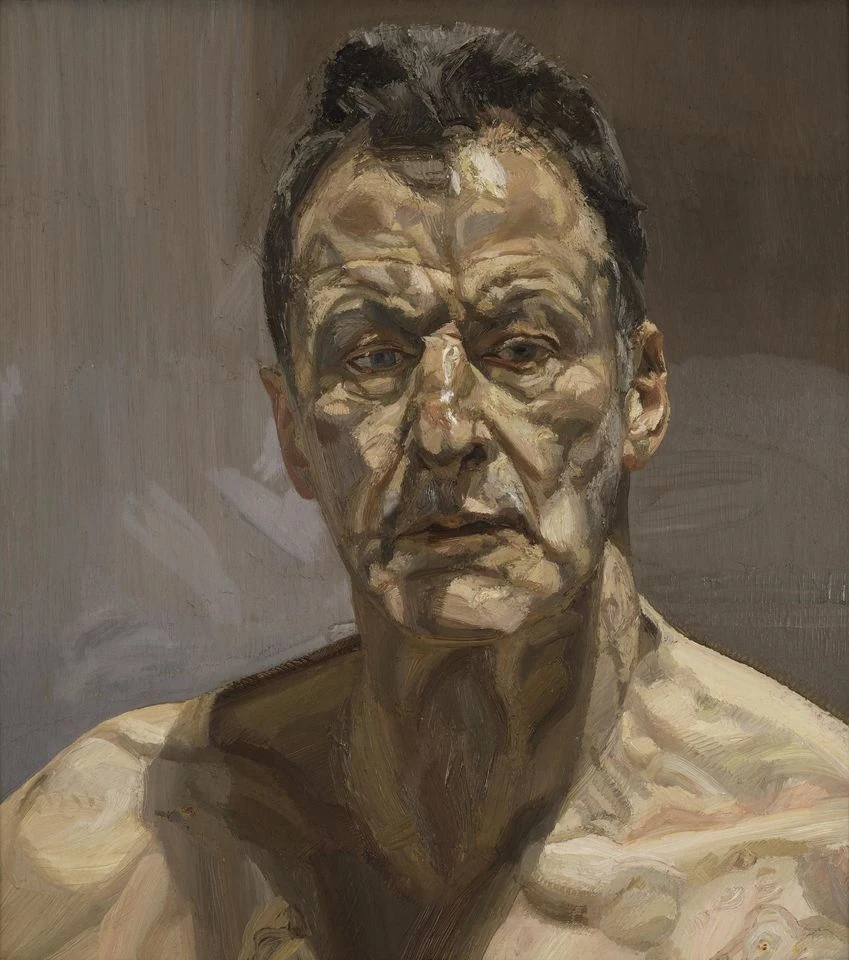
Lucian Freud made portraits that resist easy admiration. His sitters lie or sit in unguarded poses; flesh, furniture and studio interiors receive the same close attention. The paintings can be intimate and disconcerting at once. Over a career of more than 60 years, Freud moved from small, precise early works to thickly painted studies of the human body, becoming one of the best-known British figurative artists of the twentieth century.
From Berlin to London
Freud was born in Berlin on 8 December 1922, the second of three sons of Lucie Brasch and Ernst L. Freud, an architect and son of the psychoanalyst Sigmund Freud. The family moved to London in 1933 to escape the rise of Nazism. Lucian became a British subject in 1939, and remained a Londoner for the rest of his life.
His education took him through several art schools. He briefly attended the Central School of Art, then studied with Cedric Morris at the East Anglian School of Painting and Drawing, first in Dedham and, after the school moved in 1940, at Benton End in Suffolk. He also attended Goldsmiths’ College in 1942–43. His early life was not confined to the studio: in 1941 he served as a merchant seaman in an Atlantic convoy, but was invalided out the following year.
Freud’s first solo exhibition was held at the Lefevre Gallery in London in 1944. It included work connected with his illustrations for Nicholas Moore’s poetry collection The Glass Tower, among them a stuffed zebra and a palm tree. Both subjects reappeared in The Painter’s Room. The unusual juxtapositions in these early works sit alongside the precise drawing and controlled surfaces of his first portraits.
A changing way of painting
Freud’s early paintings have been associated with surrealism and German expressionism. After the war, he developed a thinly painted, exact linear style, using muted colours and small sable brushes. Man with a Thistle (1946) and portraits of his first wife, Kitty Garman, including Girl with a Kitten (1947), show this close attention to detail. The work can feel watchful and still, with large eyes and carefully observed forms.
In the 1950s Freud increasingly concentrated on portraiture, often depicting nudes. By the middle of the decade, his technique had changed: larger hog’s-hair brushes and thicker paint brought out the texture and varying colour of flesh. Girl with a White Dog (1951–52) marks a transition between the earlier precision and the more physical handling that followed. By about 1960, he had established the approach that, with changes, would carry him through the rest of his career.
Freud painted from life, building a picture gradually rather than treating a likeness as a quick impression. He might begin with the sitter’s head, work outwards across the canvas and return to the face as his understanding of the subject developed. He left a section of canvas bare until a painting was complete. Sessions could demand a long commitment: Ria, Naked Portrait (2007), for example, took about 2,400 hours over 16 months. Freud painted in natural light by day or artificial light at night, without mixing the two in a work.
Sitters, studios and the School of London
His models were often people already within his life: friends, family, fellow artists, lovers and children. He also painted himself. The relationship between painter and sitter is part of the work’s subject: people appear in close, sometimes awkward proximity to the viewer, while beds, mattresses, studio rags, animals and the surrounding rooms remain conspicuously present. Some portraits show sitters sprawled on the floor or a bed; others set a person beside a dog or another animal. His paintings of horses and plants extend that same sustained attention beyond human portraiture.
Freud’s long sittings and thickly worked surfaces give the paintings their particular weight, but they do not make them simple records of appearance. His sitters’ identities were not always disclosed, and the pictures often leave the viewer to consider the tension between the person represented and the act of looking. In the 1970s he made an extensive series of paintings of his mother. He also painted fellow artists Francis Bacon and Frank Auerbach, and a series of portraits of performance artist Leigh Bowery.
Freud was part of the loose group later known as the School of London, a circle of figurative artists working in the city while abstract painting was prominent. It included Bacon, Auerbach, Michael Andrews, Leon Kossoff, R. B. Kitaj and others. Freud taught as a visiting tutor at the Slade School of Fine Art from 1949 to 1954. His first exhibition outside London took place at Hartlepool Art Gallery in 1972.
Recognition and later work
Freud’s reputation grew through exhibitions and the sustained development of his practice. A major retrospective at the Hayward Gallery in 1988 became the focus of a BBC Omnibus programme featuring one of the few recorded conversations with the famously guarded artist. He was shortlisted for the Turner Prize in 1989 and received the Rubens Prize from the city of Siegen in 1997.
Among his best-known later subjects was Sue Tilley, whose job title appears in the name of Benefits Supervisor Sleeping (1995). Christie's sold the painting in 2008 for $33.6 million, then a record auction price for a work by a living artist. Freud’s portrait of Queen Elizabeth II, completed in 2001, attracted criticism in the British media. His final work was an unfinished portrait of his studio assistant and friend David Dawson.
Freud also made etchings during the last 25 years of his life, working with printer Marc Balakjian at Studio Prints in Kentish Town. The Victoria and Albert Museum holds 143 of his prints. He died in London on 20 July 2011, aged 88, and was buried at Highgate Cemetery.
Why Lucian Freud deserves a place in British Legacy
Freud’s place in British art rests on more than his reputation or the prices reached by his paintings. After arriving in London as a child, he became a British subject, trained in English art schools and spent his working life as a London-based painter. His career belongs to the story of British figurative art: he developed his practice alongside artists associated with the School of London, taught at the Slade, and showed his work in galleries across the country as well as abroad.
His achievement was to make sustained attention the substance of painting. Freud worked from life, returning to sitters over many sessions and allowing the process to shape the image. His shift from finely drawn early portraits to thickly painted, materially vivid figures was not a move towards easy likeness. Instead, he made the circumstances of looking—time, proximity, the sitter’s pose and the particularities of flesh—impossible to overlook. That approach extended to animals and ordinary studio surroundings, giving them a place within the same demanding field of observation. His work remains a distinctive contribution to British visual culture: not a general claim about national character, but a body of paintings made through a long engagement with people and places in Britain.
Sources
Lucian Freud — Wikipedia revision 1378762123 · Lucian Freud — Wikipedia
Adapted in part from Lucian Freud by Wikipedia contributors, under CC BY-SA 4.0. Text has been edited and combined with the existing article; this adapted text is shared under the same licence. Contributor history.