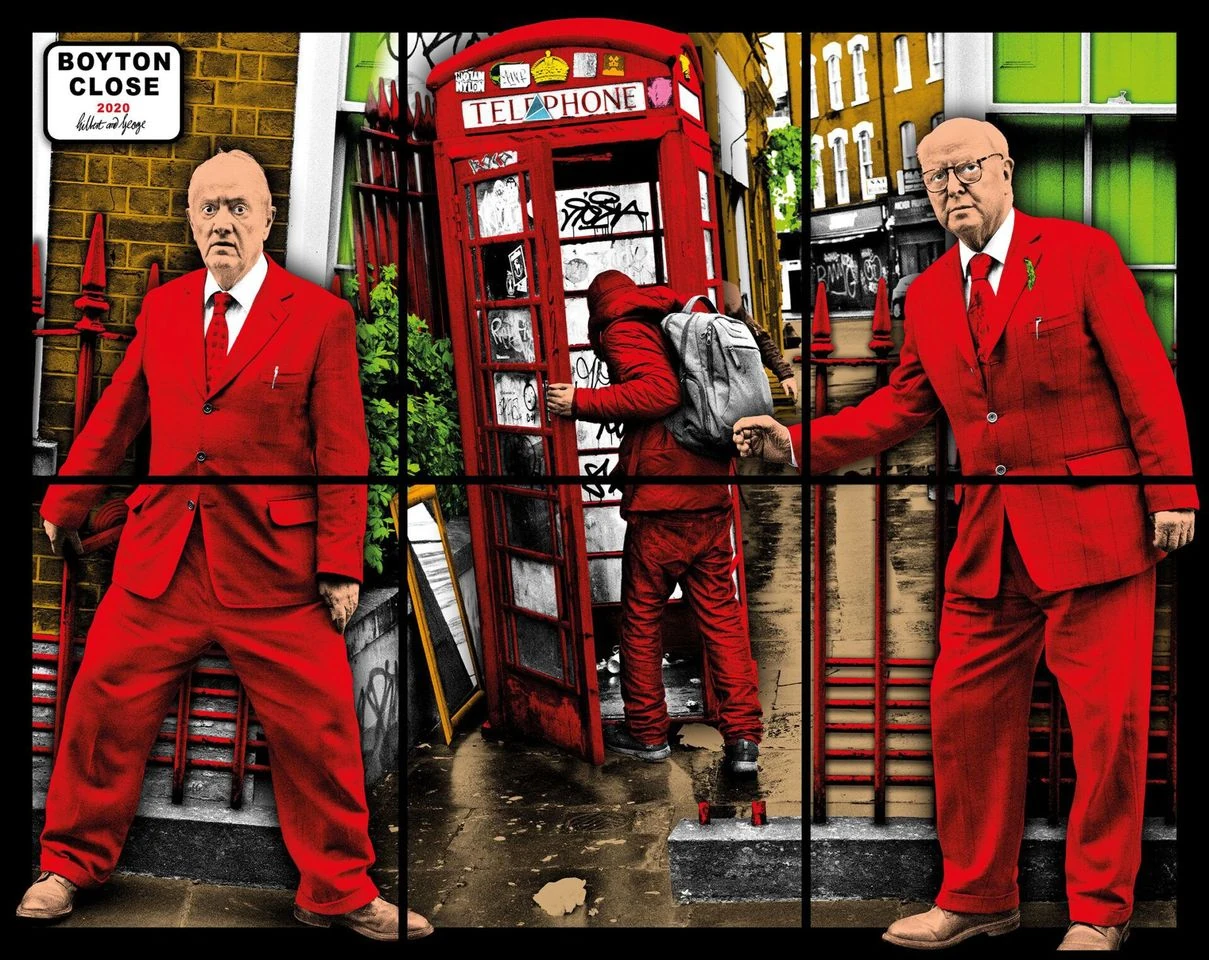
Gilbert & George turned their partnership into a subject and a medium for art. Gilbert Prousch and George Passmore met in London in 1967; two years later, they appeared together as The Singing Sculpture, performing a music-hall song while standing on a table. Later, large-scale photo-based works brought urban experience and difficult subjects into view. Across these forms, the artists’ own presence remained part of the work.
A partnership becomes a performance
Prousch and Passmore met at St Martin’s School of Art in London and began collaborating soon afterwards. Their practice brought together performance, photography and mixed media, rather than settling into a single format. In The Singing Sculpture (1969), they painted themselves in metallic colours, stood on a table and sang along to a recording of “Underneath the Arches”, a music-hall song.
The performance placed the artists themselves at its centre. Known as “Living Sculptures”, Gilbert & George presented their own figures and actions as part of the work, alongside the familiar song and simple staging. That early emphasis on their shared identity continued as their practice moved into other forms.
Urban subjects and uncomfortable pictures
The duo’s large-scale, photo-based works have a particular connection with London’s East End. They address alienation, sexuality, identity and social issues, bringing aspects of city life into their pictures. Dirty Words Pictures (1977) and Modern Fears (1980) are among the works associated with this urban strand of their practice.
Naked Shit Pictures (1994) confronted taboos around nudity, excrement and the human body. Its subject matter is deliberately difficult, extending the range of what the artists placed before viewers. Together, these works show a practice that joined photographic imagery to subjects the artists did not treat as off limits.
Exhibitions and recognition
Gilbert & George’s work has been exhibited internationally, including at Tate Modern in London and the Guggenheim in New York. They received the Turner Prize in 1986. The award and international exhibitions mark the public recognition of a partnership whose work spans performance and large-scale pictures, while retaining the artists’ shared identity as a defining element.
From the recorded song in The Singing Sculpture to pictures engaging with city life and bodily taboos, their work brings varied materials and subjects into the same artistic practice. The “Living Sculptures” idea connects those forms: Gilbert and George appear not only as makers but also as visible participants in the work.
Why Gilbert & George deserve a place in British Legacy
Gilbert & George deserve a place in British Legacy for a body of work rooted in a specific London context and recognised well beyond it. The artists met at St Martin’s School of Art, and their work has a particular connection with the East End. That connection gives their urban pictures a place in the story of British art that is more precise than a general claim to national importance.
Their contribution also lies in the range of their practice. The Singing Sculpture made performance, a music-hall song and the artists’ own presence central to the work; later photo-based pictures addressed identity, sexuality, alienation and taboo subjects. The Turner Prize and exhibitions at Tate Modern and the Guggenheim record recognition in Britain and internationally. Gilbert & George’s legacy, as evidenced here, is a partnership that carried its distinctive idea of the “Living Sculptures” from performance into pictures, bringing everyday and uncomfortable subjects into public view.