Bridget Riley’s paintings do not simply show shapes and colour: they set the eye to work. A repeated curve can seem to ripple across a flat surface; a pattern of black and white can suggest movement where nothing moves. Riley became one of the leading figures in Op art, but her practice developed through close study of earlier painters, sustained experimentation and a methodical approach to composition.
Early training and a change of direction
Bridget Louise Riley was born in Norwood, London, on 24 April 1931. Her father, John Fisher Riley, was a printer who owned his own business and had served as an Army officer. In 1938 he moved the business and family to Lincolnshire. At the beginning of the Second World War, he was mobilised as a member of the Territorial Army. Riley, her mother and her sister Sally moved to Cornwall, where they shared a cottage with an aunt who had studied at Goldsmiths’ College.
Riley attended Cheltenham Ladies’ College from 1946 to 1948, then studied at Goldsmiths’ College from 1949 to 1952 and the Royal College of Art from 1952 to 1955. Her early work was figurative and semi-impressionist. In the late 1950s she also worked as an art teacher, first at the Convent of the Sacred Heart in Harrow and later at art colleges in Loughborough, Hornsey and Croydon. At the advertising agency J. Walter Thompson, where she worked part-time as an illustrator until 1962, her work began to adopt a pointillist approach.
Georges Seurat became an important reference. After seeing his The Bridge at Courbevoie in 1959, Riley made a copy to investigate how its colours worked together. She later described the painting as a tool. The study led towards pointillist landscapes of her own, including Pink Landscape (1960), painted in Italy. Her engagement with Seurat was not a detour from abstraction: it helped her examine how a painting could organise colour and perception.
In 1959 Riley met painter and educator Maurice de Sausmarez, who became a friend and mentor. They travelled in Italy in 1960 and visited the Venice Biennale, where she encountered Futurist art. After their relationship ended later that year, Riley experienced a personal and artistic crisis. Works such as Kiss (1961) emerged from that period as she developed the black-and-white geometric language for which she first became known.
Making the eye part of the picture
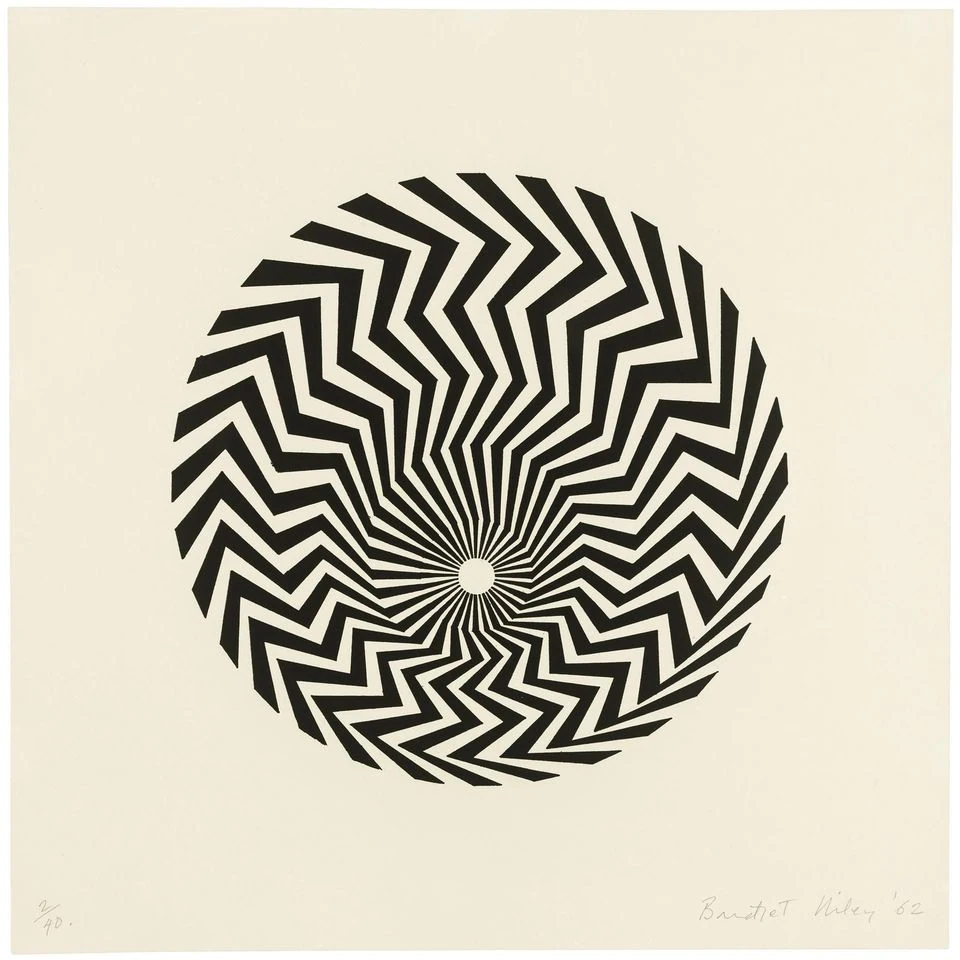
Between 1961 and 1965, Riley worked mainly with black and white, sometimes adding greys. Her compositions use carefully controlled shapes and repetitions to create sensations of movement, instability or colour. In Fall, for example, a repeated perpendicular curve produces a field of changing optical frequencies. The effect is not a painted scene in motion, but an encounter between a designed surface and a viewer’s sight.
Riley’s paintings were meticulously planned through preparatory drawings and collage. Since 1961, assistants have painted the final canvases under her instruction. That division of work enabled the patterns to be executed with precision while Riley retained control of their design. The images can seem immediate, but their apparent movement depends on careful decisions about form, interval and contrast.
Her first solo exhibition was held at Victor Musgrave’s Gallery One in London in 1962. The following years brought wider attention. In 1965 she took part in The Responsive Eye at New York’s Museum of Modern Art, an exhibition that brought Riley and Op art to an international audience. Her painting Current (1964) appeared on the catalogue cover. The exhibition also exposed a problem: in the United States at the time, the absence of copyright protection for artists allowed her work to be commercially exploited. Riley became disillusioned with such exhibitions, and legislation followed an initiative by New York-based artists in 1967.
In 1968 Riley represented Great Britain at the Venice Biennale. She was the first British contemporary painter and the first woman to receive its International Prize for painting. That year, she also helped establish SPACE with artist Peter Sedgley and journalist Peter Townsend. The organisation sought to provide artists with large, affordable studio space—a practical contribution to the conditions in which art could be made.
From monochrome to a wider colour language
Riley began investigating colour in 1967, producing her first stripe painting. Her move beyond monochrome did not abandon the exactness of the earlier work: colour, too, became a means of directing visual experience. A visit to Egypt in 1980–81 gave new impetus to this exploration. Riley developed what she called her Egyptian palette, drawing on the colours of the landscape and the country’s ancient and modern visual culture. The Ka and Ra series grew from that period.
In some later paintings, lines of colour create a shimmering effect; in others, tessellating forms fill the canvas. Shadow Play is among the works associated with this colourful phase. Riley returned to Venice in 1983 to study paintings central to European colourism. Towards the end of the decade, she reintroduced the diagonal through sequences of parallelograms that disrupt vertical stripes. In Delos (1983), blue, turquoise and emerald alternate with yellow, red and white.
Her work has also extended beyond conventional canvases. Riley made temporary murals for Tate, the Musée d’Art Moderne de la Ville de Paris and the National Gallery. At St Mary’s Hospital in London, she created murals across three floors of the Queen Elizabeth Queen Mother Wing; a further 56-metre mural was commissioned in 2014 for the hospital’s art collection. From 2017 to 2019 she completed a large wall painting for the Chinati Foundation in Texas, using a palette related to the one in her 1983 work Bolt of Colour for the Royal Liverpool University Hospital.
Exhibitions, institutions and recognition
Riley’s career has included painting, printmaking, writing and curating. She co-curated a 1996 Tate Gallery exhibition on Piet Mondrian and, with art historian Robert Kudielka, curated Paul Klee: The Nature of Creation at the Hayward Gallery in 2002. In 2010 she selected works by painters including Titian, Veronese, El Greco, Rubens, Poussin and Cézanne for an artists’ choice exhibition at the National Gallery. Her writing and public lectures have also addressed the nature and demands of artistic work.
Interest in her paintings has been renewed across several generations of exhibitions. A 1999 Serpentine Gallery show of early works was followed by a major Tate Britain retrospective in 2003. The National Gallery presented Paintings and Related Work in 2010; later exhibitions focused on her stripe and curve paintings. In 2019, a retrospective organised with the Hayward Gallery showed early paintings and drawings, black-and-white works and studies of her working methods, first at the Scottish National Gallery and then at the Hayward Gallery.
Riley’s public recognition includes the International Prize for painting at the Venice Biennale in 1968, appointment as a Commander of the Order of the British Empire in 1974 and the Praemium Imperiale in 2003. She became a Member of the Order of the Companions of Honour in 1998. In 2012 she became the first woman to receive the Dutch Sikkens Prize, which recognises the use of colour. She has received honorary doctorates from Oxford and Cambridge.
Her connection with British institutions has also taken a practical form. Riley served on the National Gallery’s board in the 1980s; the account of her work there credits her with opposing a proposal to give adjoining property to developers, helping secure the site for what became the Sainsbury Wing. She is a patron of Paintings in Hospitals, a charity providing art for health and social care in England, Wales and Northern Ireland. Since 2016, the Bridget Riley Art Foundation has funded a fellowship at the British School at Rome.
Why Bridget Riley deserves a place in British Legacy
Riley’s place in British cultural history rests on more than the recognisable patterning of her paintings. She developed a distinct visual language in which the viewer’s perception is not incidental but central: repeated lines and shapes make the eye register movement, vibration and colour across a still surface. Her shift from black-and-white compositions to increasingly complex colour did not discard the discipline of her early work. Instead, it extended an investigation begun through close attention to Seurat and sustained through decades of experiment.
Her achievements also connect artistic invention with the institutions and working conditions that sustain culture. Riley represented Great Britain at the Venice Biennale and received its International Prize for painting; she helped establish SPACE to provide artists with affordable studio room; and her murals have brought ambitious works into public and hospital settings. Her work for the National Gallery, her support for art in healthcare and the fellowship funded by her foundation show several different ways an artist can contribute to public life. Together, these achievements make her legacy specific: a British artist who changed how abstract painting could engage the eye, while also helping create places and opportunities for art to be made, encountered and valued.
Sources
Bridget Riley — Wikipedia revision 1376350551
Adapted in part from Bridget Riley by Wikipedia contributors, under CC BY-SA 4.0. Text has been edited and combined with the existing article; this adapted text is shared under the same licence. Contributor history.