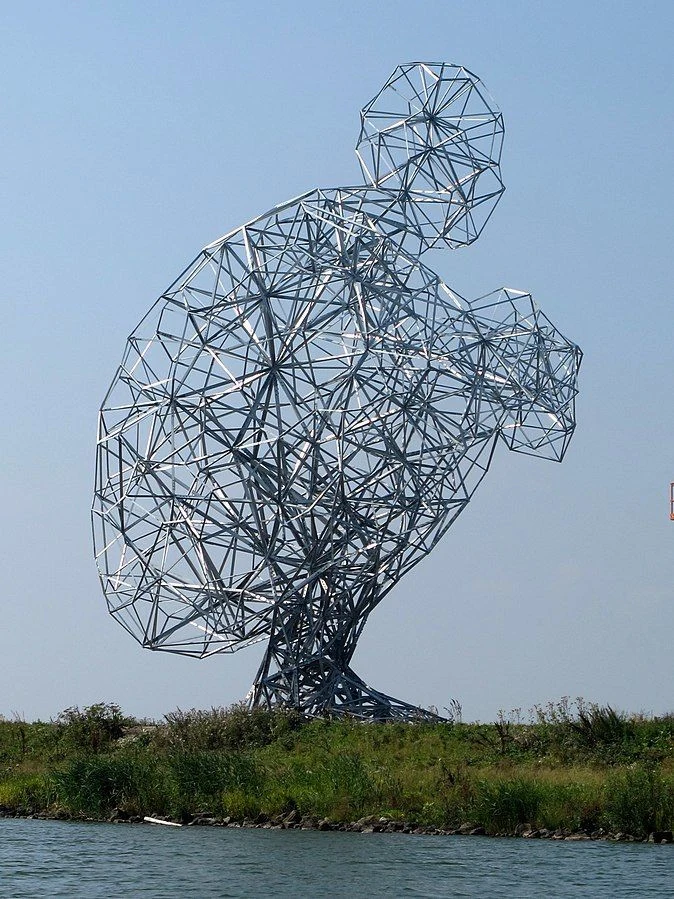
Antony Gormley’s sculptures make the human body a measure of the spaces we inhabit. A figure on a beach, a body-shaped mass in a gallery or a cast on a city rooftop can change how a place is seen. His best-known public work, the Angel of the North, stands above the approach to Gateshead; other projects invite people to move among repeated figures or take part in an artwork themselves. Across these works, Gormley has made sculpture a public encounter as well as an object to look at.
From studying people to making bodies
Gormley was born in Hampstead, London, on 30 August 1950. He read archaeology, anthropology and the history of art at Trinity College, Cambridge, from 1968 to 1971. After travelling in India and Sri Lanka between 1971 and 1974, he returned to England and began making work informed by what he had seen. One early piece, Sleeping Place, used a plaster-soaked sheet laid over a friend to make a hollow shell of a body.
He studied at Saint Martin’s School of Art and Goldsmiths in London, then completed postgraduate sculpture studies at the Slade School of Fine Art from 1977 to 1979. His first solo exhibition was at the Whitechapel Gallery in 1981. Its works explored surfaces, skins and inner structures, including objects enclosed in lead and an enclosure made from the artist’s clothes. He then began making casts of his own body, encasing them in lead. These hollow forms treated the body less as a figure to represent than as a space that could contain, enclose or be occupied.
In the 1990s, he moved from hollow body-cases towards solid iron forms. Critical Mass II comprises 60 life-size sculptures in varied positions. Gormley described it as an “anti-monument to the victims of the 20th century”; its arrangement has changed according to the places where it has been shown. That shift from an individual body to repeated, displaced figures runs through much of his later public work.
A landmark above Gateshead
Commissioned in 1994 and erected in February 1998, the Angel of the North is a monumental steel sculpture in Gateshead, overlooking the A1 and A167. It is 20 metres tall, with a wingspan of 54 metres. Its position on the site of a former colliery connects a new public landmark with a landscape shaped by industry, without prescribing a single meaning for the figure. Its scale and distinctive silhouette have made it one of the most recognisable works of contemporary British sculpture.
Gormley’s approach to public space is not limited to monumental size. Another Place, permanently installed on Crosby Beach near Liverpool, comprises iron figures looking out to sea. Their exposure to changing tides and weather makes the work inseparable from the beach and its shifting conditions. The figures can be gradually covered and revealed by the water; visitors encounter the work over time rather than from one fixed viewpoint. On the tenth anniversary of its installation, Gormley described the pleasure of watching the tide move around the figures.
Event Horizon brought another variation to the city. First installed on London’s South Bank in 2007, it consisted of 31 life-size casts of Gormley’s body: four in cast iron and 27 in fibreglass. Placed on rooftops and other locations, the figures altered the familiar urban skyline. The installation later appeared around Madison Square in New York, in São Paulo and in Hong Kong. In each setting, the isolated human form became part of a much larger cityscape.
Many figures, and a public invited in
Gormley has also made large groups of small figures. Field for the British Isles, one of his Field works, uses thousands of handmade terracotta figures to create an assembly that faces the viewer. Its crowd shifts attention between the presence of each small object and the mass formed by the whole. Gormley won the Turner Prize in 1994 with this work. Later Field projects included Asian Field, made in 2006 from approximately 200,000 clay figurines crafted by around 300 Chinese villagers in five days from 100 tonnes of red clay.
In 2009, One & Other, his Fourth Plinth commission in Trafalgar Square, put members of the public on the vacant plinth for an hour at a time. Participants were chosen by lot. Rather than setting a fixed sculpture on the plinth, the project made the changing presence of its participants the work itself. Gormley’s public projects thus take different forms: a permanent landmark, a beach installation, figures placed across a city, or an artwork that depends on people taking part.
His commissions and exhibitions have continued to place works in conversation with particular sites. In 2015, five life-size sculptures titled Land were installed near the centre and at four compass points of the UK for the Landmark Trust’s 50th anniversary. In 2024, he unveiled True, for Alan Turing, made from slabs of Corten steel, at King’s College, Cambridge. The work honours the mathematician and computer scientist’s influence. In the same year, Time Horizon, comprising 100 cast-iron sculptures, opened in the grounds of Houghton Hall in Norfolk in response to the parkland and the history of the house.
Recognition and a continuing practice
Gormley’s recognition includes the Turner Prize in 1994 and the South Bank Prize for Visual Art in 1999. He became a Royal Academician in 2003 and was knighted in 2014 for services to the arts. In 2025, he was appointed a Companion of Honour. His work is held in collections including Tate, the British Museum, the National Galleries of Scotland and the Victoria and Albert Museum. These distinctions sit alongside a practice that has continued across public commissions, exhibitions and works made for specific sites.
His career has also crossed into other forms of public culture. For the dance production Babel (Words), created with Sidi Larbi Cherkaoui and Damien Jalet, he received the Laurence Olivier Award for Outstanding Achievement in Dance in 2011. In 2017, he curated Inside at London’s Southbank Centre, an exhibition of work by prisoners, detainees and ex-offenders presented by the Koestler Trust. Such projects extend his work beyond sculpture alone, while retaining an interest in how bodies occupy spaces and how people encounter one another there.
Why Antony Gormley deserves a place in British Legacy
Gormley deserves a place in British Legacy because his work has become part of the country’s public environment, not merely its galleries. The Angel of the North is a major British commission, erected in Gateshead on the site of a former colliery. Its scale gives it visibility, but its significance also lies in how it connects a contemporary artwork with a place shaped by industrial history. At Crosby Beach, Another Place offers a different kind of public encounter: the figures change in appearance as the tide advances and recedes. Both works ask people to experience sculpture through its setting and over time.
His contribution also includes works that make participation and collective presence central. Field for the British Isles brought him the Turner Prize, while One & Other made members of the public the changing occupants of Trafalgar Square’s Fourth Plinth. These projects show the range of his approach, from durable public landmarks to temporary events shaped by individuals. Gormley’s British legacy is therefore not only a list of celebrated sculptures. It is the continuing presence of works that bring art into shared places and give people a reason to look again at the landscape, city or public space around them.
Sources
Antony Gormley — Wikipedia revision 1378820998
Adapted in part from Antony Gormley by Wikipedia contributors, under CC BY-SA 4.0. Text has been edited and combined with the existing article; this adapted text is shared under the same licence. Contributor history.