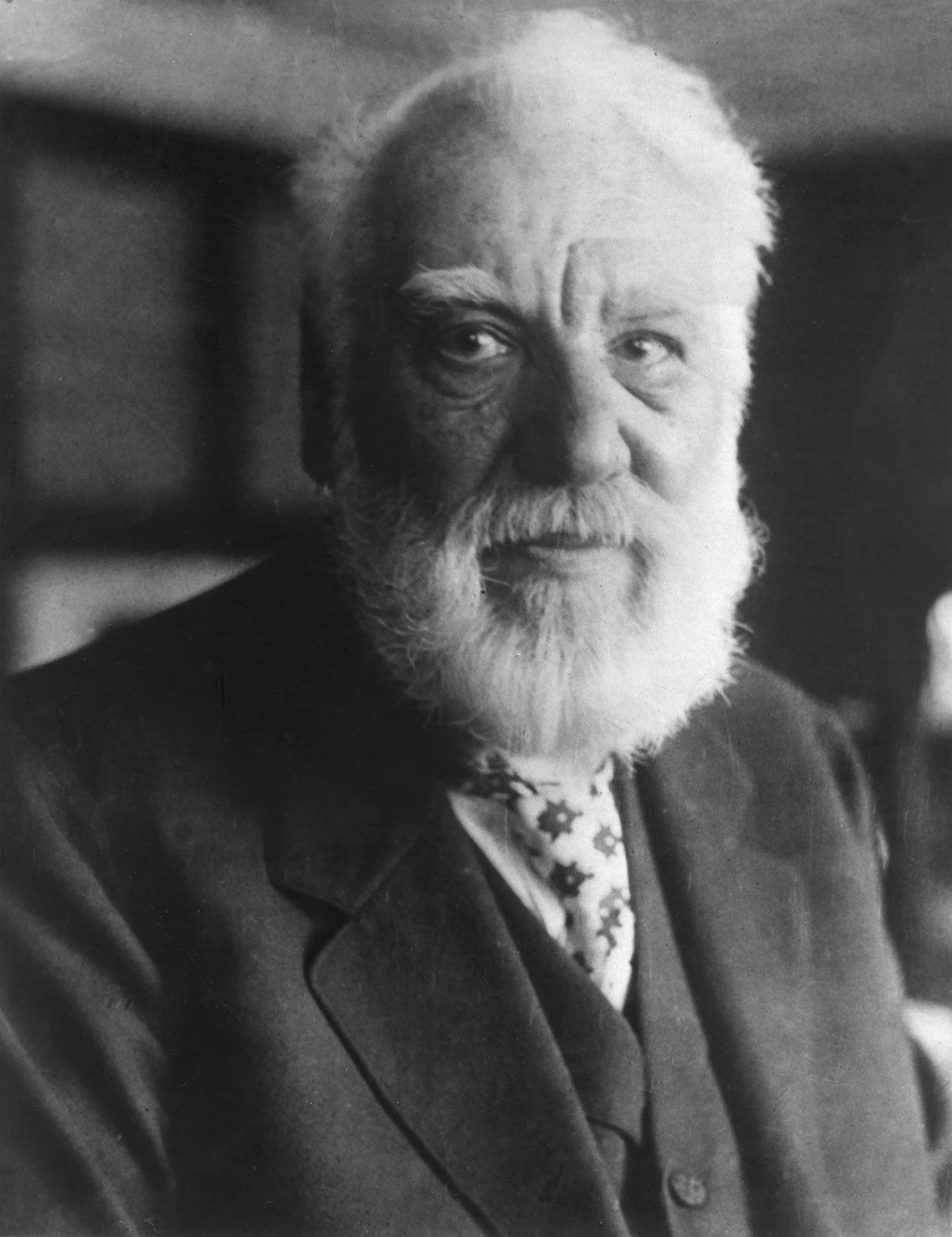
Alexander Graham Bell was born in Edinburgh in 1847 and became known around the world for patenting the first practical telephone. His route to that invention ran through a family steeped in speech and elocution, teaching deaf pupils in Britain and North America, and years of experiments with sound. The telephone made his name, but Bell’s work also extended to optical communication, aircraft and hydrofoils. His life connects British beginnings with a career largely pursued in Canada and the United States.
Edinburgh beginnings and an early interest in sound
Bell was born on 3 March 1847 to Alexander Melville Bell, a phonetician, and Eliza Grace Bell, née Symonds. His father and other members of the family taught elocution and speech. His mother gradually lost her hearing when Bell was about 12; he learned finger spelling so he could communicate with her and developed ways of speaking clearly near her forehead. The experience helped draw his attention to acoustics, though it was part of a wider family and educational background rather than a single explanation for his later work.
As a boy, Bell showed a practical curiosity. At 12, he and his friend Ben Herdman made a dehusking machine for the Herdman family’s flour mill, using rotating paddles and nail brushes. The machine was put to work there, and the boys were given access to a small workshop. Bell also experimented with sound and speech, including building a model speaking head with his brother Melville. These early projects foreshadowed a career in which observation and mechanical experiment went together.
Bell attended the Royal High School in Edinburgh but left at 15, having completed only four forms. He later studied at the University of Edinburgh and was accepted for admission to University College London, although he did not complete his studies there. He worked as a pupil-teacher in elocution and music at Weston House Academy in Elgin, then taught in England. In 1870, after the deaths of his brothers from tuberculosis, Bell travelled with his parents to Canada. The family settled near Brantford, Ontario.
Teaching speech across the Atlantic
Bell’s work with deaf people began in Britain. He taught at a private school for deaf pupils in South Kensington and became familiar with his father’s Visible Speech system, a set of symbols intended to represent speech sounds. In 1871, he travelled to Boston to train teachers in the system. He went on to teach in Hartford and Northampton, and returned to Boston as a teacher.
In 1872, Bell opened a school of vocal physiology and mechanics of speech in Boston. He also taught at Boston University. Among his pupils was Mabel Hubbard, who had lost her hearing after scarlet fever and later became his wife. Bell’s work in education continued alongside his experiments: he sought ways to teach speech and lip-reading, and in 1891 established the American Association for the Promotion of the Teaching of Speech to the Deaf. His approach was not beyond dispute. Members of the Deaf community have criticised his support for oral education and lip-reading in preference to sign language; Bell himself wrote that oral, manual or combined methods could benefit pupils.
His interest in speech also fed his experiments with electricity. Bell explored the possibility of sending several telegraph messages along one wire, each at a different pitch. By 1874, he was considering whether electrical currents could follow the shape of sound waves and then be converted back into sound. He found an experienced electrical mechanic, Thomas Watson, to work with him. Their experiments moved from the harmonic telegraph towards a device that could carry intelligible speech.
How the telephone took shape
On 2 June 1875, Watson accidentally plucked a reed in their experimental apparatus. Bell heard its overtones through the wire and recognised that a single reed or armature might transmit sound. The following year brought a race to secure patents. Bell’s lawyer filed his telephone application on 14 February 1876; the United States Patent Office granted Bell patent 174,465 on 7 March. The application and events surrounding it became the subject of later disputes, but the account in the patent describes Bell’s method and apparatus for transmitting sounds through electrical undulations.
On 10 March, Bell spoke into a liquid-transmitter experiment and Watson heard him in another room. Bell’s notebook records the words: “Mr. Watson—Come here—I want to see you.” This successful test demonstrated that intelligible speech could be transmitted electrically. Bell then concentrated on improving the electromagnetic telephone rather than using the liquid transmitter in public demonstrations or commercial use.
Experiments soon moved beyond the laboratory. In August 1876, Bell made telephone tests between Brantford and nearby places in Ontario. A two-way conversation between Cambridge and Boston followed in October. Bell demonstrated the invention to a wider audience at the 1876 Centennial Exposition in Philadelphia. The Bell Telephone Company was established in 1877, and the telephone began to move from experimental apparatus towards a commercial system. Bell’s role in its invention sits within a period of competing experiments and patent challenges; the invention was not a solitary event detached from that wider context.
A British demonstration and a wider field of invention
Bell returned to Britain to demonstrate the telephone to Queen Victoria at Osborne House on the Isle of Wight on 14 January 1878. He placed calls to Cowes, Southampton and London. These were the first publicly witnessed long-distance telephone calls in the UK. The queen found the experience “quite extraordinary”, although she thought the sound rather faint. The demonstration is a particularly direct link between Bell’s British birth and the technology that would transform communication.
The telephone did not exhaust Bell’s interests. In 1880, he and his assistant Charles Sumner Tainter demonstrated the photophone, which transmitted sound on a beam of light. Bell regarded it as one of his most important inventions. It anticipated principles later used in optical communications, though the modern systems that made fibre-optic communication widely used came much later.
Bell also worked on flight and watercraft. Through the Aerial Experiment Association, formed in 1907 with his support and his wife Mabel’s financial backing, he encouraged experiments with powered aircraft. The association developed several designs, including the Silver Dart, which made Canada’s first aircraft flight in 1909. With Frederick W. Baldwin, Bell developed hydrofoil craft. Their HD-4 reached a speed of 70.86 miles per hour in 1919, setting a world marine speed record that stood for a year. These projects show the breadth of his engineering work without diminishing the telephone’s central place in his public reputation.
Family, later years and remembrance
Bell married Mabel Hubbard in 1877. They had four children, two of whom died in infancy. He became a United States citizen in 1882, having previously been a British subject in Scotland and Canada. The family spent increasing amounts of time at Beinn Bhreagh, their estate near Baddeck in Nova Scotia, where Bell continued his experiments. He died there on 2 August 1922, aged 75, and was buried on the estate.
Bell received honours for his work, including the French government’s Volta Prize in 1880 and the Albert Medal from the Royal Society of Arts in London in 1902. He was elected president of the National Geographic Society in 1898 and served until 1903, helping to shape its use of illustrations and photography. His name remains associated with the telephone, but his scientific work ranged across communication, aeronautics, hydrofoils and research into heredity. His work and influence are commemorated at historic sites in Scotland, Canada and the United States.
Why Alexander Graham Bell deserves a place in British Legacy
Bell’s place in British Legacy begins with a clear, documented connection: he was born in Edinburgh, attended the Royal High School there, studied at the University of Edinburgh, and spent formative years teaching in Britain. His career later crossed the Atlantic, so his story should not be reduced to a claim that his achievements belonged to Britain alone. Rather, it shows how an education and family background rooted in Scotland formed part of an international life in science and invention. His 1878 demonstration to Queen Victoria, with calls reaching Cowes, Southampton and London, brought the telephone directly into British public view.
The case for remembering Bell also rests on the substance and range of his work. He helped turn experiments in transmitting sound into a practical telephone, a device that altered how people communicated. His photophone explored transmission by light; his work with the Aerial Experiment Association contributed to early powered flight in Canada; and his hydrofoil experiments set a world marine speed record. Alongside these achievements, his teaching and institutions devoted attention to deaf education, even as his preference for speech and lip-reading remains contested by members of the Deaf community. A thoughtful British legacy can hold both points in view: the reach of Bell’s inventions and the complexity of the educational ideas associated with them.
Sources
Alexander Graham Bell — Wikipedia revision 1379219806
Adapted in part from Alexander Graham Bell by Wikipedia contributors, under CC BY-SA 4.0. Text has been edited and combined with the existing article; this adapted text is shared under the same licence. Contributor history.