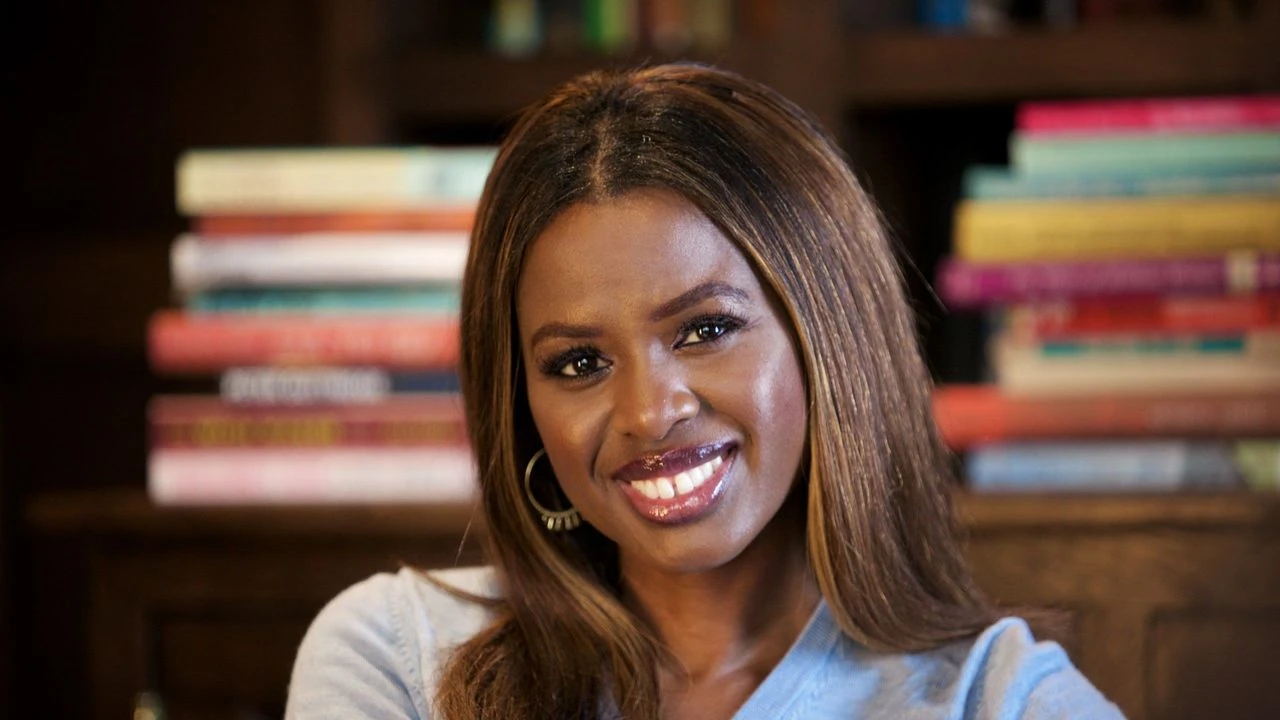
June Sarpong’s career has crossed the worlds of youth radio, popular television, publishing, institutional leadership and Parliament. She first became widely known as a presenter, but the through-line is how she has used that visibility: to bring people together, make arguments about representation accessible, and press major institutions to consider whose lives and experiences they put before the public.
From east London to T4
Sarpong was born in Newham, London, on 31 May 1977, to Ghanaian parents. She attended Connaught School for Girls in Leytonstone and Sir George Monoux College in Walthamstow. Her broadcasting career began in the late 1990s, when she worked as a DJ and presenter at Kiss 100. She went on to present for MTV UK and Ireland, including the MTV Dance Floor Chart, before joining Channel 4.
For nine years, Sarpong was one of the presenters of T4, Channel 4’s teen-oriented strand. The programme put her in the middle of a lively mix of music, entertainment and public conversation, and gave her a national audience. She also appeared across a range of formats: she presented the Smash Hits Poll Winners Party and Party in the Park, and hosted the MOBO Awards for three consecutive years. Her appearances on programmes including Question Time, 8 Out of 10 Cats and Have I Got News for You brought her into settings beyond youth and music television.
In January 2005, she interviewed Prime Minister Tony Blair for the T4 special When Tony Met June. The programme joined a familiar presenter and a head of government in a format aimed at a younger audience. The combination was a sign of the range Sarpong had developed: she could move between entertainment and political conversation without leaving her television audience behind.
Her television work continued in different forms. She co-hosted E4’s game show Your Face or Mine? with Jimmy Carr, presented Playing It Straight for Channel 4 and hosted ITV2’s WAGs Boutique. She also appeared on panel and comedy programmes, and became a regular on Sky News’ The Pledge from 2016. After leaving T4 at the end of 2007, she continued to work across entertainment and discussion rather than becoming associated with a single programme.
Building platforms beyond broadcasting
Sarpong’s work away from the screen has included bringing people together around women’s influence and opportunity. She co-founded Women: Inspiration & Enterprise, known as WIE, a network and conference platform that began in New York and later expanded to Britain. It connected women from business, culture and public life. The initiative extended her work from presenting other people’s conversations to helping create settings in which those conversations could happen.
She has also spoken publicly about race, gender, class and inclusion, addressing audiences beyond television. That communication has been a consistent feature of her career: taking subjects that can be discussed in abstract or polarised terms and making them part of a wider public conversation. Her work has included speaking to employers and other professional audiences as well as general audiences, bringing questions about representation into settings where decisions are made.
Writing gave Sarpong more room to develop those arguments. Her books include Diversify: Six Degrees of Integration (2017), The Power of Women (2018) and The Power of Privilege: How White People Can Challenge Racism (2020). Their subjects connect social division, gender equality and racism to the way people understand opportunity and belonging. Together, they show that her work on representation has not been confined to a job title or a particular broadcaster. She has addressed the same broad questions in print as in interviews, events and television.
Sarpong has also worked behind the scenes in media. She runs Lipgloss Productions, and projects described in the supplied biographical record included a sitcom and a programme about climate change in development. This production work sits alongside, rather than replacing, her on-screen career: it points to another way of shaping the programmes and ideas that reach audiences.
A role at the BBC
In November 2019, Sarpong was appointed the BBC’s first Director of Creative Diversity. The appointment moved her work on representation into one of Britain’s most influential broadcasting institutions. The role concerned creative diversity within the BBC; it was not simply another presenting position. It brought her into an organisation whose programmes reach audiences across television, radio and online services, and whose decisions help shape what people encounter as mainstream British culture.
The significance of such a role lies in the relationship between institutional choices and what appears on screen and in sound. Commissioning, production and editorial decisions affect whose stories are told and who has the opportunity to tell them. Sarpong’s appointment placed a senior figure with a public profile in a position focused on creative diversity at the BBC. That is concrete work within an institution, distinct from the public arguments she made as an author and speaker.
It also brought together strands of her career that had previously been visible in different places. As a presenter, she had worked across youth entertainment, music and current affairs; as a writer and speaker, she had addressed inclusion and social opportunity; and through WIE she had helped convene women across professional and cultural life. The BBC role gave her a platform inside a major broadcaster to work on questions related to representation and creative output.
Honours and Parliament
Sarpong’s honours came at different points in her career. She was appointed a Member of the Order of the British Empire (MBE) in the 2007 New Year Honours for services to broadcasting and charity. In the 2020 New Year Honours, she was appointed an Officer of the Order of the British Empire (OBE) for services to broadcasting. These are separate appointments, not two descriptions of a single award.
In August 2026, she entered the House of Lords as Baroness Sarpong, of Walthamstow in the London Borough of Waltham Forest, after being nominated for a life peerage in the July 2026 political peerages. Her move to the Lords adds a parliamentary role to a career previously centred on broadcasting, public discussion and writing. It gives her another platform in British public life, although it does not make the earlier work disappear: the presenter, author and BBC executive remain essential parts of the same professional history.
Her path from Newham and east London education to Channel 4, the BBC and the Lords connects local roots with national institutions. It also illustrates the reach that popular broadcasting can give someone whose work later takes place in less visible settings: production, organisational leadership, publishing and public service.
Why June Sarpong deserves a place in British Legacy
June Sarpong deserves a place in British Legacy because she has worked on representation through several different parts of British public life. Her years on T4 made her a familiar television presenter to a broad audience; her interview with Tony Blair showed her moving from entertainment into political conversation. Later, books on integration, women’s power and privilege let her address questions of equality and belonging at greater length. WIE added a practical platform for connecting women in business, culture and public life. These are distinct achievements, but they share an interest in who gets to take part, speak and be recognised.
Her appointment as the BBC’s first Director of Creative Diversity brought that interest into a major public-service broadcaster. The BBC has an extensive role in the stories and voices that reach audiences across the UK, so creative decisions there matter beyond the organisation itself. Sarpong’s position placed her within the institution where those decisions are made, while her broadcasting experience gave her a direct understanding of the medium. Her subsequent entry into the House of Lords extends her presence into Parliament, adding a new public platform to the one she had built in media.
The British connection is specific: Sarpong’s career has developed through east London, Channel 4, the BBC, the British honours system and the House of Lords. Her story is not simply one of rising public profile. It is a record of moving between the screen, the page and institutions that shape national conversation, repeatedly bringing questions of inclusion and opportunity with her. That range, and the practical platforms she has used to pursue those questions, gives her a substantial place in the story of contemporary British public life.
Sources
Adapted in part from June Sarpong by Wikipedia contributors, under CC BY-SA 4.0. Text has been edited and combined with the existing article; this adapted text is shared under the same licence. Contributor history.