Marc Wadsworth’s career has repeatedly taken him to the places where representation is decided: political parties, newsrooms, campaigns and the stories a country tells about its past. A Birmingham-born campaigner, journalist and broadcaster, he helped organise Black representation within the Labour Party, founded the Anti-Racist Alliance and worked on the campaign for justice after Stephen Lawrence’s murder. He also used journalism and broadcasting to challenge who gets heard and remembered in British public life.
A Birmingham childhood shaped by migration
Wadsworth’s family story connects wartime service and post-war migration. His father, George “Busha” Rowe, travelled from Jamaica to Britain in 1944 to serve as Royal Air Force ground crew during the Second World War. He returned to Jamaica in 1946 and came back to Britain aboard the Empire Windrush in 1948. Rowe and other Jamaican passengers settled in Birmingham, where he described the city as unfriendly and said it had a colour bar.
Wadsworth’s mother was Finnish. She had worked as a hairdresser in Finland before moving to England, initially to work as an au pair. Wadsworth was born in Birmingham and spent his first six years in a children’s home at Hagley, where his mother worked as a domestic helper. He then spent a year in foster care in Balsall Heath before attending Ottershaw School, a boys’ boarding school in Surrey. He later recalled being its only Black pupil and being bullied. At 13, inspired by Muhammad Ali, he took up amateur boxing.
Those experiences sat within a wider British history: Caribbean service during the war, migration in the years that followed, and racial barriers in everyday life. Wadsworth’s later work repeatedly addressed the gap between the promise of inclusion and the way institutions operated. Rather than treating racial discrimination only as individual prejudice, he concentrated on how power was organised: who could gain influence in a party, whose account reached the press and whose experience entered national memory.
Making representation an organised effort
Wadsworth helped secure Black Sections, or caucuses, within the Labour Party. The proposal was first tabled in 1983 to advance the political representation of African, Caribbean and Asian people. Its significance lay in making representation an organised political demand. Members could act collectively inside the party, rather than relying on senior figures to include them as a matter of goodwill.
The supplied biographical account says that all four of Britain’s first modern-era African, Caribbean and Asian MPs were members of the Black Sections. That detail points to the caucuses’ place in the development of political representation, although their work was one part of a larger history and should not be mistaken for a complete explanation of change. Wadsworth’s contribution was to help build a structure through which members could press the party to take their presence and concerns seriously.
His efforts to change institutions also extended to journalism. He served twice on the National Executive Council of the National Union of Journalists and later chaired its Black Members Council. In March 2023, the NUJ awarded him its Gold Badge for what it described as his “exceptional contribution” to the union over many years. These roles connected his campaign for representation in politics with a parallel interest in who had influence within the profession that reports on politics and public life.
The Anti-Racist Alliance and the Lawrence campaign
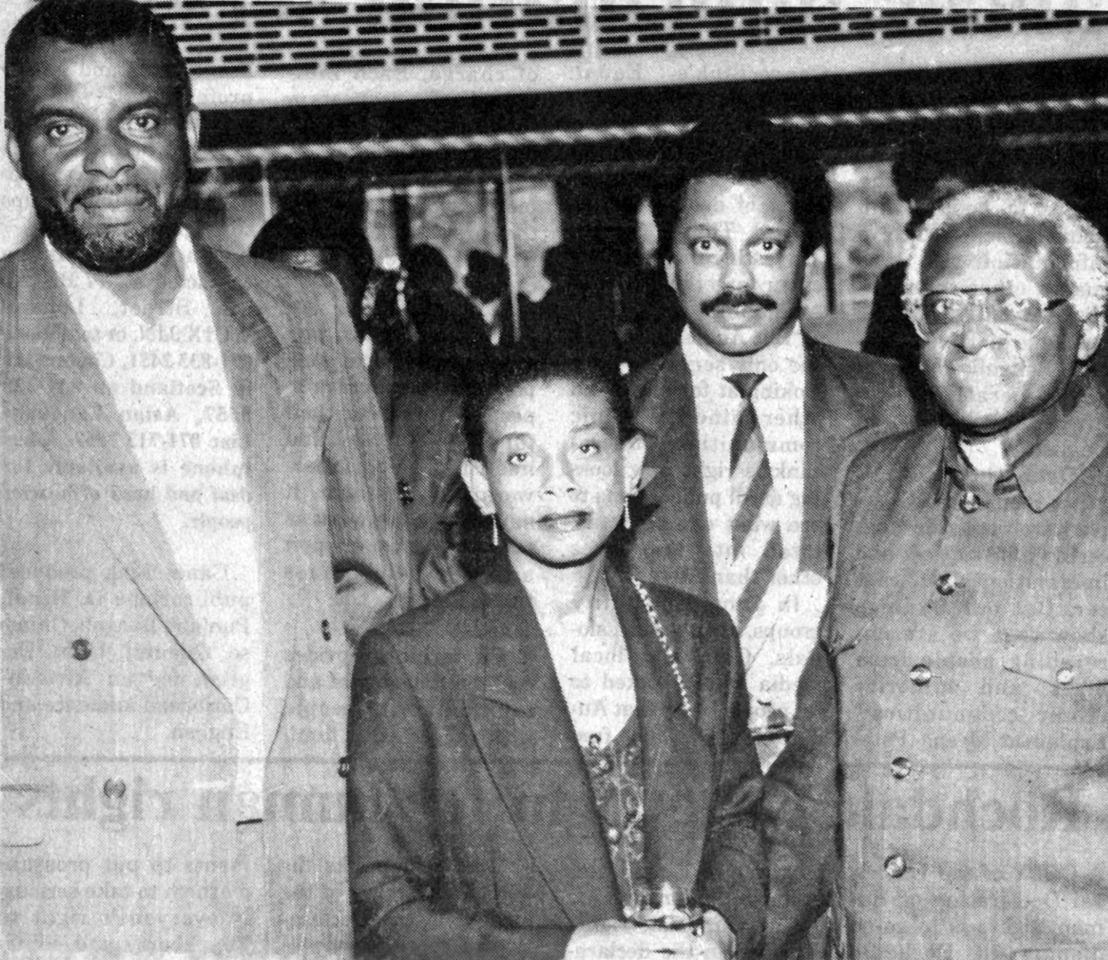
In 1991, Wadsworth founded the Anti-Racist Alliance. Following the racist murder of Stephen Lawrence in 1993, the organisation became involved in the campaign for justice. Wadsworth helped introduce Lawrence’s parents to Nelson Mandela and Archbishop Desmond Tutu, connecting a British family’s campaign with internationally recognised opponents of racial oppression.
The Alliance also sought legal change. The supplied biographical account records that it secured work from human-rights lawyer Geoffrey Bindman on proposals to make racial harassment and racial violence specific criminal offences, which later became law. The account of this work illustrates the range of methods involved: campaigning, building public attention and seeking changes to the law. It does not mean that Wadsworth alone secured those changes, or that one organisation’s contribution can stand for the full campaign.
The Lawrence case became a major point of public reckoning over racism and policing in Britain. Wadsworth’s part in the story was as an organiser and campaigner helping to support a family’s demand for justice. Such work depends on more than a public statement: introductions, relationships, publicity and sustained pressure all contribute to whether a case can remain in view. The record supports his involvement in that effort, while the wider campaign belongs to the family and many others who pursued justice.
Journalism, public accountability and Comrade Sak
Wadsworth worked in print and broadcasting, wrote for national newspapers, reported and presented for BBC radio and television, and appeared on ITV’s Thames News. He also helped with community journalism training. From 2001 to 2012, he lectured in journalism at City University London. In 2012, he was awarded an MA in Contemporary British History from King’s College London, passing with distinction.
In January 2006, he became founding editor of The-Latest.com, described in the supplied record as Britain’s first dedicated citizen-journalism news portal. The project placed news production beyond established newsrooms and gave a platform to reporting that might otherwise struggle to reach a wider audience. In 2008, an interview Wadsworth published on the site led to the resignation of James McGrath, political strategist and spokesman for the newly elected London mayor, Boris Johnson.
McGrath had said he would be fine if many elderly British African-Caribbean Londoners left the country because of Johnson’s policies. Wadsworth said he had given McGrath a month to clarify his remarks privately before publishing the interview. The episode showed how reporting outside a traditional newsroom could bring a comment to public attention and provoke a response from those close to political power. The significance is not that one story settled broader debates about journalism, but that it demonstrated the reach independent reporting could have.
Wadsworth’s book Comrade Sak turned from immediate political events to a neglected part of British political history. It is a biography of Shapurji Saklatvala, a British Indian Labour and Communist MP. First published by Peepal Tree Press in 1998, it was issued in a new edition in 2020. Saklatvala’s life brought together British politics, class and anti-colonialism; writing about him widened the record beyond the figures more routinely placed at the centre of national political history.
Films and programmes that widen the historical record
Wadsworth’s documentary Divided by Race, United in War and Peace examined Caribbean Second World War veterans, including the experiences of his late father’s fellow servicemen, and their struggles against colour prejudice and racism. The project was made through The-Latest.com. It placed wartime service alongside the discrimination veterans faced, rather than treating their military contribution as separate from their lives in Britain.
The BBC remade the film with Wadsworth as a producer. Fighting for King and Empire: Britain’s Caribbean Heroes was broadcast in May 2015 and later shown during Remembrance Sunday week. Wadsworth also wrote Guardian obituaries for two veterans featured in his films: Sam King, in 2016, and Allan Wilmot, in 2021. The work made Caribbean service part of a broader public account of Britain’s wartime history and the country that veterans encountered afterwards.
In May 2022, BBC Radio 4 broadcast The Amazing Life of Olaudah Equiano, a docudrama made by Wadsworth’s independent production company. Produced by Wadsworth and Deborah Hobson, it told the story of Equiano, a freed African in Britain and an abolitionist whose 1789 autobiography formed part of his campaign. Putting Equiano at the centre of a programme about abolition gave listeners a route into the history through the life and writing of a campaigner, rather than presenting him only as an adjunct to better-known political figures.
Controversy, party discipline and the importance of precision
Wadsworth’s public record includes a serious and lasting political dispute. On 30 June 2016, at the launch of the Chakrabarti Inquiry report into antisemitism and racism in the Labour Party, he challenged Labour MP Ruth Smeeth after seeing her receive a press release he had given to a journalist. The exchange became the subject of sharply different accounts and a sustained public controversy. In April 2018, Labour’s National Constitutional Committee found two charges of prejudicial and detrimental conduct proved and expelled him from the party.
In describing the episode, it is important not to turn disputed claims into established fact or to collapse distinct events into a simplified version. The supplied biographical record says Wadsworth had left Labour in 2003 in protest against the Iraq War and rejoined in May 2016. It also records that he pursued complaints over reporting about the confrontation. In 2021, The Jewish Chronicle accepted that a separate report claiming he was part of a group planning to locate and intimidate Jewish Labour members was wholly untrue, published an apology and agreed to pay damages and costs. That later correction does not resolve every disagreement about the 2016 events; it does establish the importance of accuracy when reporting them.
Wadsworth’s career has involved political argument as well as campaigning and journalism. Remembering the controversy alongside his other work avoids presenting an untroubled or one-dimensional portrait. It also keeps separate the party’s disciplinary finding, competing accounts of the encounter and the later correction of an inaccurate newspaper report. In a story so often narrowed to accusation and response, that distinction matters.
Why Marc Wadsworth deserves a place in British Legacy
Marc Wadsworth deserves a place in British Legacy because his work addressed who could participate in British public life and whose experience became part of its record. Helping secure Labour Party Black Sections gave members a means to organise around representation within a major political party. Founding the Anti-Racist Alliance and contributing to the campaign after Stephen Lawrence’s murder connected public campaigning with efforts to pursue justice and legal change. These achievements were collective, but Wadsworth’s organising role forms a specific part of their history.
His work in journalism and broadcasting extended the same concern into the public record. The-Latest.com provided an early platform for citizen journalism, while the reporting that led to James McGrath’s resignation showed how an independently published interview could make a political statement answerable to the public. His writing on Shapurji Saklatvala and programmes about Caribbean veterans and Olaudah Equiano brought people and histories into view that conventional accounts can leave at the edges. Together, these projects connect political representation, reporting and historical memory: not separate interests, but ways of asking who gets heard. Wadsworth’s controversial public life should be remembered with care and precision, rather than reduced either to unqualified praise or to one episode. The lasting value of his contribution is the practical work of widening participation and making British history more complete.
Sources
Marc Wadsworth — Wikipedia revision 1373303635 · Marc Wadsworth — Wikipedia
Adapted in part from Marc Wadsworth by Wikipedia contributors, under CC BY-SA 4.0. Text has been edited and combined with the existing article; this adapted text is shared under the same licence. Contributor history.