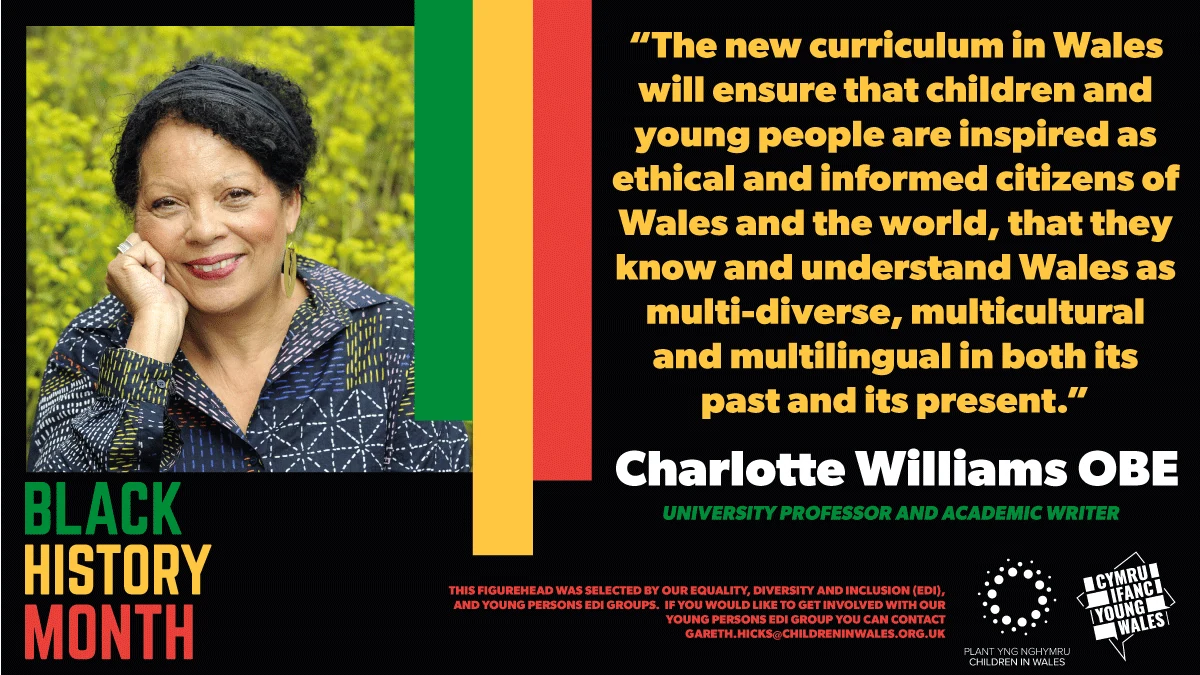
When the Welsh Government asked Professor Charlotte Williams to lead a review of how Black, Asian and minority ethnic histories should appear in the new curriculum, it turned to a scholar and writer whose work had long asked who is included in the story of Wales. Williams, an Emeritus Professor at Bangor University, has written about race, welfare, devolution, identity and belonging. Her memoir, Sugar and Slate, brought those concerns into a personal and literary account of Welsh-Guyanese inheritance. Her academic work and writing met in a public task: helping Wales consider whether the histories taught in its schools reflected the country itself.
The significance of that work lies in more than the appointment or the report that followed. The Welsh Government’s curriculum initiative placed Black, Asian and minority ethnic contributions within a wider discussion about what pupils should learn across the curriculum. The working group she chaired made 51 recommendations. Government statements and progress reports describe Wales as the first UK nation to make the teaching of Black, Asian and minority ethnic histories mandatory, and connect that change to the group’s work. Williams’s contribution therefore belongs both to the history of Welsh public policy and to a longer effort to make the country’s cultural life more representative.
A Welsh story told from more than one inheritance
Williams grew up in Llandudno, in north Wales, and has written from the perspective of Welsh-Guyanese heritage. Her work challenges accounts of Welsh life that leave minority histories at the edges, or treat them as recent additions to an otherwise complete national story. The issue is not simply whether pupils encounter a particular subject on a particular day. It is whether the curriculum gives them a reliable sense of who has shaped Wales and who belongs within it.
In public reflections, Williams has returned to the importance of children encountering the many histories that meet in Wales. That emphasis joins questions of education to questions of identity: what pupils are taught affects whose presence seems ordinary, whose experience counts as part of the national past, and how confidently children can understand themselves in relation to their country. Her approach is not to set Welsh identity aside, but to ask for a fuller account of it.
Sugar and Slate, published in 2002, gives that argument a literary form. The memoir explores Welsh-Guyanese heritage and diasporic identity, bringing together questions of race, family memory, empire, language and locality. It received Wales Book of the Year in 2003. The book’s importance is not limited to its award: it made a Black Welsh perspective visible in writing rooted in a specific place, rather than treating that perspective as separate from Welsh literature. Williams showed that these subjects were part of the substance of Welsh writing and history, not outside additions to them.
Her writing has also appeared in journals and magazines, including Planet, Wales Review Online and Wasafiri. Alongside her memoir and editorial work, these contributions have brought her ideas to readers beyond academic and policy settings. Literature, criticism and public discussion can change the terms in which people talk about home; Williams’s writing has helped make Black Welsh thought part of that conversation.
Race, welfare and devolved government
As an academic, Williams connected questions of culture and identity to the institutions that shape everyday life. Her social-policy work considered how racial difference is treated by welfare systems, public services and devolved government. These are practical questions as well as academic ones: whose experiences inform decisions, how institutions respond to different needs, and whether public provision recognises the full population it serves.
In a 2006 article co-authored with Philomena De Lima, Williams considered devolution in relation to multicultural citizenship and race equality. Devolution created the possibility of developing policy at national level in Wales; the question was whether that new scope would also recognise a diverse population. Her work treated race equality as part of the substance of public policy, rather than a secondary issue to be considered after constitutional change.
Her book Race and Ethnicity in a Welfare Society belongs to the same field of enquiry. It places race within the ordinary responsibilities and practices of a welfare society: care, public provision and the obligations institutions have to the people they serve. Read alongside her work on devolution, it helps explain why Williams’s scholarship has a civic dimension. It asks not only how people describe identity, but how systems make that identity consequential in people’s dealings with public services.
This body of work also challenged the idea that race in Wales was a marginal or imported subject. Williams treated it as integral to questions about citizenship, public responsibility and belonging. Institutions can acknowledge difference without reducing people to stereotypes; they can also fail to recognise difference while claiming to treat everyone alike. By bringing these questions into discussions of social policy and Welsh self-government, her work made race equality part of the serious debate about what public institutions are for.
Turning research into curriculum reform
In July 2020, Williams was appointed to chair the working group on Black, Asian and Minority Ethnic Communities, Contributions and Cynefin in the new curriculum. Its remit extended across the curriculum. The task was therefore broader than adding occasional lessons or commemorative material: it asked how the story taught in Welsh schools could better reflect the country’s history and population. The appointment drew on her earlier work on race, public policy and belonging. She had been awarded an OBE in 2007 for services to ethnic minorities and equal opportunities in Wales.
The working group’s final report appeared in March 2021. It made 51 recommendations and placed the subject within the Curriculum for Wales, rather than treating it as a separate, optional addition. The report addressed the support needed to make change practicable, including teacher development and learning materials. Its scale reflects the breadth of the task: a more representative curriculum requires not just new content but the confidence and resources to teach it well.
Subsequent Welsh Government statements and progress reports describe Wales as the first UK nation to make the teaching of Black, Asian and minority ethnic histories mandatory. They connect that change to the working group and its recommendations. The associated work has included professional learning, stronger resources and attention to diversity in the education workforce. These developments do not mean that a report alone can settle questions of representation in schools. They do mark a shift from debating whether these histories belong in the curriculum to considering how to teach them as part of Wales’s history.
Williams’s role in that process linked her academic concerns to an institutional change with consequences for teachers and pupils. Her work helped make the case that representation is not an optional supplement to education. A curriculum offers an account of a society: what it remembers, whose contributions it recognises and what it asks its pupils to understand. The reform effort she chaired gave that argument a policy framework and a set of recommendations for schools and government to take forward.
A public voice on children and belonging
In a Black History Month interview, Williams spoke of wanting children’s education in Wales to be enriched by the many stories woven into Welsh history. The point is both cultural and educational. When pupils meet a broader account of the past, they can understand the country without assuming that its history belongs to only one group. A more complete account does not weaken Welsh identity; it gives that identity a firmer basis in the range of experiences that have shaped it.
Her public work has therefore addressed readers, educators and policymakers in different ways. The memoir makes questions of inheritance and place available through personal writing; her scholarship examines how public systems respond to racial difference; and her curriculum work asks what schools should teach. These are connected projects, though they are not interchangeable. Together they show why Williams’s contribution extends beyond a single committee or a single publication.
The curriculum work also brings the practical challenges into view. Recommendations need resources, teacher development and sustained institutional support if they are to become part of everyday teaching. Williams’s contribution was to help set out the problem and a framework for addressing it. Public reports and progress statements describe changes that followed, while the continuing work of schools and government remains essential to putting those ambitions into practice.
Why Charlotte Williams deserves a place in British Legacy
Charlotte Williams deserves a place in British Legacy because her work has helped Wales tell a more complete story about itself. Through scholarship, memoir and public service, she has connected race and belonging to Welsh literature, social policy, devolution and education. These are not separate interests joined only by biography. They each ask whose experience is recognised: in a book, in a public service or in the account of the past taught to children. Williams’s work has made that question harder to leave unanswered.
Her achievements have specific and lasting forms. Sugar and Slate placed Welsh-Guyanese inheritance within Welsh writing and received Wales Book of the Year. Her academic work brought race equality into discussion of welfare and devolved government. As chair of the curriculum working group, she helped produce 51 recommendations, and Welsh Government accounts connect the group’s work to Wales becoming the first UK nation to make the teaching of Black, Asian and minority ethnic histories mandatory. That policy development offers pupils a curriculum intended to include histories that earlier accounts could marginalise, and it gives teachers a framework to address them.
There is also a wider benefit in the way these contributions reinforce one another. A memoir can make a perspective legible; scholarship can explain how institutions shape people’s lives; public policy can turn an argument into a programme of change. Williams has worked across all three. Her legacy is not a claim that the work of inclusion is finished, but evidence that sustained writing and research can influence the questions a nation asks and the policies it adopts. For British Legacy, her story shows how Welsh identity can be strengthened by a more truthful account of its many histories and inheritances.