Edward Burne-Jones made images of legend and romance, but his work was not confined to the painter’s canvas. He designed stained glass, tapestries and book illustrations, and worked with William Morris in a business that brought fine-art design into churches and homes. Born in Birmingham in 1833, he became a leading figure in the Pre-Raphaelite and Aesthetic movements. His career also shows how a Victorian artist could move between painting, craft and the commercial making of objects.
From Birmingham to Oxford
Burne-Jones was born Edward Coley Burne Jones in Birmingham, the son of Edward Richard Jones, a Welsh frame-maker. His mother, Elizabeth Coley, died within days of his birth. He attended King Edward VI grammar school and Birmingham School of Art before going to Exeter College, Oxford, to study theology. He intended to enter the Church, but his reading and friendships redirected him towards art.
At Oxford he became friends with William Morris through their shared interest in poetry. Together with friends from Birmingham, they formed a group known as the Brotherhood, reading John Ruskin and Alfred Tennyson and taking an interest in medieval art and society. Thomas Malory’s Le Morte d’Arthur became an important source for Burne-Jones’s imagination. He left Oxford without taking a degree and, under the influence of Dante Gabriel Rossetti, chose to pursue art. His early work reflected Rossetti’s example, while its finely worked detail already showed an individual approach.
His first oil sketch dates from 1856. The following year he began a long series of designs for stained glass, and in 1858 decorated a cabinet with a subject from Chaucer. His interests were broad from the start: drawing, painting, illustration and design would remain connected throughout his working life. A visit to Italy in 1859 brought him into contact with the country’s art; he was particularly drawn to the Sienese painters.
Painting a world of story
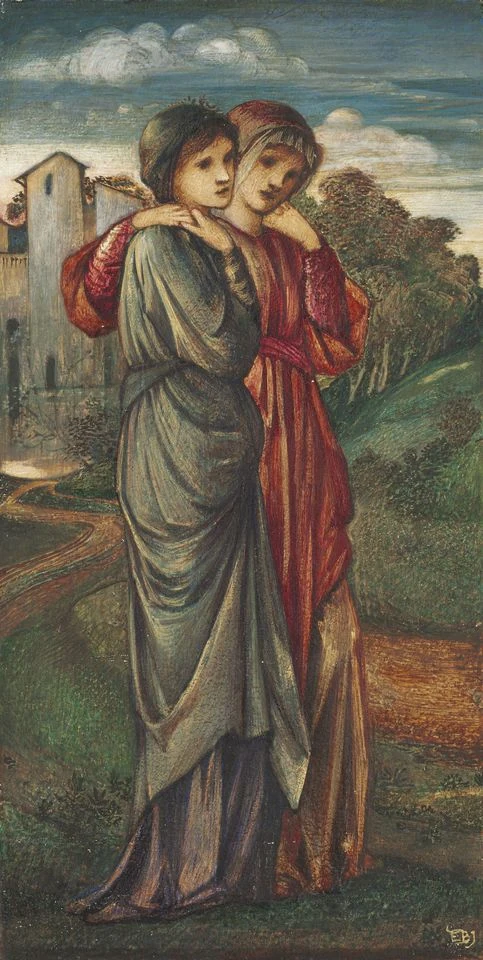
Burne-Jones first exhibited widely in watercolour. Elected an associate of the Society of Painters in Water-Colours in 1864, he showed The Merciful Knight, a work that marked the emergence of a more assured personal style. His subjects drew on medieval romance, classical stories and literature. Rather than treating these narratives as straightforward history, he made images that dwell on their atmosphere and emotional tension.
In 1870 he withdrew from the Society after controversy over Phyllis and Demophoön. The painting’s treatment of the figures, including its nudity, offended Victorian sensibilities. For several years he exhibited little, but the pause in public appearances did not mean a pause in work. During that period he developed paintings including The Golden Stairs, the Pygmalion series and The Mirror of Venus.
His public breakthrough came in 1877, when the new Grosvenor Gallery exhibited eight of his oil paintings, including The Beguiling of Merlin and The Mirror of Venus. The gallery offered an alternative to the Royal Academy, and the exhibition helped establish Burne-Jones as a prominent figure in the Aesthetic Movement. He continued to develop his use of colour and composition: The Golden Stairs was first exhibited in 1880, while King Cophetua and the Beggar Maid followed in 1884. His subjects could be remote from everyday life, but his careful handling of figures, pattern and colour made them visually compelling.
Design beyond the canvas
In 1861 Morris founded Morris, Marshall, Faulkner & Co. with Burne-Jones, Rossetti, Ford Madox Brown and Philip Webb, among others. The firm undertook work in stained glass, metalwork, textiles, carpets and other decorative arts, with church decoration an important part of its business. Burne-Jones contributed designs for stained glass and, later, tapestries. The firm’s work for St James’s Palace and the South Kensington Museum helped establish its reputation; the museum is now the Victoria and Albert Museum.
His stained-glass designs were made for churches across Britain, including buildings in Birmingham, Oxford and Frome. In 1875 the business was reorganised as Morris & Co., and Burne-Jones continued to supply designs. At Stanmore Hall, one of the firm’s major later commissions, his figures appeared in tapestries based on the story of the Holy Grail. These projects gave his imagery a life beyond the gallery: it became part of buildings and objects made for use and contemplation.
He also designed illustrations for books, including editions associated with Morris and the Kelmscott Press. In 1894 the actor-manager Henry Irving commissioned him to design sets and costumes for the Lyceum Theatre production of King Arthur. Burne-Jones accepted enthusiastically, though he was disappointed by aspects of the finished staging. These commissions underline the range of his practice, from the private work of the studio to designs realised by craftsmen and performers.
Recognition, death and changing reputations
Burne-Jones became an associate of the Royal Academy in 1885, exhibited there the following year and resigned his associateship in 1893. He was made a baronet in 1894, an honour he was unhappy to accept. His work also attracted attention beyond Britain, influencing French painters and the Symbolists. His designs and paintings continued to be discussed and exhibited after his death, although his reputation did not remain constant.
He died in London on 17 June 1898, aged 64, after a period of declining health. His memorial service was held at Westminster Abbey, and his ashes were buried at St Margaret’s Church, Rottingdean, a place associated with his family’s summer holidays. He had worked on The Last Sleep of Arthur in Avalon over many years, leaving it unfinished. In the decades that followed, modern art’s changing priorities pushed his work from favour. It was reassessed from the 1970s onwards, with exhibitions and writing renewing attention to his place in Victorian art.
Why Edward Burne-Jones deserves a place in British Legacy
Burne-Jones deserves a place in British Legacy because his career connects British painting with the history of design and craft. His legendary subjects made him a distinctive painter, but his contribution also travelled through stained-glass windows, tapestries, books and theatre. Working with Morris and Co., he helped bring the same imaginative design into settings beyond the gallery, including churches across Britain. These works remain part of the country’s built and visual environment, where art is encountered not only in exhibitions but as an element of architecture and craft.
His path from Birmingham School of Art and Oxford to national recognition also gives his story a clear connection to British cultural life in the nineteenth century. Burne-Jones took medieval stories seriously as a source for modern art, while working in forms that relied on collaboration between designer, maker and patron. His later reassessment is part of that legacy too: reputation can shift, but the work’s presence in public collections, churches and books continues to invite attention. Remembering him means recognising both the singular atmosphere of his paintings and the practical breadth of the designs through which his ideas reached wider audiences.
Sources
Edward Burne-Jones — Wikipedia revision 1377407645
Adapted in part from Edward Burne-Jones by Wikipedia contributors, under CC BY-SA 4.0. Text has been edited and combined with the existing article; this adapted text is shared under the same licence. Contributor history.