
David Hockney made change part of his artistic method. He painted swimming pools in Los Angeles, assembled photographs into multi-viewpoint collages, returned to the landscapes of his native Yorkshire and used digital tools to draw. Across those shifts, he kept asking how pictures shape the way people see. Born in Bradford in 1937, he became an internationally recognised British artist whose work ranged from painting and printmaking to photography, digital drawing and opera design.
Bradford, London and an early break with convention
Hockney studied at Bradford College of Art from 1953 to 1958 before entering the Royal College of Art in London in 1959. There he encountered fellow students including R. B. Kitaj and Frank Bowling, and exhibited in New Contemporaries alongside Peter Blake. The exhibition helped announce British Pop art, though Hockney’s early work also showed expressionist influences. His interests would never be confined to one movement or medium.
In 1962, the Royal College said he could not graduate without completing an examination essay. Hockney argued that his work should be judged on his art, and made Life Painting for a Diploma in protest. The college changed its regulations and awarded him a diploma. This episode foreshadowed a career in which curiosity about artistic conventions went hand in hand with a willingness to challenge them.
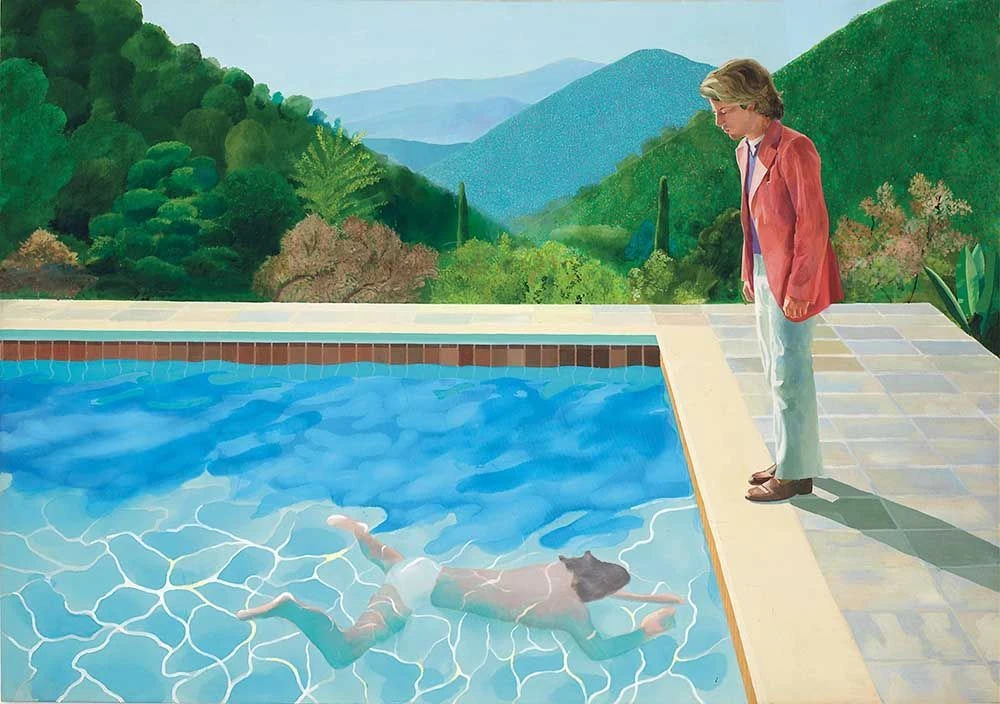
He taught briefly at Maidstone College of Art, then held teaching posts at universities in Iowa, Colorado and California. In 1964 he moved to Los Angeles. The city’s light and lifestyle became a major subject: using the comparatively new medium of acrylic, he painted swimming pools in vivid colours. Works such as A Bigger Splash (1967) made the pool a distinctive setting for experiments in surface, composition and the depiction of water.
Portraits, prints and pictures assembled from photographs
Hockney returned to portraiture throughout his career. From 1968 he painted friends, relatives and other familiar subjects in a realistic style, often in pairs. His portraits include fashion designer Celia Birtwell and her husband Ossie Clark, with their cat Percy, in Mr. and Mrs. Clark and Percy (1970–71). He also repeatedly painted himself, producing more than 300 self-portraits. In 2016, the Royal Academy presented 82 portraits and a still life, bringing together work made across several decades.
Printmaking was another continuing strand, from early lithographs and etchings to later collaborations with the printer Aldo Crommelynck. Hockney made illustrated sequences including A Rake’s Progress, based on Hogarth, and prints inspired by poems by C. P. Cavafy and Wallace Stevens. His work in this field was not a side project: it gave him another way to test how images could be made and organised.
In the early 1980s, he began making photographic collages he called “joiners”. Using multiple photographs of a subject, taken from different viewpoints and at slightly different times, he assembled composite images such as Pearblossom Highway #2. Their shifting perspectives echoed aspects of Cubism and questioned the idea that a single camera view could capture a place. Hockney first explored this approach with Polaroid photographs and later with commercially processed colour prints.
Technology remained a practical tool rather than a departure from observation. In 1985 he used the Quantel Paintbox to draw directly on a screen. From 2009 he produced hundreds of portraits, still lifes and landscapes on an iPhone and iPad, often sending the images to friends. He also used an iPad to design the hawthorn-blossom window at Westminster Abbey, unveiled in 2018 to mark the reign of Elizabeth II. His digital work extended his longstanding interest in drawing into new formats.
Yorkshire landscapes and the scale of the stage
Although California shaped much of his public image, Hockney repeatedly returned to Yorkshire. From the 1990s he visited the county more often, and painted its countryside outdoors. His large landscape Bigger Trees Near Warter, made from 50 canvases, was shown at the Royal Academy in 2007. The following year he donated it to Tate, describing it as a painting of England. In 2012 the Royal Academy’s A Bigger Picture exhibition brought together more than 150 works, including Yorkshire landscapes, watercolours and iPad drawings; it drew more than 600,000 visitors before travelling to galleries in Europe.
Hockney also carried his visual imagination into theatre. His stage designs included productions at the Royal Court Theatre and Glyndebourne, as well as opera productions for the Metropolitan Opera in New York and the Royal Opera House in London. He designed sets and costumes for works including Stravinsky’s The Rake’s Progress and Mozart’s The Magic Flute. Designing for the stage required him to think about space, colour and movement on a scale different from that of a painting, while keeping those elements central to the experience.
His career was marked by major exhibitions and honours. Tate Britain’s 2017 retrospective, staged in his 80th year, was the most visited exhibition in the gallery’s history, according to the article. Hockney was elected a Royal Academician, appointed a Member of the Order of the Companions of Honour in 1997 and appointed to the Order of Merit in 2012. In November 2018, Portrait of an Artist (Pool with Two Figures) sold for $90 million, then a record auction price for a work by a living artist. Hockney died in London on 11 June 2026, aged 88.
Why David Hockney deserves a place in British Legacy
Hockney’s British legacy is rooted in both place and practice. Bradford was his birthplace and the starting point of his formal art education; later, the Yorkshire countryside became the subject of substantial bodies of work. Bigger Trees Near Warter, painted across 50 canvases and donated to Tate, joined an ambitious contemporary artwork to a recognisable English landscape. His return to Yorkshire did not mean retreating from experiment: he made paintings, watercolours and digital drawings of the region, and presented them together in exhibitions that brought large audiences to his work.
His importance also lies in the breadth of ways he made images. Hockney worked across painting, prints, photography, collage and digital drawing, while applying his visual ideas to opera and theatre design. The iPad drawings and Westminster Abbey window show how he brought new tools into established artistic and public settings; his printmaking and “joiners” show a sustained interest in the structure of pictures and the limits of a single viewpoint. His international reputation and honours accompanied a career that remained closely connected to British art institutions, from the Royal College of Art and Royal Academy to Tate and Westminster Abbey. That combination of Yorkshire subject matter, institutional presence and restless experimentation gives his work a specific place in British cultural history.
Sources
David Hockney — Wikipedia, revision 1376796197
Adapted in part from David Hockney by Wikipedia contributors, under CC BY-SA 4.0. Text has been edited and combined with the existing article; this adapted text is shared under the same licence. Contributor history.
.jpg)