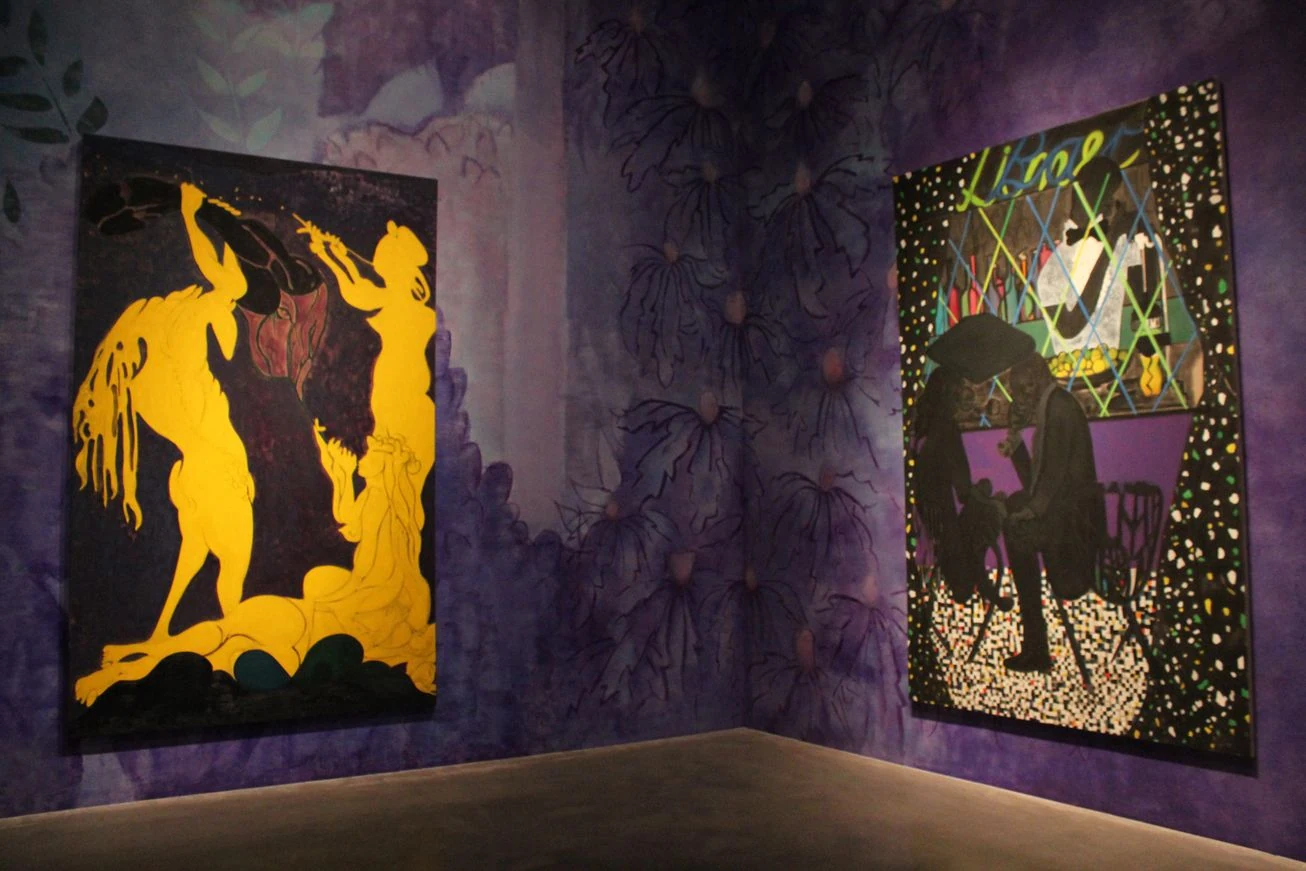
Chris Ofili’s paintings make materials part of their argument. Oil paint, resin, glitter, beads and lumps of elephant dung can sit together in layered compositions that draw on varied visual traditions and resist easy classification. The Manchester-born artist came to national attention through exhibitions associated with the Young British Artists, won the Turner Prize in 1998 and represented Britain at the Venice Biennale in 2003. His career connects British art education and institutions with a practice that has continued to change since he moved to Trinidad.
Manchester, London and an education in art
Born in Manchester on 10 October 1968, Ofili is the son of May and Michael Ofili, who are of Nigerian descent. He attended St Pius X High School for Boys and Xaverian College in Manchester, then took an art foundation course at Tameside College in Ashton-under-Lyne. In 1988 he began studying at the Chelsea School of Art in London, where he remained until 1991, before moving on to the Royal College of Art. During his final year at the Royal College, he received a one-year exchange scholarship to Universität der Künste Berlin, which he began in autumn 1992.
Another scholarship took him to Zimbabwe in 1992. There he studied cave paintings, an experience that had an effect on his developing style. The evidence of his early career is not a single, fixed visual formula: it is an accumulation of influences, materials and references. Ofili’s early work was influenced by artists including Jean-Michel Basquiat, Georg Baselitz, Philip Guston and George Condo. At Chelsea he also became friends with the painter Peter Doig, who was then undertaking graduate work.
Building paintings from layers
Ofili’s work often builds its image through layers of paint, resin, glitter, collage and other materials, including elephant dung. Beads and cut-outs from pornographic magazines have also formed part of his visual vocabulary. These are not simply additions to a conventional painted surface: they contribute to the way a work is composed and read. The combination of materials allows exuberant colour and intricate pattern to coexist with references to popular culture, race and sexuality.
His art has been described as punk art. In paintings that refer to blaxploitation films and gangsta rap, Ofili has used humour to question racial and sexual stereotypes. His Harems series, for example, arranges a male figure with as many as four women on either side. The small watercolours he made between 1995 and 2005 offer a different scale and pace: each is about 9½ by 6½ inches and was produced in a single sitting. Many show heads of men and women; others depict flowers or birds.
Exhibitions, recognition and public debate
Exhibitions organised by Charles Saatchi helped establish Ofili’s reputation, as did the travelling exhibition Sensation in 1997. He became recognised as one of the few British artists of African or Caribbean descent to break through as part of the Young British Artists group. His work had already appeared in the 1995 exhibition Brilliant! New Art from London at the Walker Art Center. Solo exhibitions followed, including one at Southampton City Art Gallery in 1998.
In 1998, Ofili won the Turner Prize. Among the works associated with that period is No Woman No Cry, also dated 1998. The painting is a tribute to Doreen Lawrence, whose son Stephen Lawrence was murdered in a racially motivated attack in London. Its image of a weeping woman includes images of Stephen’s face in her tears, connecting private grief with a public story. The work’s emotional subject and layered surface place personal loss alongside the visual complexity that marks Ofili’s wider practice.
The Holy Virgin Mary, made in 1996, brought a different kind of attention. The painting depicts a Black Madonna amid imagery drawn from blaxploitation films, cut-outs from pornographic magazines and elephant dung shaped to recall figures of angels. When the work was shown in New York as part of Sensation in 1999, it became the focus of a public dispute between the city’s mayor, Rudy Giuliani, and the Brooklyn Museum of Art. That controversy placed arguments about art, public institutions and offence around one painting; it also made clear that Ofili’s use of materials and images could not be separated from the debates it provoked.
From the British Pavilion to Trinidad
In 2003, Ofili was selected to represent Britain at the 50th Venice Biennale. His contribution to the British Pavilion, Within Reach, was made in collaboration with architect David Adjaye. The commission extended a career rooted in British training and exhibitions into an international setting, without fixing the artist to one period or style.
Ofili first visited Trinidad in 2000, attending a painting workshop in Port of Spain. He moved there permanently in 2005 and maintains a studio in the city. After the move, he began making blue paintings inspired by the Jab Jab, or “blue devils”, who take part in Trinidad and Tobago Carnival, as well as by the German and Russian Expressionist group Der Blaue Reiter. These works often use a silver acrylic ground beneath layers of dark oil pigment. At the New Museum in New York, later paintings in this series were shown in a dimly lit room, where viewers had to adjust their eyes to make out the images.
Ofili’s career has continued to span different institutions and places. Tate Britain presented the most extensive exhibition of his work to date in 2010. The New Museum presented his first major solo exhibition in the United States in 2014, titled Chris Ofili: Night and Day. His honours include appointment as a Commander of the Order of the British Empire in the 2017 New Year Honours for services to art. His practice, meanwhile, has continued to draw on the settings and visual sources around him rather than simply repeat the work that first brought him prominence in Britain.
Why Chris Ofili deserves a place in British Legacy
Ofili’s place in British Legacy rests on a career that changed what a prominent British painting practice could look like. Trained at Chelsea and the Royal College of Art, he emerged through exhibitions in Britain and won the Turner Prize in 1998. His work combines painting with materials such as resin, glitter, beads and elephant dung, and draws on sources ranging from cave paintings to blaxploitation films and gangsta rap. The result is not just a striking surface: his use of popular imagery and humour has provided a way to question racial and sexual stereotypes within contemporary art.
His British significance is also visible in the public life of his work. No Woman No Cry connects the grief of Doreen Lawrence to the murder of her son, Stephen Lawrence, while The Holy Virgin Mary became the subject of a public dispute over art and offence. In 2003, Ofili represented Britain at the Venice Biennale, carrying that distinctive practice into the British Pavilion. His later move to Trinidad brought new visual influences into the work, including Carnival’s Jab Jab figures, without erasing the British education and recognition that shaped his public career. Taken together, these achievements offer a specific account of British art as both institutionally grounded and open to complex histories, materials and identities.
Sources
Adapted in part from Chris Ofili by Wikipedia contributors, under CC BY-SA 4.0. Text has been edited and combined with the existing article; this adapted text is shared under the same licence. Contributor history.