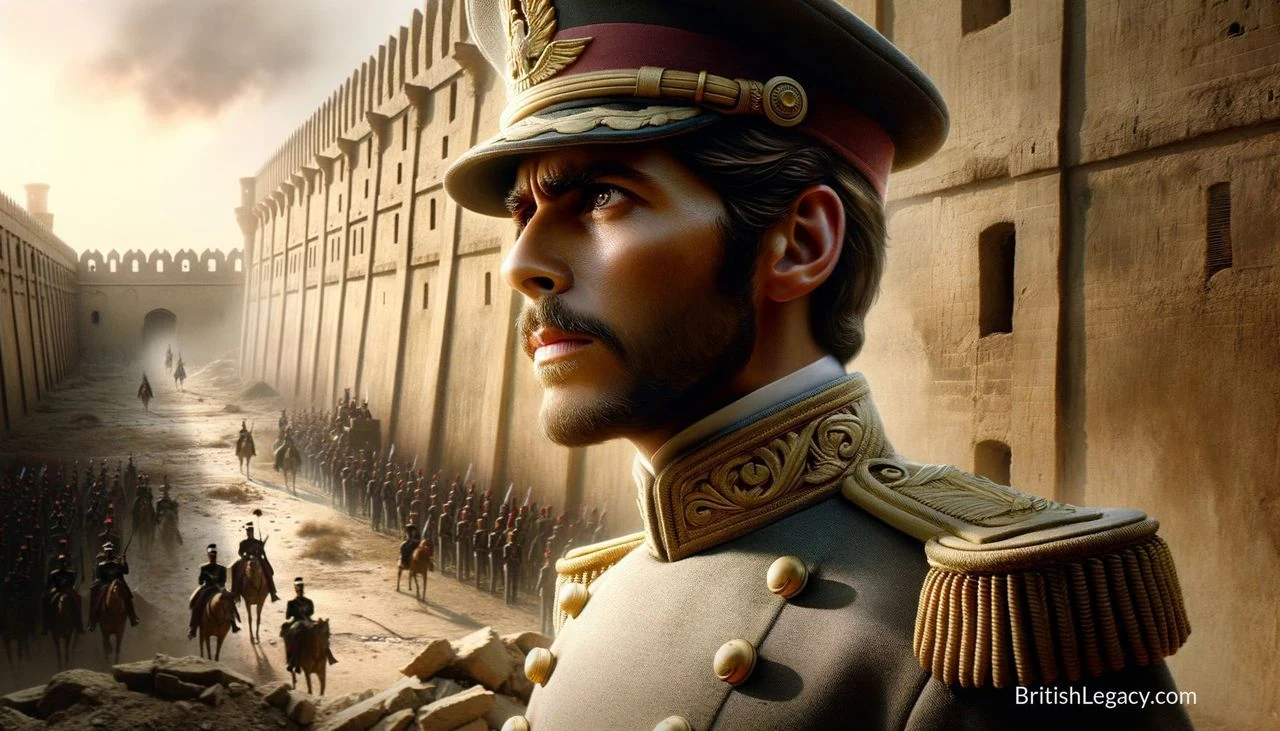
Charles George Gordon’s reputation was made in two wars fought far from Britain. In China, he commanded the Ever Victorious Army against the Taiping rebels; in Sudan, he remained in besieged Khartoum after being sent to help organise an evacuation. His death there in January 1885 turned a complex military career into a national story of heroism. That story reflected both his courage and the power of the press, and has never been the whole account.
A Royal Engineers officer
Gordon was born in Woolwich, Kent, on 28 January 1833, the son of Major General Henry William Gordon and Elizabeth Gordon. Military service ran through the family: his father was an Army officer, and Gordon and his brothers all entered the Army. He attended the Royal Military Academy at Woolwich and received his commission in the Royal Engineers in 1852. The engineers’ work included reconnaissance, fortification and other hazardous duties, a demanding grounding for an officer who would spend much of his career in active service.
During the Crimean War, Gordon served at the siege of Sevastopol, where his engineering duties included mapping Russian fortifications under fire. He also took part in the expedition to Kinburn. After the war, he worked on international boundary commissions in Bessarabia and Armenia, before returning to Britain and becoming an instructor at Chatham. These assignments combined military service with surveying and the practical work of defining borders.
Command in China
Gordon’s best-known Chinese service came during the Taiping Rebellion, a civil war against the Qing dynasty. In 1863, he took command of the Ever Victorious Army, a force of Chinese soldiers led by European officers. He inherited a force whose earlier commanders had struggled with discipline and reliability. Gordon insisted that its men be paid, tried to prevent looting, and treated prisoners humanely in the hope that opponents would surrender rather than fight on.
He also adapted his tactics to the landscape. The canals and rivers that divided the countryside could carry men and supplies, rather than simply obstruct an advance. In May 1863, he used an armed paddle steamer and a flotilla of boats to move troops through the waterways towards Quinsan. The town fell after the operation opened a route into its defences. His force later took Kunshan and Suzhou, and fought at Changzhou. Gordon’s record was not an unbroken sequence of uncomplicated victories: after Suzhou surrendered, imperial troops executed prisoners despite his promise that they would be treated humanely. Gordon was furious, and the breach of that promise helped bring his command to a halt for a time.
The Ever Victorious Army was disbanded in 1864. Gordon declined a substantial imperial gift, and his service brought recognition from both the Qing court and the British government. In Britain, newspaper coverage made him widely known as “Chinese Gordon”. His Chinese reputation, however, cannot be reduced to British praise: he had served the Qing government against a rebellion, and accounts of his place in Chinese history differ from the Victorian celebration that took hold at home.
Reform and limits in Sudan
In 1873, with British government approval, Gordon entered the service of the Khedive of Egypt. He became governor of Equatoria, a southern province of the Egyptian-ruled Sudan, and later Governor-General of the Sudan. He tried to suppress the slave trade and reform an administration undermined by corruption and resistance from officials. He also explored parts of the region and established posts along the Nile. His work was constrained by the very system he served: local officials and traders could obstruct his orders, while the Egyptian government lacked the resources and, at times, the will to support his reforms.
Gordon’s hostility to the slave trade was genuine, but his role was not that of an independent humanitarian acting outside empire. He was an administrator employed by the Egyptian state, whose rule in Sudan was itself oppressive. His efforts to curb abuses repeatedly collided with officials who profited from them. He left the Sudan in 1879, having failed to make the changes he had sought, and resigned his appointment.
In January 1884, as the Mahdist revolt advanced and the Egyptian government decided to abandon Sudan, the British government sent Gordon to Khartoum to report on how the evacuation could be carried out. He arrived in February. The distinction between an advisory mission and executive authority became contested, but Gordon did not leave with the people he had been sent to help evacuate. Instead, he stayed in Khartoum and organised its defence as the Mahdi’s forces closed in.
The siege and the making of a hero
Gordon arranged for about 2,500 civilians to be evacuated before the city was isolated. He strengthened its defences and used armed steamers on the Nile, while sending dispatches that made his position and his conflict with government policy matters of public debate in Britain. The siege began in March 1884 and lasted for almost a year. The British government eventually sent a relief expedition, but it reached Khartoum on 28 January 1885, two days after the city had fallen.
Gordon was killed when Mahdist forces captured Khartoum on 26 January 1885. The precise circumstances of his death are uncertain. Popular accounts pictured him in ceremonial dress, facing his attackers with only a cane; other accounts, including testimony attributed to people in the city, describe him armed and fighting. The familiar image of a solitary martyr was powerful, but should not be mistaken for settled fact.
News of his death produced public mourning in Britain and fierce criticism of the government for failing to rescue him. The press had helped build the demand for his mission and then presented his death as a national tragedy. That response made Gordon a symbol of duty and sacrifice, while obscuring the policy dispute behind the siege: the government had planned to withdraw, and Gordon’s decision to remain helped turn an evacuation into a prolonged military crisis.
Memory, service and controversy
Gordon’s British reputation was marked in public places as well as newspapers. A statue by Hamo Thornycroft was erected in Trafalgar Square in 1888, removed in 1943 and later reinstalled on the Victoria Embankment. A statue of Gordon on a camel, commissioned by the Royal Engineers, stands at Chatham. His memorials and the school that became Gordon’s School in Woking record the extent to which Victorian Britain commemorated him as a military and Christian hero.
That image did not go unchallenged. Later writers differed sharply in their assessments of his temperament, judgement and suitability for independent command. Lytton Strachey’s Eminent Victorians offered a famous critical portrait; other biographers have reassessed the evidence and reached different conclusions. The siege itself has also been examined as a case in which an individual’s defiance of government policy, amplified by public campaigning, could shape events. Gordon’s place in history therefore involves more than admiration for personal courage: it requires attention to the consequences of his decisions and to the imperial conflicts in which he served.
Why Charles George Gordon deserves a place in British Legacy
Gordon belongs in British Legacy not because his career fits a simple tale of national virtue, but because it reveals how British military service, imperial government and public memory could become entangled. His command in China brought him international recognition and honours, but also placed him on the Qing side of a civil war. In Sudan, his efforts against the slave trade met persistent obstruction, while his work as an Egyptian governor remained part of a coercive system. Those contradictions matter: they make his story useful for understanding the reach and limits of Victorian power, rather than merely celebrating it.
His final stand at Khartoum had a lasting effect on British public life. Newspapers and popular accounts shaped pressure for intervention, and the relief expedition became a subject of national debate. Gordon’s death then generated memorials, biographies and sharply divided assessments of his character and judgement. The distinction between the uncertain circumstances of his death and the confident legend built around it is especially instructive. Remembering Gordon critically preserves both his demonstrated resolve and the costs of the decisions surrounding him. His legacy offers a way to examine how heroism is made, how imperial policy is contested, and why public commemoration can outlive—and simplify—the events it seeks to honour.
Sources
Charles George Gordon — Wikipedia revision · Charles George Gordon — Wikipedia
Adapted in part from Charles George Gordon by Wikipedia contributors, under CC BY-SA 4.0. Text has been edited and combined with the existing article; this adapted text is shared under the same licence. Contributor history.