
Benjamin Disraeli’s political career crossed the worlds of fiction, parliamentary conflict and imperial diplomacy. He became prime minister twice, helped remake the Conservative Party after its division over the Corn Laws, and led a government that passed a substantial programme of social legislation. He also pursued a more assertive role for Britain abroad, from buying shares in the Suez Canal Company to negotiating at the Congress of Berlin. His record was neither a simple story of reform nor an unbroken success: war, economic pressures and a resurgent Liberal opposition helped bring his second government down.
A writer enters politics
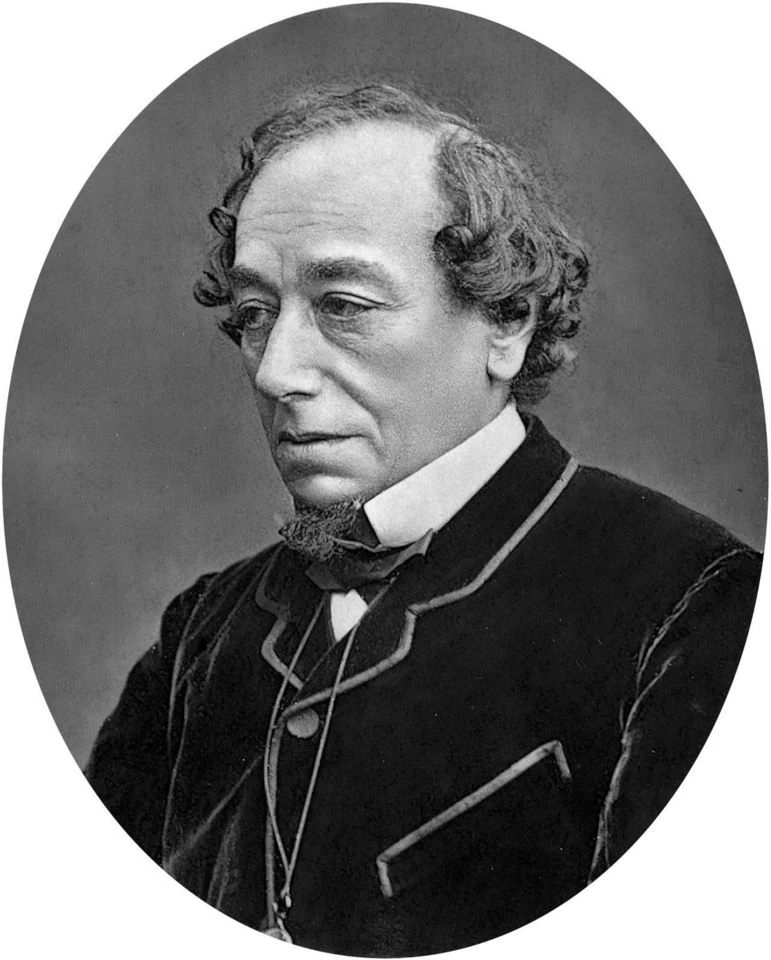
Disraeli was born Benjamin D’Israeli on 21 December 1804 in Bloomsbury, London, the eldest son of Isaac D’Israeli, a literary critic and historian, and Maria Basevi. His family was of Sephardic Jewish mercantile background, with some Ashkenazi Jewish ancestors. After a dispute between his father and the Bevis Marks Synagogue, Isaac left Judaism; Benjamin and his siblings were baptised into the Church of England in 1817. Disraeli was therefore raised as an Anglican from the age of 12, though his Jewish family background remained an important part of how he was understood in public life. He later changed the spelling of his surname from D’Israeli to Disraeli.
He was articled to a firm of solicitors as a teenager, then turned towards literature and politics. His first novel, Vivian Grey, appeared in 1826–27. Its satire caused offence when readers identified people behind its characters, and a failed investment in South American mining companies left him with debts that took years to repay. Writing was both a livelihood and a continuing part of his public identity: he published novels throughout his career, including the political trilogy Coningsby, Sybil and Tancred.
Disraeli’s early attempts to win a parliamentary seat were unsuccessful. He entered the House of Commons in 1837 as a Conservative MP for Maidstone. His maiden speech was interrupted by Daniel O’Connell’s supporters, and it did not establish him as an orator overnight. He later became known for his command of parliamentary debate, but his route to influence ran through years of opposition, party division and financial difficulty. In 1839 he married Mary Anne Lewis, the widow of his former colleague Wyndham Lewis. Their marriage lasted until her death in 1872.
Building a Conservative career
The defining rupture in Disraeli’s early parliamentary career came in 1846, when Robert Peel’s government repealed the Corn Laws. Disraeli opposed the repeal and became a leading figure among the protectionists who broke with Peel. The split left the Conservatives short of experienced leaders. Under Lord Derby, Disraeli served three times as Chancellor of the Exchequer and became a central figure in the party’s parliamentary strategy.
His political ideas combined support for some reforms with a belief in established institutions and a stronger political role for the Conservatives among working people. In the 1840s, he associated with the Young England group, which argued that the landed aristocracy should use its influence to protect the poor from exploitation. He also supported extending the franchise. As Chancellor in Derby’s government, he helped steer the Reform Act 1867 through Parliament. The Act substantially widened the vote for men in borough constituencies, although Disraeli’s reasons and the political consequences of the measure have been debated. It was a decisive moment in his rise and in the development of representative politics.
Disraeli first became prime minister in February 1868, after Derby resigned, but his government lacked a Commons majority. The dispute over the established Church of Ireland gave Gladstone’s Liberals a cause around which to unite, and the Conservatives lost the general election in December. Out of office, Disraeli led the party through the years of Gladstone’s first ministry, writing Lothair and working to strengthen Conservative organisation. In 1874 the Conservatives won a Commons majority, and Disraeli returned to Downing Street.
Legislation at home, influence abroad
Disraeli’s second government, in office from 1874 to 1880, passed measures that addressed housing, public health, education, food standards and the legal position of workers. The Artisans’ and Labourers’ Dwellings Improvement Act 1875 enabled local authorities to borrow for schemes to improve working-class housing. The Public Health Act 1875 consolidated and modernised sanitary provisions. The Sale of Food and Drugs Act 1875 addressed the adulteration of food and medicines. The Employers and Workmen Act 1875 allowed workers and employers to sue over broken employment contracts in civil courts, while the Conspiracy, and Protection of Property Act 1875 protected peaceful picketing and changed the law around trade disputes. The Elementary Education Act 1876 also extended the government’s education measures.
These laws mattered, but they do not make the government a straightforward expression of a settled “One Nation” programme. Disraeli’s priorities were broader and sometimes inconsistent; he did not reverse competitive examinations in the Civil Service introduced under Gladstone, but his appointments could still serve party interests. The legislation nevertheless marked a significant period of government action on living and working conditions.
Foreign affairs offered Disraeli the chance to pursue a more visible British role. In 1875 he arranged the purchase of the Khedive of Egypt’s shares in the Suez Canal Company, using a loan from Lionel de Rothschild rather than waiting for a public funding process. The canal shortened the sea route between Britain and India, making the transaction strategically important to British interests. It was an investment in influence, not an acquisition of the canal itself.
Disraeli also backed the Royal Titles Act 1876, under which Queen Victoria formally took the title Empress of India. The measure reflected the importance his government attached to the imperial relationship and to the monarchy’s public status. In 1876 Victoria made him Earl of Beaconsfield, taking him from the Commons to the House of Lords. His government’s foreign policy reached its most celebrated diplomatic moment at the Congress of Berlin in 1878. Disraeli and his foreign secretary, Lord Salisbury, negotiated there over the settlement following the Russo-Turkish War. The resulting treaty limited the scale of the Bulgarian state proposed at San Stefano and sought terms favourable to British interests. Britain also secured Cyprus under a separate agreement with the Ottoman Empire.
Rivalry, war and defeat
Disraeli’s relationship with William Ewart Gladstone gave Victorian politics one of its defining rivalries. They stood for opposing parties and often sharply different approaches to government and foreign policy. Gladstone’s public campaign against Ottoman actions in Bulgaria helped turn opinion against Disraeli’s policy of maintaining the Ottoman Empire as a counterweight to Russia. Their clash was not simply a contest of personalities: it concerned Britain’s responsibilities and interests abroad, and the conduct of its government at home.
After the Congress of Berlin, events increasingly weakened Disraeli’s position. The Second Anglo-Afghan War and the Anglo-Zulu War brought military costs and damaging news. In southern Africa, British troops suffered a major defeat at Isandlwana in 1879 before later defeating the Zulu at Ulundi. Disraeli had to answer for the consequences of decisions made by officials overseas, including actions taken without his prior agreement. At home, poor harvests and falling grain prices hurt farmers, while he refused calls to restore the Corn Laws. Gladstone’s campaigning helped turn discontent into a Liberal victory in the 1880 general election.
Disraeli resigned and returned to opposition as leader of the Conservatives in the Lords. In his final months he continued to write, completing Endymion, published in 1880. He died in London on 19 April 1881, aged 76. Queen Victoria sent primroses to his funeral at Hughenden, and he was buried with his wife in the church vault on the estate. His novels, political record and public image continued to shape how later generations remembered him.
Why Benjamin Disraeli deserves a place in British Legacy
Disraeli’s place in British history rests on more than the distinction of having served twice as prime minister. He helped steer the Conservative Party through the rupture caused by the repeal of the Corn Laws and, as Chancellor, played a central role in passing the Reform Act 1867, which greatly widened the male electorate in borough constituencies. His second government enacted a connected body of legislation on housing, sanitation, food standards, education and workers’ rights. These measures brought public authority more directly into questions that shaped everyday conditions, even though the scale and motives of his reforming politics remain subjects for historical debate.
His impact also reached beyond Britain’s domestic institutions. The Suez Canal share purchase and the diplomacy of the Congress of Berlin show how his government sought to protect British strategic interests and assert influence in a changing European order. That policy had consequences for people and territories beyond Britain, and should be remembered as imperial politics rather than celebrated without qualification. Disraeli’s writing gives another dimension to his legacy: novels such as Sybil engaged with class divisions, while his own political career repeatedly joined literary ambition to parliamentary action. Taken together, these achievements and tensions make him an important figure in a British Legacy account of how party politics, social legislation, literature and empire intersected in the Victorian era.
Sources
Benjamin Disraeli (revision 1379423180)
Adapted in part from Benjamin Disraeli by Wikipedia contributors, under CC BY-SA 4.0. Text has been edited and combined with the existing article; this adapted text is shared under the same licence. Contributor history.

_cropped.png)