
Barbara Hepworth made sculpture that asks the eye to move around and through it. By piercing carved forms and setting curves against open space, she developed a modernist language that was both abstract and closely attentive to material. Her career linked Wakefield, London and St Ives, while works including Single Form carried her art into an international public setting.
Training in Yorkshire and London
Jocelyn Barbara Hepworth was born in Wakefield on 10 January 1903, the eldest child of Gertrude and Herbert Hepworth. Her father was a civil engineer who worked for the West Riding County Council. Hepworth attended Wakefield Girls’ High School and won a scholarship to Leeds School of Art in 1920. There she met Henry Moore, another Yorkshire sculptor; the two became friends and maintained a professional rivalry.
In 1921 she won a county scholarship to study at the Royal College of Art in London, where she remained until receiving her diploma in 1924. The path was not straightforward: sculpture was a male-dominated field, but Hepworth secured a place in its professional institutions and established a career of her own. A West Riding travel scholarship took her to Florence in 1924. She was runner-up for the Prix de Rome, which was won by John Skeaping, and travelled with him to Siena and Rome. In Florence she learnt marble carving from the sculptor Giovanni Ardini.
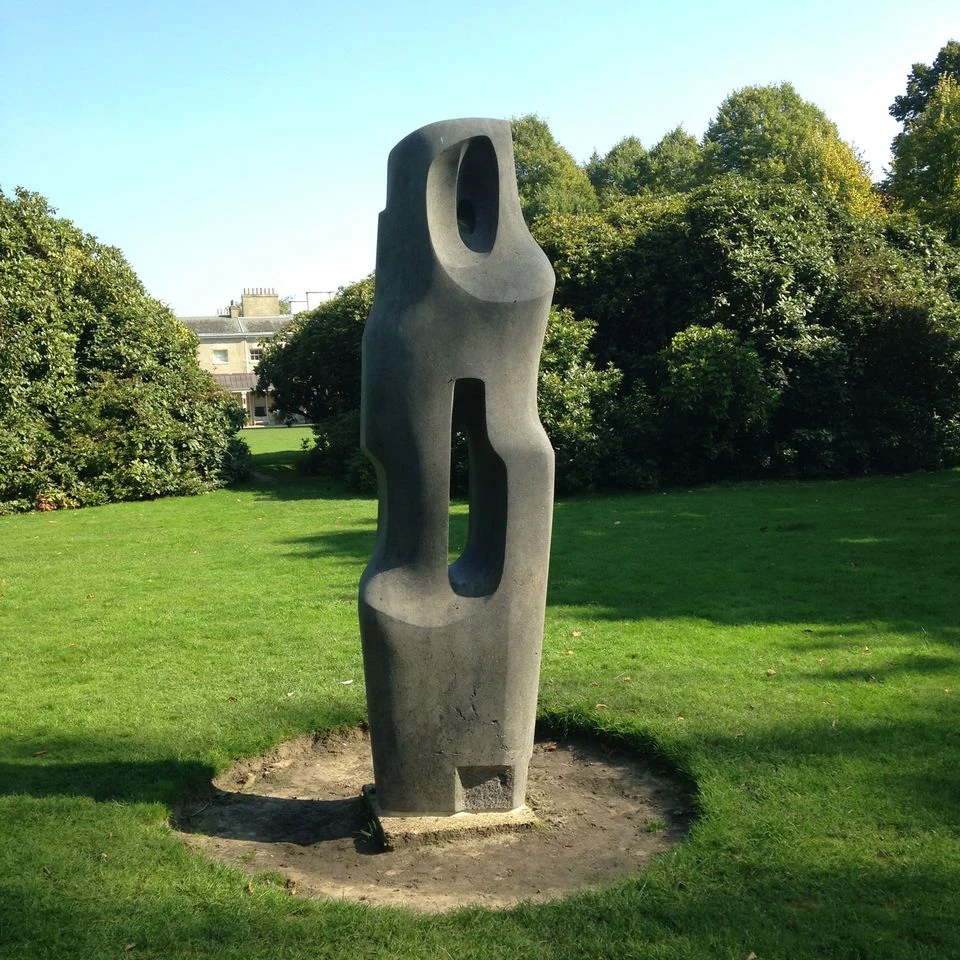
Hepworth and Skeaping married in May 1925 and returned to London the following year, exhibiting their work from their flat. Their son Paul was born in 1929. Hepworth’s early sculpture already showed an interest in abstraction and in developments beyond Britain. In 1931 she made pierced figures, a formal approach that became characteristic of her work and was later associated with Henry Moore’s sculpture too.
Abstraction, artists and family life
In 1931 Hepworth met and fell in love with the painter Ben Nicholson. She and Skeaping divorced in 1933; Hepworth and Nicholson married in 1938. Their artistic lives intersected with a wider circle of modern artists in London and abroad. In 1933, Hepworth travelled with Nicholson to France, where they visited the studios of Jean Arp, Pablo Picasso and Constantin Brâncuși. She became involved with Abstraction-Création, a Paris-based art movement.
That year she also co-founded Unit One with Nicholson, Paul Nash, Herbert Read and Wells Coates. The group sought to bring abstraction and surrealism into British art. Hepworth helped introduce British audiences to continental work in 1937, designing the layout for Circle: An International Survey of Constructivist Art, a substantial survey edited by Nicholson, Naum Gabo and Leslie Martin.
Hepworth and Nicholson had triplets in 1934: Rachel, Sarah and Simon. Her ability to continue making work while caring for a young family was important to her own account of being an artist. In a statement quoted in her biography, she argued that domestic and family life need not deprive a woman artist of creative work, provided she continued to work each day. Rachel and Simon later became artists.
St Ives: work, community and change
At the outbreak of the Second World War in 1939, Hepworth, Nicholson and their children moved to St Ives in Cornwall. The town became a refuge for artists during the war, and Hepworth remained there for the rest of her life. From 1949 she worked at Trewyn Studios, a place she described as offering a studio, yard and garden where she could work outdoors. In 1949 she and Nicholson helped found the Penwith Society of Arts, alongside 17 other artists, including Peter Lanyon and Bernard Leach.
Sculpture was not her only practice. Hepworth was also a skilled draughtsperson. After her daughter Sarah was hospitalised in 1944, surgeon Norman Capener invited her to observe operations. Between 1947 and 1949 she made nearly 80 drawings of operating rooms in chalk, ink and pencil. She saw a connection between the concentration and approach of surgeons and those of artists. The drawings show how her work could respond to a particular environment without abandoning her enduring interest in form.
In 1950, Hepworth’s work appeared in the British Pavilion at the Venice Biennale, alongside work by Matthew Smith and John Constable. The following year, two public works, Contrapuntal Forms and Turning Forms, were shown at the Festival of Britain. Contrapuntal Forms, made for the Festival, comprised two Irish limestone figures. It was first displayed on London’s South Bank and later placed at Glebelands in Harlow, where it remains.
After her divorce from Nicholson in 1951, Hepworth broadened her use of materials, working in bronze and clay as well as stone and wood. She used her St Ives garden to view large bronzes, shaping how the works met their surroundings. In 1960 she bought the former Palais de Danse across the road from Trewyn Studios, giving her more space for large-scale commissions. She also explored lithography, producing print suites in 1969 and 1971; the latter, The Aegean Suite, drew on a trip to Greece with Margaret Gardiner in 1954.
Public sculpture and international recognition
Hepworth’s sculpture often makes the space inside a work as significant as its outer surface. Among her works, Oval Form (Trezion) and Single Form show how she carried that concern into bronze. Single Form was made in memory of Dag Hammarskjöld, the United Nations Secretary-General and a friend and collector of her work. Commissioned after his death, it stands in the plaza at the United Nations headquarters in New York. Its public setting gave Hepworth’s abstract sculpture a place in a civic landscape far beyond the studio.
She received the Grand Prix at the São Paulo Art Biennial in 1959 and was awarded the Freedom of St Ives in 1968. That year she was also inducted into Gorsedh Kernow, the Cornish cultural association, with the bardic name Gravyor, meaning “Sculptor”. She was made a CBE in 1958 and a DBE in 1965, and received honorary degrees from universities including Birmingham, Leeds, Exeter, Oxford, London and Manchester.
Hepworth died in an accidental fire at Trewyn Studios on 20 May 1975, aged 72. The studio and home later became the Barbara Hepworth Museum, which came under Tate’s control in 1980. In Wakefield, the Hepworth opened in 2011, bringing a major public collection of her work to her home city. Tate Britain’s 2015 retrospective included more than 70 works, from major carvings and bronzes to photographs and a 1930s self-photogram.
Why Barbara Hepworth deserves a place in British Legacy
Hepworth’s place in British Legacy rests on the particular achievement of her sculpture and on the institutions and public spaces through which it continues to be encountered. She helped make abstraction a substantial part of British art: as a co-founder of Unit One, she worked alongside artists and critics seeking to unite abstraction and surrealism, while her design for Circle brought Constructivist art to a wider British readership. Her own pierced forms made the relationship between solid material and empty space a central sculptural problem, explored through different materials and at many scales.
Her career also gives this legacy a clear geography. Trained in Yorkshire and London, Hepworth moved to Cornwall during the war and made St Ives her home and working centre. There she contributed to an artistic community, helped establish the Penwith Society and developed sculpture in a studio and garden that became part of her working practice. Public works such as Contrapuntal Forms in Harlow and Single Form at the United Nations show the reach of that practice: one is rooted in a British new town, the other addresses an international audience. The museum in St Ives and the Hepworth in Wakefield keep her work accessible in the places that shaped her story. Together, her art, teaching-by-example through public presence, and lasting cultural institutions make her an important part of Britain’s modern artistic inheritance.
Sources
Barbara Hepworth — revision 1373792674 · Barbara Hepworth
Adapted in part from Barbara Hepworth by Wikipedia contributors, under CC BY-SA 4.0. Text has been edited and combined with the existing article; this adapted text is shared under the same licence. Contributor history.
_by_Erling_Mandelmann.jpg)