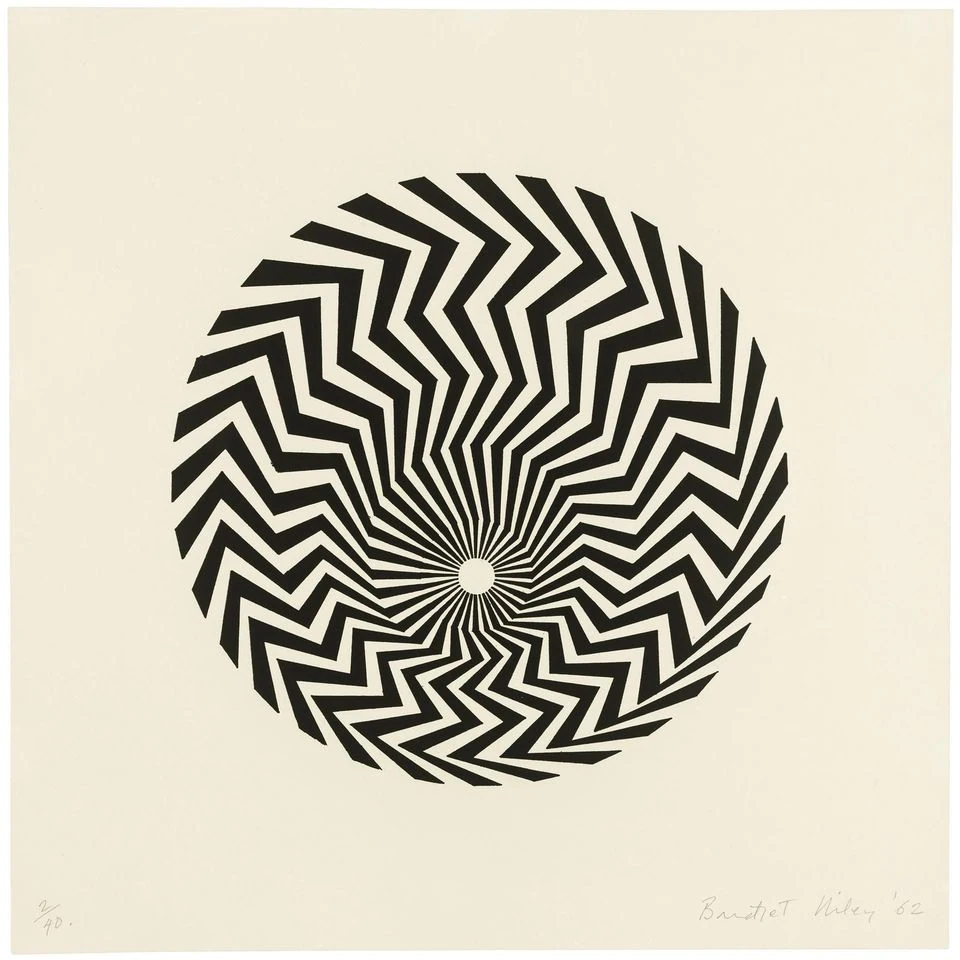
Bridget Riley’s paintings make still surfaces seem to move. Repeated curves, stripes and geometric shapes set the eye working: a field of black and white can appear to pulse or buckle, while carefully organised colour can shimmer across a canvas. Riley became one of the best-known artists associated with Op art, but her practice was not simply a matter of optical tricks. It grew from sustained study of how colour and form shape what we see.
From Norwood to art school
Bridget Louise Riley was born in Norwood, London, on 24 April 1931. Her father, John Fisher Riley, was an Army officer before becoming a printer and running his own business. In 1938, he moved the business and his family to Lincolnshire. When the Second World War began and her father was mobilised, Riley, her mother and her sister, Sally, moved to a cottage in Cornwall. An aunt who had studied at Goldsmiths’ College shared the cottage, and Riley attended talks given by retired teachers and other speakers.
After Cheltenham Ladies’ College, where she studied from 1946 to 1948, Riley attended Goldsmiths’ College from 1949 to 1952 and the Royal College of Art from 1952 to 1955. She began her career in teaching, including work with children at the Convent of the Sacred Heart in Harrow. She also taught at Loughborough School of Art, Hornsey College of Art and Croydon College of Art. Between 1956 and 1959, she nursed her father after he was seriously injured in a car crash. Later, she worked in a glassware shop and as a part-time illustrator at the J. Walter Thompson advertising agency.
Riley’s early paintings were figurative and semi-impressionist. Her work at the advertising agency brought her towards pointillism, in which distinct dots of colour combine in the viewer’s eye. A visit to the Whitechapel Gallery’s 1958 Jackson Pollock exhibition also left an impression. In 1959 she met painter and educator Maurice de Sausmarez, who became a friend and mentor. His encouragement led her to look closely at artists including Paul Klee and Georges Seurat, and at movements such as Futurism and Divisionism.
Learning to see
In 1960, Riley travelled in Italy, where she and de Sausmarez visited the Venice Biennale. She painted Pink Landscape, a pointillist study of the countryside near Radicofani. Her close engagement with Seurat’s work helped her investigate how colour could be organised to affect perception. Riley later described her copy of Seurat’s The Bridge at Courbevoie as a tool: a way to examine how a painting works, rather than an end in itself.
After her relationship with de Sausmarez ended in 1960, Riley experienced a personal and artistic crisis. Her experiments then led towards the black-and-white geometric paintings for which she first became widely known. In works such as Kiss (1961), carefully repeated forms unsettle the eye. Between 1961 and 1965, she worked mainly with black and white, sometimes introducing gradations of grey. The curved line repeated across Fall, for example, creates a field of changing visual rhythms.
Movement in Squares is another early work that demonstrates how a regular pattern can disturb the sense of space. Riley’s paintings are meticulously planned: she develops compositions through preparatory drawings and collage, then works with assistants who paint the finished canvases under her direction. The precision of the surface is matched by the complexity of the experience. Viewers may perceive movement, vibration or colour where the painted elements remain fixed.
Colour, exhibitions and public attention
Riley began investigating colour in 1967, the year she made her first stripe painting. Following a trip to Egypt in 1980–81, she developed what she called her Egyptian palette, drawing on the colours of the landscape and its ancient and modern decoration. Works from the following years explore the effects of colour through shimmering lines and interlocking patterns. In Delos (1983), blues, turquoise and emerald alternate with yellows, reds and white. Later, she returned to diagonal forms, using sequences of parallelograms to animate fields of stripes. Shadow Play is among the works associated with her colour-based practice.
The 1965 exhibition The Responsive Eye at New York’s Museum of Modern Art brought Riley and Op art to a wide international audience. Her painting Current (1964) appeared on the exhibition catalogue’s cover. The experience also exposed a practical problem: in the United States at the time, the lack of copyright protection allowed commercial interests to exploit artists’ work. Riley became disillusioned with such exhibitions, and artists in New York later campaigned for changes to the law.
In 1968, Riley represented Great Britain at the Venice Biennale and became the first British contemporary painter, as well as the first woman, to receive its International Prize for Painting. That same year, she helped establish SPACE—Space Provision Artistic Cultural and Educational—with artist Peter Sedgley and journalist Peter Townsend. The organisation aimed to provide artists with large, affordable studio spaces. Riley also continued to exhibit internationally. Her work featured in the 1970s documenta exhibitions, and a 1999 presentation of early paintings at the Serpentine Gallery renewed interest in her optical experiments. Tate Britain mounted a major retrospective in 2003; a further retrospective, organised with the Hayward Gallery, toured the Scottish National Gallery and Hayward Gallery in 2019–20.
Work beyond the easel
Riley has made temporary murals for the Tate, the Musée d’Art Moderne de la Ville de Paris and the National Gallery. In London, she created three murals at St Mary’s Hospital between 1987 and 2014. A permanent 56-metre mural, commissioned for the hospital’s Queen Elizabeth Queen Mother Wing, was installed in 2014, joining two earlier works there. These public commissions put her investigations of colour and pattern into shared spaces beyond galleries.
She has also contributed as a writer and curator. Riley co-curated the Tate Gallery’s 1996 exhibition Piet Mondrian: From Nature to Abstraction with Sean Rainbird, and, with art historian Robert Kudielka, curated the Hayward Gallery’s 2002 exhibition Paul Klee: The Nature of Creation. In 2010, she selected paintings by artists including Titian, Veronese, El Greco, Rubens, Poussin and Cézanne for an artists’ choice exhibition at the National Gallery. Her interest in the traditions of painting is visible in this work as well as in her own close study of earlier artists.
Recognition of Riley’s career has included the AICA Critics Prize and the John Moores Liverpool Open Section Prize in 1963, and honorary doctorates from Oxford and Cambridge. She was appointed a Commander of the Order of the British Empire in 1974 and became a Member of the Order of the Companions of Honour in 1998. In 2003 she received the Praemium Imperiale. Her honours sit alongside a continuing record of exhibitions, public commissions and support for the arts: she is a patron of Paintings in Hospitals, and the Bridget Riley Art Foundation has funded a fellowship at the British School at Rome since 2016.
Why Bridget Riley deserves a place in British Legacy
Riley’s place in British Legacy rests first on the distinctive achievement of her painting. She made the mechanics of looking central to the work: repeated shapes and precise relationships between colours produce movement and instability without the canvas itself changing. Her path towards that practice was grounded in study, from her early experiments with pointillism to her close attention to Seurat and the later development of her own geometric language. The result is not a single visual effect repeated indefinitely, but an evolving body of work that tests how form, contrast and colour act on perception.
Her contribution also reaches beyond individual paintings. Riley represented Great Britain at the Venice Biennale in 1968 and became the first British contemporary painter and the first woman to win its International Prize for Painting. Through SPACE, she helped address artists’ need for affordable working studios; through murals at St Mary’s Hospital and other institutions, she brought carefully designed colour into public settings. Her work as a curator and her support for Paintings in Hospitals and the British School at Rome add other forms of cultural contribution. Together, these achievements give her British legacy substance: artistic innovation, international recognition and practical engagement with the places and organisations through which art is made and encountered.
Sources
Bridget Riley — Wikipedia revision 1376350551
Adapted in part from Bridget Riley by Wikipedia contributors, under CC BY-SA 4.0. Text has been edited and combined with the existing article; this adapted text is shared under the same licence. Contributor history.