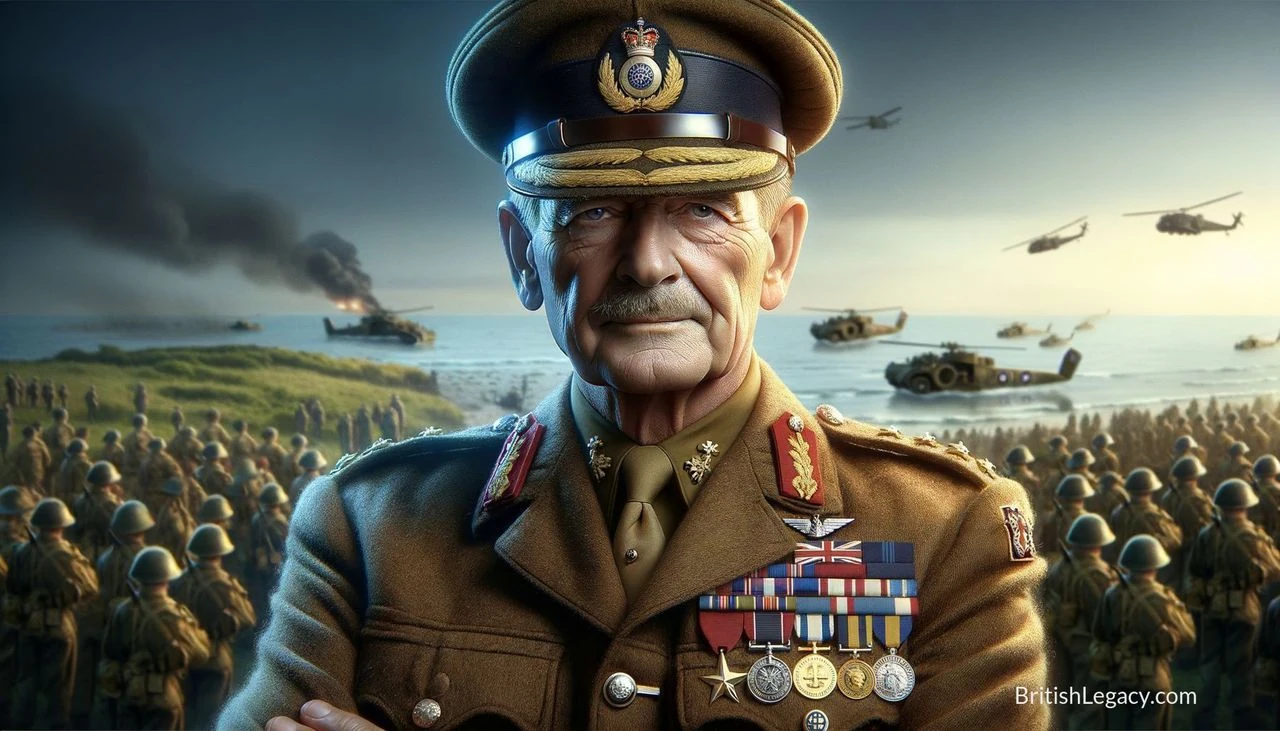
General Sir John Winthrop Hackett’s life crossed military, academic and literary worlds. Born in Perth, Western Australia, he became a British Army officer, commanded the 4th Parachute Brigade during the Allied operation at Arnhem, and later led the British Army of the Rhine and NATO’s Northern Army Group. His career also took in university leadership and writing, including a first-hand account of his escape after being wounded and captured at Arnhem. The details matter: Hackett commanded a brigade there, not the British 1st Airborne Division.
From Perth to the British Army
Born on 5 November 1910, Hackett was known by the nickname “Shan”. His father, also named John Winthrop Hackett, was an Irish Australian newspaper proprietor, editor and politician; his mother was Deborah Drake-Brockman. Hackett’s schooling began in Australia at Geelong Grammar School. He later travelled to London to study painting at the Central School of Art, before reading Greats and Modern History at New College, Oxford.
Hackett’s university studies did not lead to an academic career. He joined the British Army instead, having entered the Supplementary Reserve of Officers in 1931, and was commissioned into the 8th King’s Royal Irish Hussars in 1933. His intellectual interests remained part of his military life: he completed a history thesis on the Crusades and the early Middle Ages, earning a Bachelor of Letters, and qualified as an interpreter in French, German and Italian. He also studied Arabic and eventually became fluent in ten languages.
His early service included Palestine during the Arab revolt and the Trans-Jordan Frontier Force. In the Second World War’s Syria-Lebanon campaign he was wounded and awarded the Military Cross. Later, in North Africa, he commanded C Squadron of the 8th Hussars. When his M3 Stuart tank was hit during the fighting for Sidi Rezegh airfield, he was severely burnt escaping from it. While recovering in Cairo, he helped with the formation of the Long Range Desert Group, the Special Air Service and Popski’s Private Army.
Arnhem: brigade command, injury and escape
In 1944 Hackett raised and commanded the 4th Parachute Brigade for Operation Market Garden, the Allied airborne assault that included the battle at Arnhem. He was a brigadier, not the commander of the British 1st Airborne Division. During the battle, shrapnel from an overhead shellburst severely wounded him in the abdomen. He was taken to St Elizabeth’s Hospital in Arnhem and captured.
A German doctor told Hackett’s British surgeon, Alexander Lipmann-Kessel, that German practice would have been to give a lethal morphine injection in a case considered hopeless. Kessel operated and saved his life. After a period of recovery, Hackett faced another danger: the Germans planned to move him to a prisoner-of-war camp. Dutch resistance workers helped him escape. Piet van Arnhem took him from the hospital to Ede, disguising the journey as a transfer for medical care; Hackett’s bandages were made to look even bloodier to strengthen the pretence that his condition was grave.
A family named de Nooij hid and nursed him at their home in Ede for several months. With the underground’s help, he eventually reached Allied lines. Hackett later described the experience in I Was A Stranger, published in 1977. His account gives the escape its particular human scale: survival depended not only on the wounded officer’s recovery, but on Dutch civilians and resistance members willing to shelter him under occupation.
Building a senior military career
After the war, Hackett returned to service in Palestine during the Palestine Emergency and commanded the Trans-Jordan Frontier Force. The force was disbanded under his direction as part of the British withdrawal from the region. He then continued his education in Graz, studying post-medieval studies, before attending the Staff College at Camberley in 1951.
His subsequent appointments brought command and institutional responsibility. He led the 20th Armoured Brigade and, after promotion to major-general, the 7th Armoured Division. In 1958 he became commandant of the Royal Military College of Science at Shrivenham. Promoted to lieutenant-general in 1961, he took command of Northern Ireland Command and was knighted in 1962. In 1963 he moved to the Ministry of Defence as Deputy Chief of the Imperial General Staff, with responsibility for forces organisation and weapon development. He also became a leading figure in reorganising the Territorial Army, a role that made him unpopular.
In 1966 Hackett was appointed to command the British Army of the Rhine and, in parallel, NATO’s Northern Army Group. His language skills and relationships with foreign officers suited the international responsibilities of those commands. In 1968, shortly before retirement, he wrote to The Times criticising what he saw as the British government’s lack of concern about NATO’s strength in Europe. He signed the letter as a NATO officer rather than as a British commander.
University leadership and writing
Hackett retired from the Army in 1968 and became Principal of King’s College London, holding the post until 1975. He also served as president of the Classical Association in 1971 and the English Association in 1973. Those roles extended a career in which study and public service had repeatedly overlapped: he had brought historical scholarship into his military training, and now led a major London college.
His books ranged from memoir to military analysis and fiction. The Profession of Arms appeared in 1963, and I Was A Stranger recounted his wartime experience. In 1978 he published The Third World War: August 1985, a fictional scenario built around a Red Army invasion of West Germany. He followed it in 1982 with The Third World War: The Untold Story, which expanded the scenario and included more detail from a Soviet perspective. He also appeared in the television documentary In Search of the Trojan War, discussing Homer’s Iliad.
Hackett received the Knight Grand Cross of the Order of the Bath, the Commander of the Order of the British Empire, the Distinguished Service Order and Bar, and the Military Cross. He died on 9 September 1997, aged 86.
Why John Hackett deserves a place in British Legacy
Hackett’s place in British Legacy rests on a career that linked British military service with the wider history of the Second World War and the post-war alliance. He was born in Australia, but served in the British Army from 1933 to 1968, rising to command British forces in Germany and NATO’s Northern Army Group. His appointments included responsibility for military education and forces organisation as well as operational commands. That record gives a specific, evidenced British connection: his contribution was made through service in British institutions and through senior roles in the defence of Britain’s NATO allies.
Arnhem is central to his story, but it should be told accurately. Hackett led the 4th Parachute Brigade, was gravely wounded and captured, and survived because a surgeon operated on him and Dutch resistance members and a local family helped him escape and recover. I Was A Stranger preserved that experience in his own account. His later work as Principal of King’s College London and as an author broadened his legacy beyond military command. Taken together, these achievements show a figure whose life connected service, learning and writing—and whose survival story also records the indispensable help offered by Dutch civilians during the war.
Sources
John Hackett (British Army officer), revision 1379818112 · John Hackett (British Army officer)
Adapted in part from John Hackett (British Army officer) by Wikipedia contributors, under CC BY-SA 4.0. Text has been edited and combined with the existing article; this adapted text is shared under the same licence. Contributor history.