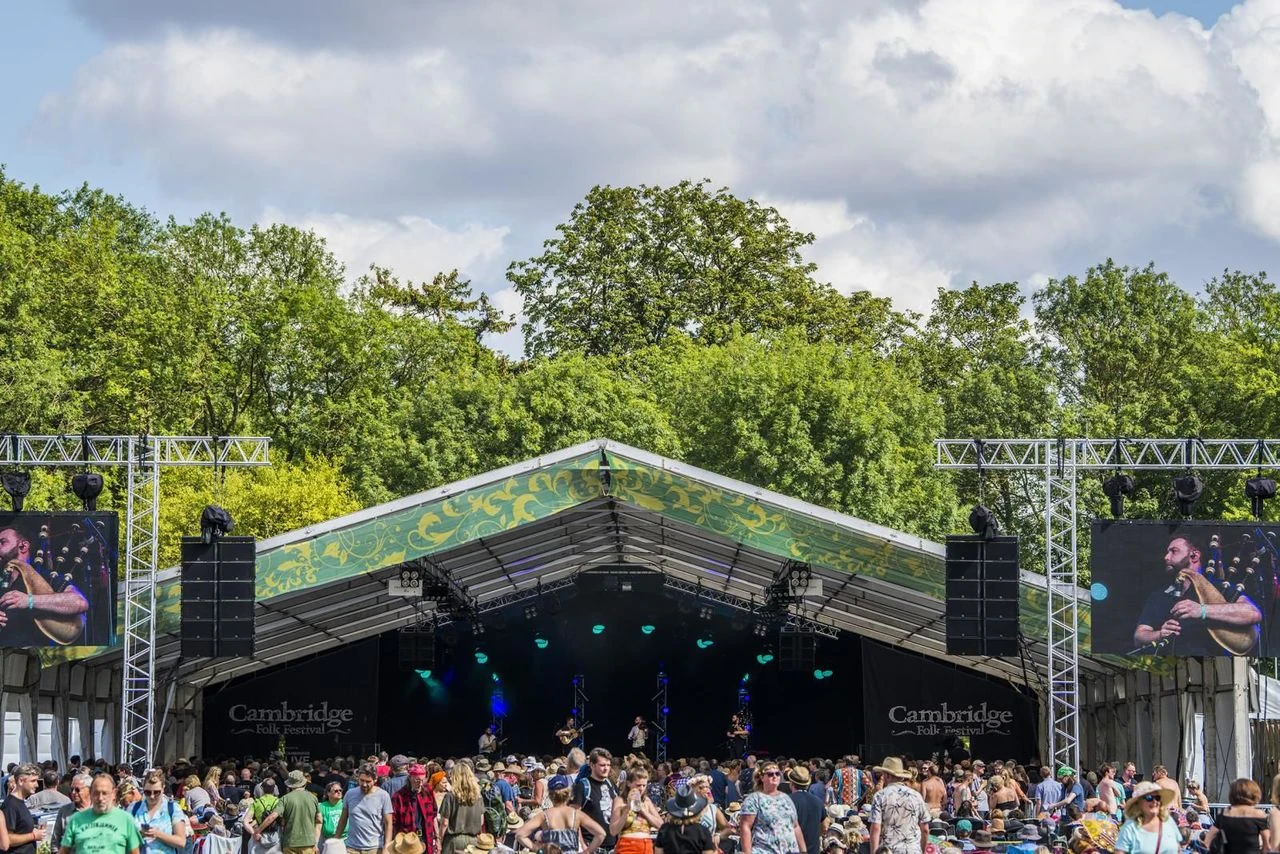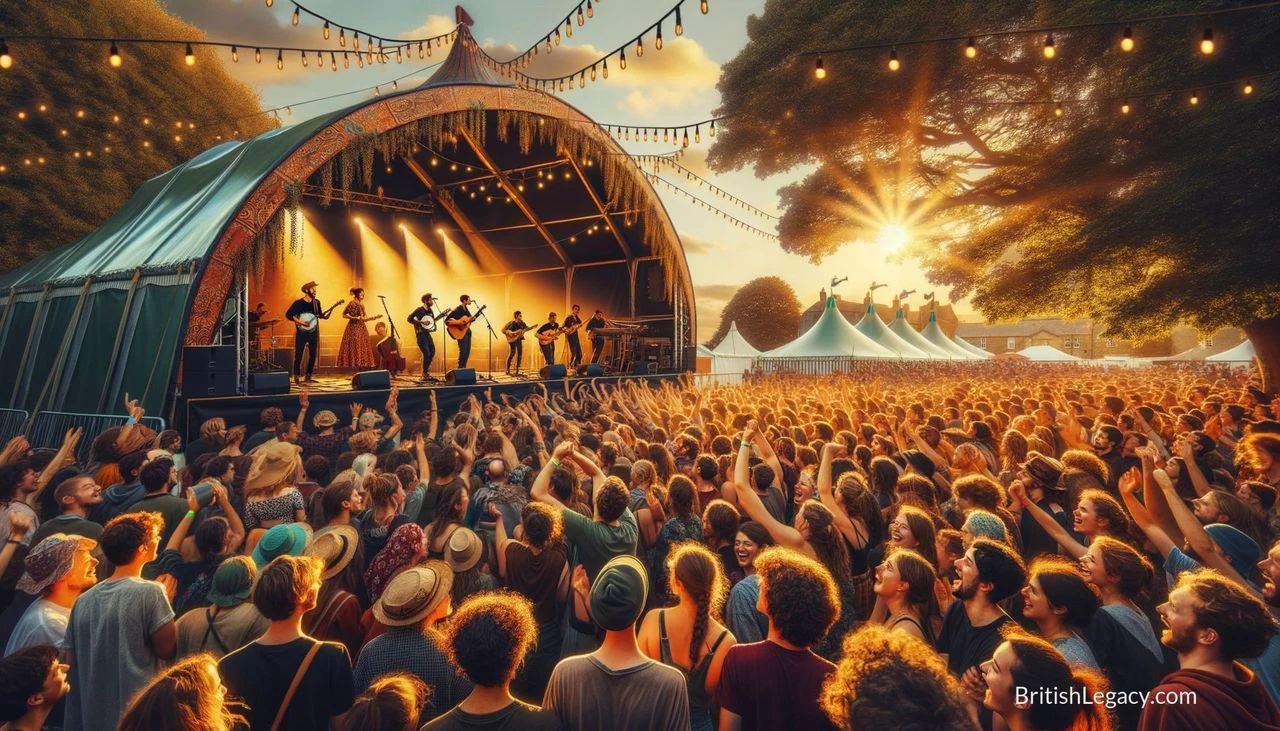
In 1965, a new music festival took shape in Cherry Hinton, then a village absorbed into the city of Cambridge. Its first event sold 1,400 tickets and almost broke even. Among the late additions to the bill was a young Paul Simon, who had just released “I Am a Rock”. The Cambridge Folk Festival would grow from that modest beginning into a long-running summer gathering, recognised for treating folk as a broad and changing musical category rather than a fixed repertoire.
From a local idea to a festival
The festival’s origins are more specific than the story of a council simply deciding to celebrate folk music. The project developed over about nine months through the efforts of Cambridge figures including councillors Paul Rayment, Philip Abrams and George Scurfield. Jack Sharkey had proposed the idea and suggested Cherry Hinton Hall as a venue; Rayment helped turn it into a practical event. He suggested the site, managed the electrics at the first festival and stayed overnight in its marquee, where there was no security.
Different interests came together in the project. Abrams, a sociology professor, viewed it as a social initiative; Scurfield was an author, poet and politician; and Rayment brought political and organisational drive. Ken Woollard, a local firefighter and political activist, was asked to run the festival and became its first director in 1965. The first event was the product of a Labour-dominant city council in a traditionally conservative area, but it was also the work of people with distinct political, professional and cultural backgrounds.
Woollard continued as festival organiser and artistic director until his death in 1993. His assistant Eddie Barcan took on the role, followed by Rebecca Stewart in 2015. The festival remained under Cambridge City Council until 2015, then passed briefly to the charity Cambridge Live. The council took it over again in 2019.
A wide definition of folk
Held over a summer long weekend of three and a half days, the festival’s programme has ranged well beyond a narrow definition of traditional folk. Its stages have brought together folk musicians, singers and performers from across genres. Martin Carthy, Shirley Collins, Peggy Seeger and John Tams have appeared alongside artists such as Judy Collins, Graham Nash, Chumbawamba, Joe Strummer and the Mescaleros, and the Levellers. Later performers included Frank Turner, Mumford & Sons, Laura Marling and Jake Bugg. The mix makes room for roots and experiment without suggesting that every act belongs to one musical category.
Paul Simon’s early appearance became part of the festival’s origin story; he was far from the only major name to play there. Joan Baez appeared at the 50th festival in 2014, which also featured Van Morrison and Sinéad O’Connor. Baez returned as a 2015 headliner, alongside Joan Armatrading, Wilko Johnson and Passenger. That year’s line-up illustrates how an established name and contemporary performers could share the same event.
The festival has also given artists a role in shaping its programme. Rhiannon Giddens was guest curator in 2018, and Cambridge-born singer Nick Mulvey was announced as curator for 2019, selecting five artists for the line-up. Its anniversary prompted another form of musical record: a digital album released for the 50th festival featured tracks by 50 artists, among them Baez, the Proclaimers, Fairport Convention and Loudon Wainwright III.
Stages, sessions and recordings
Performers may appear more than once over the weekend, across stages with different settings and purposes. The main stage sits in a large marquee in front of the festival arena; a smaller marquee provides a second stage. The campsite at Coldham’s Common has hosted a floor-singers stage, while local folk clubs once programmed artists in the Club Tent. That arrangement ended after 2022, when the festival rebranded the tent as a third stage.
Not every musical encounter is a formal performance. Informal sessions around the site have included Irish music, and workshops have given festival-goers a chance to take part. A space called The Hub has offered young people room to practise together or attend workshops. The Flower Garden marquee has hosted changing workshop programmes, including storytelling and Northumbrian smallpipes sessions run by the band Camus. The detail of these activities suggests a festival experience built around listening, learning and playing as well as watching headline sets.
Broadcasts and publications have extended the event’s life beyond its grounds. BBC Radio 2 sponsored the festival until 2008 and broadcast it live; highlights were recorded and shown later. BBC Four screened occasional live coverage between 2002 and 2009, followed by Sky Arts broadcasts from 2010 to 2012. In 2007, a double album, Cool As Folk: Cambridge Folk Festival, collected live performances by artists including Altan, Kate Rusby, Beth Orton, Martin Simpson, Eliza Carthy and Joan Baez. Photographer Nick Elliott’s books TEN – A Decade in Images and 50Folk documented festival scenes and performers across the years.
A changed future
The festival’s history is not a simple account of uninterrupted growth. Its organisation changed hands, its stages and programming evolved, and the event faced financial pressure. The 2024 festival lost £320,000. In January 2025, Cambridge City Council announced that the festival would not take place that year, which would have marked its 60th anniversary. The council said the funds would instead be used to explore new opportunities for a 2026 festival. That announcement marks a pause in the event’s run, not evidence that a future edition has taken place.
Why Cambridge Folk Festival deserves a place in British Legacy
Cambridge Folk Festival deserves a place in British Legacy because its history records how a local cultural project can be made through practical collaboration. The 1965 event was not the product of a single, abstract vision: its founders brought together council politics, social thought, literary and musical interests, and the unglamorous work of preparing a site and managing its electrics. Woollard then helped establish the festival as an organised event. Its beginnings in Cherry Hinton connect the story directly to Cambridge and to the civic life that enabled a new public music gathering.
Its contribution is also audible in the breadth of artists and activity it has brought together. Traditional performers, songwriters and acts from neighbouring genres have shared its stages, while workshops, informal sessions and opportunities for young people have made participation part of the programme. Broadcasts, live albums and photographic books have preserved aspects of the event beyond a single weekend. The festival’s financial loss and cancellation in 2025 belong in that legacy too: they show that cultural institutions need more than a celebrated past to secure their future. Remembering both its creative reach and its vulnerability gives a fuller account of what Cambridge built, and of what is at stake when a long-running local festival pauses.
Sources
Cambridge Folk Festival (revision 1357465232)
Adapted in part from Cambridge Folk Festival by Wikipedia contributors, under CC BY-SA 4.0. Text has been edited and combined with the existing article; this adapted text is shared under the same licence. Contributor history.